Air India Express Faces Scrutiny After Passengers Observed Standing During Active Taxiing

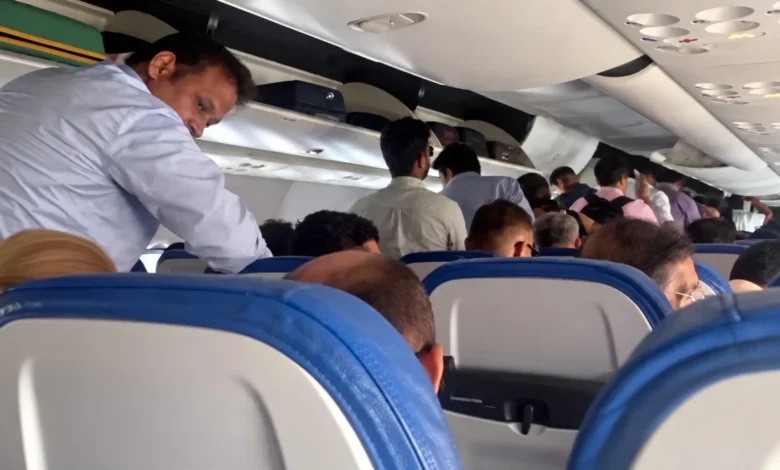
The aviation industry operates under a rigorous set of safety regulations designed to protect passengers during the critical phases of flight, particularly during taxiing, takeoff, and landing. Recently, these safety protocols were brought into sharp focus following an incident involving Air India Express flight IX1236. Reports and visual evidence surfaced on social media platforms indicating that passengers were standing in the cabin aisles with overhead bins open while the aircraft was actively moving on the tarmac. This breach of standard operating procedure has ignited a broader conversation regarding passenger compliance and the enforcement of safety mandates by cabin crews.
The incident, which reportedly took place on September 21, 2026, involved an Air India Express aircraft operating on a domestic route, identified by flight tracking data as either the Pune to Indore or Indore to Delhi sector. Video footage shared by a passenger, Amitava Das, depicted a cabin environment where individuals had vacated their seats and were gathering their belongings from overhead compartments while the aircraft was still in motion. The footage, which has since circulated widely, suggests a significant departure from the Federal Aviation Administration (FAA) and Directorate General of Civil Aviation (DGCA) guidelines that mandate passengers remain seated with seatbelts fastened until the aircraft has reached its final parking position and the seatbelt sign has been extinguished.
A Chronology of the Event
The timeline of the incident begins with the aircraft’s final approach and subsequent arrival at the airport terminal. According to witness statements posted on social media, the aircraft had completed its landing and was transitioning to the gate. During this taxiing phase, passengers began to rise from their seats. The primary concern raised by observers is not merely the act of standing—a common, albeit impatient, habit of air travelers—but the fact that the aircraft was in motion while these safety protocols were being actively ignored.
According to the account provided by the passenger who captured the footage, the cabin crew failed to issue verbal warnings or directives to the passengers to return to their seats and secure their belongings. The user stated, "Unfortunately no crew members announce anything, and suddenly flight start running." This allegation of crew inaction forms the core of the controversy. If true, it represents a failure to exercise authority over the cabin, a responsibility that is paramount for flight attendants, whose primary function is the safety of the passengers rather than hospitality services.
Understanding the Physics of Cabin Safety
To understand why this behavior is considered a serious safety violation, one must consider the dynamics of a moving aircraft. An airplane taxiing to the gate is subject to sudden stops, abrupt turns, and ground maneuvers that can cause significant physical jolts. In the event of an emergency stop—such as an engine fire on the ground, a ground collision, or a sudden obstruction on the taxiway—a passenger standing in the aisle is at extreme risk of being thrown, potentially suffering concussions, fractures, or other bodily harm.
Furthermore, the presence of open overhead bins adds a secondary layer of danger. Items stowed in these bins, which may have shifted during flight, can become projectiles if the aircraft decelerates suddenly. A suitcase falling from an overhead compartment onto a passenger below can cause severe blunt-force trauma. Regulatory bodies strictly enforce the "stowed and secured" policy specifically to mitigate these kinetic risks. The act of standing, while the aircraft is still technically under the control of the pilots and moving, negates these protective measures.
Official Responses and Airline Protocol
In response to the viral dissemination of the footage, Air India Express issued a formal statement expressing regret regarding the incident. The airline stated that "safety remains our highest priority" and affirmed that its operations are conducted in strict compliance with applicable procedures and regulations. The carrier emphasized that its cabin crew members undergo rigorous training to manage various onboard situations and to enforce safety protocols consistently.
However, the airline’s assertion of strict compliance is being challenged by the evidence presented. If the crew failed to intervene while passengers were standing, it suggests either a lapse in the crew’s situational awareness or a breakdown in the implementation of standard operating procedures. Industry experts note that while passengers often disregard instructions in their eagerness to disembark, the ultimate responsibility for cabin safety lies with the airline’s crew. When passengers refuse to comply, crew members are trained to utilize specific escalation protocols, which can include notifying the cockpit, delaying the taxiing process, or, in extreme cases of non-compliance, involving ground security upon arrival.
Broader Industry Implications and Passenger Behavior
The incident on flight IX1236 is not an isolated occurrence in the annals of commercial aviation. Similar reports have emerged from other global carriers, including TUI and Pakistan International Airlines, where cabin safety standards have been questioned. In some rare instances, airlines have even faced scrutiny for carrying more passengers than available seats, a scenario that fundamentally undermines the entire premise of aviation safety, where every occupant must have access to a restraint system.
The "standing before the seatbelt sign is off" phenomenon is a persistent challenge for airlines worldwide. While seasoned travelers often stand as soon as the plane parks to retrieve luggage, the behavior remains a violation until the seatbelt sign is explicitly extinguished by the flight deck. Some analysts argue that the increasing frequency of this behavior is a reflection of a decline in the perceived authority of flight attendants, combined with a "rush culture" among travelers who prioritize time-saving over personal safety.
However, there is also the argument regarding human psychology in confined spaces. After enduring long hours in cramped seating, the instinct to stretch and prepare for exit is a powerful physiological response. Yet, aviation safety is predicated on the understanding that individual comfort must be secondary to collective safety. The aviation industry relies on the "sterile cockpit" and "secure cabin" rules precisely because the risks inherent in flight—even during ground maneuvers—are significant and unpredictable.
Analyzing the Regulatory Environment
In India, the Directorate General of Civil Aviation (DGCA) maintains strict oversight of airline operations. Any incident involving a breach of safety protocols is typically subject to a formal review. If an investigation confirms that the crew failed to enforce safety mandates, the airline could face administrative action, ranging from warnings to mandatory retraining of staff.
The incident highlights the necessity for airlines to strike a delicate balance between passenger experience and regulatory enforcement. While airlines are encouraged to provide excellent service, the priority must always remain the maintenance of a controlled environment. The digital age has amplified the visibility of these lapses; where once a passenger’s non-compliant behavior might have gone unnoticed, it is now documented and shared globally, placing immense pressure on airlines to uphold their own internal standards.
Conclusion: The Future of Cabin Safety
As commercial aviation continues to grow, the importance of maintaining strict safety culture cannot be overstated. The Air India Express incident serves as a reminder that safety protocols are not merely bureaucratic formalities but essential safeguards developed through decades of incident analysis and lessons learned from past tragedies.
For the aviation industry, the path forward involves a twofold approach: continuous and rigorous training for cabin crews to ensure they are empowered to enforce safety rules without hesitation, and an ongoing public awareness campaign to educate passengers on the gravity of these regulations. Whether through improved verbal directives, better communication from the flight deck, or stricter enforcement policies, the goal remains the same: ensuring that the transit from runway to gate is as safe as the flight itself. The reputation of an airline is built on its ability to guarantee the security of its passengers, and incidents like this serve as a critical inflection point for review and improvement.