The Looming Shadow of Middletown: Inside the High-Stakes Army Ammunition Plant Detonation Crisis

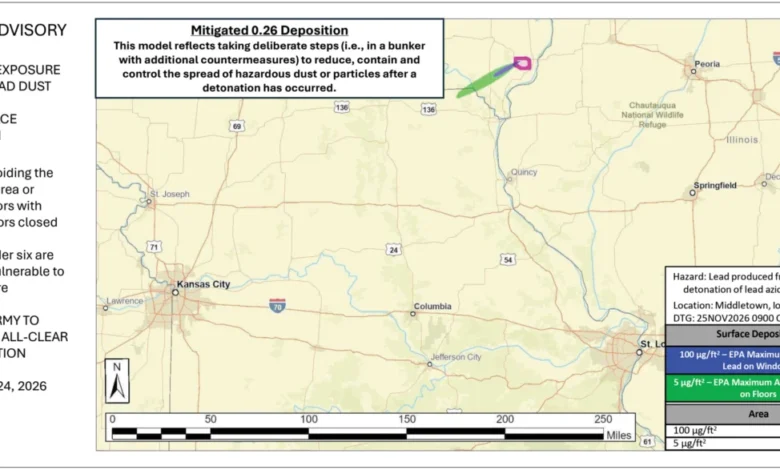
As the calendar turned toward the Thanksgiving holiday in late November 2026, the residents of Middletown, Iowa, found themselves at the epicenter of a precarious environmental and public safety standoff. The U.S. Army, following a series of legal challenges and intensifying public scrutiny, scheduled the controlled detonation of 68 barrels containing volatile lead azide explosives for Wednesday morning. The operation, centered at the Iowa Army Ammunition Plant (IAAP), triggered a massive, cross-state evacuation order, forcing residents—particularly vulnerable populations including pregnant women, children, and those with chronic health conditions—to clear the area before 9 a.m.
The situation marks a critical failure in the long-term management of hazardous military stockpiles. For decades, the IAAP has functioned as a cornerstone of American munitions production, yet the discovery in March 2026 that five tons of lead azide had crystallized—rendering the material dangerously unstable—has forced an emergency response that highlights systemic gaps in oversight, infrastructure, and federal environmental funding.
A Chronology of Neglect: The Crystallization Crisis
The seeds of this crisis were sown nearly two decades ago. The lead azide in question was placed in storage barrels at the Iowa depot in 2009. At the time of storage, the material was already considered legacy stock, with significant portions dating back even further. Lead azide is a primary explosive used as a detonator; however, it is highly sensitive to friction, heat, and impact. Over time, particularly when subjected to fluctuating storage conditions, the compound can undergo chemical degradation, leading to the formation of unstable crystals.
By the time military personnel identified the crystallization in March 2026, the material had become too fragile to transport. Experts determined that any attempt to move the barrels for off-site disposal would likely result in an accidental detonation. This left the Department of Defense with few alternatives, ultimately selecting on-site destruction as the only viable path to mitigate the risk of an uncontained explosion.
The timeline of the response has been criticized by local stakeholders. While the danger was identified in the spring, public notification did not reach a fever pitch until mid-November, leaving residents with minimal time to plan for evacuations that span across regional borders, including portions of Missouri.
The Engineering Challenge: Mitigation and Containment
During a press conference held on Tuesday, November 24, Major General Eric Shirley addressed the necessity of the operation. "Inaction is no longer an option," Shirley stated, emphasizing that the volatile state of the explosives precluded any other disposal method. To minimize the environmental fallout, the Army, in coordination with interagency partners, designed a complex mitigation strategy.
The plan involved constructing a protective earthen dam around the blast site, followed by the application of aqueous foam—a chemical agent designed to suppress and capture hazardous dust and particulate matter generated by the explosion. Despite these measures, environmental scientists have expressed concern regarding the release of lead, a heavy metal with no safe level of human exposure. Lead exposure is particularly devastating for developing nervous systems in children and can cause severe developmental delays, while pregnant women face heightened risks of pregnancy complications and birth defects.
The uncertainty surrounding the plume’s path—dependent on real-time wind speed and atmospheric pressure—has led the National Weather Service to work closely with the EPA and FEMA. However, the efficacy of this multi-agency coordination is being questioned by observers who point to recent, significant budget cuts to federal environmental and weather-monitoring programs.

Political Friction and Local Response
The crisis has exposed deep divisions between federal authorities, state-level representatives, and local leadership. Middletown Mayor Rodney Johnson has adopted a staunchly defensive posture, framing the criticism from the public as a misunderstanding of military necessity. In recent public comments, Johnson cautioned against "keyboard warriors" who he argued were ignoring the realities of national security during wartime. His rhetoric, including a controversial suggestion on social media regarding the disposal of the material, has drawn sharp rebukes from residents and regional politicians who argue that transparency, not secrecy, is required when public health is at stake.
State-level officials, including governor-elects, have demanded a formal federal investigation into the oversight failures that allowed the explosives to decay for fifteen years without discovery. The broader sentiment among impacted residents is one of profound frustration. Many farmers and ranchers, whose livelihoods depend on the integrity of the soil and water, are now facing the prospect of long-term contamination. While USDA undersecretary Richard Fordyce promised that affected agricultural producers would have access to federal assistance, many worry that the existing programs are insufficient to cover the potential loss of land value and crop safety.
Historical Precedents and Environmental Impact
The IAAP is no stranger to controversy. Since its inception in 1941, the facility has maintained a complicated legacy. According to internal Army records, at least 70 fatalities have occurred at the plant over its 85-year history. The site’s environmental footprint also includes the 1980s-era discovery of "pink water"—a byproduct of TNT leaching into the groundwater. The toxic, photoluminescent water contamination forced years of remediation efforts, reminding the local community that the current crisis is merely the latest chapter in a long history of industrial hazards.
The facility is currently operated by American Ordnance, a subsidiary of the global conglomerate Day and Zimmermann. This relationship underscores the privatization of the military supply chain. While Day and Zimmermann manages the daily operations of the Middletown site, it concurrently holds billions of dollars in government contracts, ranging from the production of munitions used in international conflicts to the development of modular nuclear reactors. Critics argue that this corporate structure incentivizes profit-driven operations while offloading the environmental and social costs of hazardous waste management onto the public and local government entities.
Broader Implications for Federal Oversight
The situation in Middletown serves as a case study for the risks associated with aging military infrastructure and reduced oversight. Environmental scientist Marco Kaltofen, a visiting fellow at Harvard and a member of the Army’s Superfund Restoration Advisory Board, highlighted a systemic issue: the loss of institutional knowledge. "Data can be interrupted by big cutbacks at scientific organizations," Kaltofen noted. He argued that the current crisis is exacerbated by the difficulty of making informed decisions when the historical records and specialized staff capable of managing such legacy issues have been diminished or let go.
The reliance on a diminished federal workforce to manage complex, multi-state environmental disasters suggests that the "mitigation" strategies currently in place may be less robust than officials claim. As the nation grapples with the fallout of the Middletown detonation, the event is likely to fuel a larger debate regarding the Department of Defense’s responsibility for the lifecycle of its munitions.
For the residents of Middletown and the surrounding counties, the immediate concern is the safety of their families and the potential for long-term health consequences. As the plume drifts, the reliance on weather modeling and administrative promises will be put to the ultimate test. The incident highlights a fundamental question for American defense policy: how can the nation maintain its military readiness without sacrificing the safety and environmental integrity of the very communities that host its most dangerous assets?
Ultimately, the events of late November 2026 will be remembered not just as an emergency operation, but as a turning point in the public’s relationship with the defense industrial complex. Whether this incident prompts a meaningful reform of how hazardous materials are monitored and stored, or whether it becomes another footnote in a history of industrial accidents, remains to be seen. What is clear is that the reliance on last-minute, high-risk solutions to address systemic decay is an unsustainable strategy for a nation that continues to prioritize the rapid production of munitions over the long-term stewardship of its own soil.