Harvesting Renewable Energy: How Agrivoltaics is Transforming Massachusetts Cranberry Bogs

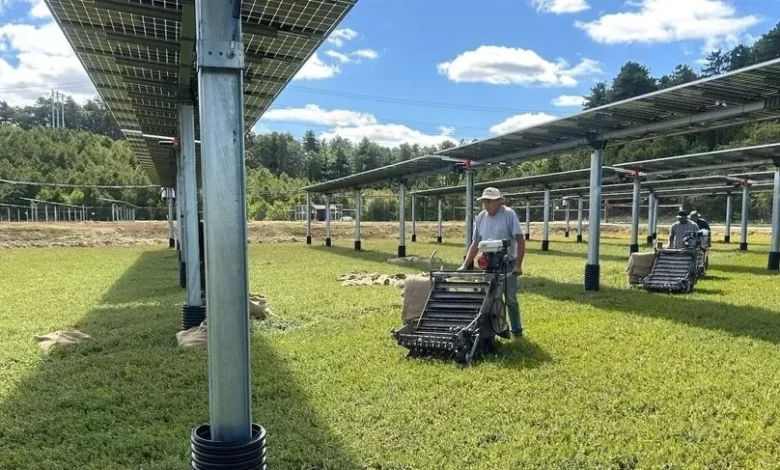
In the heart of southeastern Massachusetts, the annual autumn harvest has long been defined by the vivid, ruby-red hue of cranberries floating in flooded bogs, destined for holiday tables across the nation. However, at two specific sites in Kingston and Plymouth, the traditional harvest scene has undergone a radical transformation. Cranberry growers are now maneuvering harvesting machinery around specialized steel pylons, tending to their crops beneath the cooling shade of elevated solar arrays. These sites represent the first successful instances in the United States—and likely the world—of integrated agricultural and renewable energy production within a commercial cranberry bog, marking a significant milestone in the evolution of land-use policy.
The project, spearheaded by Distributed Energy Infrastructure in collaboration with local agricultural stakeholders, serves as a high-stakes proof-of-concept for the burgeoning field of agrivoltaics. By mounting photovoltaic panels ten feet above the ground, the installations allow for the continued cultivation of fruit while simultaneously generating enough clean electricity to support the regional power grid. As Massachusetts accelerates its transition toward a net-zero carbon economy by 2050, these dual-use projects offer a potential solution to the persistent tension between the need for renewable infrastructure and the preservation of protected agricultural landscapes.
A Chronology of Innovation and Stalled Ambition
The path to integrating solar technology with cranberry production has been neither linear nor simple. The concept gained serious momentum in 2018 when Massachusetts became the first state in the nation to provide specific financial incentives for dual-use solar projects. Under this policy, the state’s solar incentive program provides a base rate for electricity generation, with an additional premium of 9 cents per kilowatt-hour specifically designated for agrivoltaic operations.
However, the road to implementation was fraught with engineering challenges and administrative hurdles. Five years ago, an initial attempt to pioneer cranberry agrivoltaics in the town of Carver set high expectations. The arrays were constructed and the crops were planted, but the venture collapsed into bankruptcy before the system could be commissioned. While that specific project stalled, it provided the essential data and lessons that allowed the current Kingston and Plymouth projects to succeed. Today, those original arrays in Carver remain in a state of suspended animation, with new owners reportedly working toward completion—a testament to the resilience of the dual-use model.
The current installations in Kingston and Plymouth, which represent a 4.4-megawatt array paired with 13.5-megawatt-hour battery storage and a 1-MW array respectively, serve as the functional templates for future development. These sites successfully completed their second full harvest cycle this fall, proving that the engineering modifications—such as deep-soil piling to account for the unique hydrology of wetlands and overhead wiring to bypass waterlogged ground—are effective and scalable.
Engineering the Future: Technical Challenges in the Bog
Constructing solar infrastructure in a cranberry bog is a task that defies standard solar development practices. In a typical utility-scale solar farm, structural foundations are driven 8 to 10 feet into the earth. Cranberry bogs, characterized by their high water table and soft, unstable peat-based soil, required a more rigorous approach. Developers discovered that to find structural integrity, piles had to be driven significantly deeper than in traditional dry-land sites.
Furthermore, the design had to be optimized for the specific requirements of the cranberry industry. The panels are mounted on a tracking axis, allowing them to follow the sun’s trajectory throughout the day. This height—ten feet above the bog floor—was meticulously calibrated to ensure that specialized harvesting machinery could pass beneath the structure without interference. The result is a highly complex, precision-engineered system that respects the integrity of the bog’s delicate ecosystem while maximizing energy capture.
Economic Viability and Land-Use Policy
For Massachusetts cranberry farmers, the pressure to maintain economic viability has intensified over the last decade. As one of the primary cranberry-producing states in the U.S., trailing only Wisconsin, the local industry faces significant competition and thin profit margins. When farmers decide to retire, their land is often at risk of being sold; however, because cranberry bogs are classified as protected wetlands, they cannot be converted into standard residential or commercial housing developments.
This regulatory protection creates a unique opportunity for solar developers. The bogs cannot be destroyed, but they can be repurposed. For the landowner, leasing land for solar energy creates a "financial lifeline," providing consistent, long-term revenue that is decoupled from the volatility of fruit commodity prices. The community solar model employed at these sites also allows local residents to purchase electricity generated from these arrays, often at a reduced cost compared to traditional utility rates.
Prateek Tare, co-founder of Distributed Energy Infrastructure, emphasizes that the primary goal is to ensure the land remains "productive" in every sense of the word. "We are literally proving it can be done," Tare noted, highlighting that the company is now applying these same lessons to apple orchards, cattle pastures, and Christmas tree farms.
Broader Implications for National Energy Policy
The success of the Massachusetts model has broader implications for the United States, where land-use conflicts are a primary barrier to renewable energy expansion. As the U.S. aims to reach aggressive climate targets, the debate over "siting"—where to place massive solar and wind farms—has become a flashpoint.
Environmental groups, while supportive of clean energy, often protest projects that require the clearing of forests or the fragmentation of critical habitats. Conversely, agricultural advocates fear that the loss of arable land to solar farms could threaten food security. Agrivoltaics offers a "middle path." By layering energy production over existing farmland, developers can bypass the need to clear virgin land, satisfy local concerns about the loss of rural character, and provide farmers with an additional income stream that helps keep family farms in operation.
Analyzing the Path Forward
The data emerging from the Kingston and Plymouth projects suggest that the "dual-use" label is more than a buzzword; it is a viable industrial strategy. However, scalability remains a factor. The current financial incentives in Massachusetts, which provide a 9-cent-per-kilowatt-hour premium, are essential for offsetting the increased capital expenditure required for specialized engineering. Without these policy-driven subsidies, the higher upfront costs of agrivoltaic projects might make them less competitive compared to standard ground-mounted arrays.
Moreover, the success of these projects requires a high level of coordination between energy developers and agricultural experts. As Iain Ward, a longtime cranberry farmer and consultant for these projects, observed, "When you change a paradigm, it takes a little time." The paradigm shift involves moving away from the assumption that land must be dedicated to a single use.
As the technology matures, the "learning curve" noted by developers suggests that costs will eventually decrease. Future projects will likely benefit from standardized design templates, more efficient piling techniques, and more robust battery storage integration. If the Massachusetts experience can be replicated in other agricultural states, the integration of solar into the nation’s food-producing regions could become a cornerstone of the American energy transition.
In conclusion, the ruby-red harvest in Massachusetts now carries a dual significance. It is not only a symbol of agricultural tradition but also a indicator of a shifting industrial landscape where technology and ecology exist in a carefully managed, mutually beneficial relationship. As more farmers and developers watch the progress of these bogs, the transition from traditional farming to integrated agrivoltaics seems increasingly likely to become a permanent fixture of the agricultural landscape. Whether this model can be scaled to meet national demands remains the next great challenge for the renewable energy sector, but the foundational work in the bogs of Kingston and Plymouth has provided a clear, actionable blueprint.