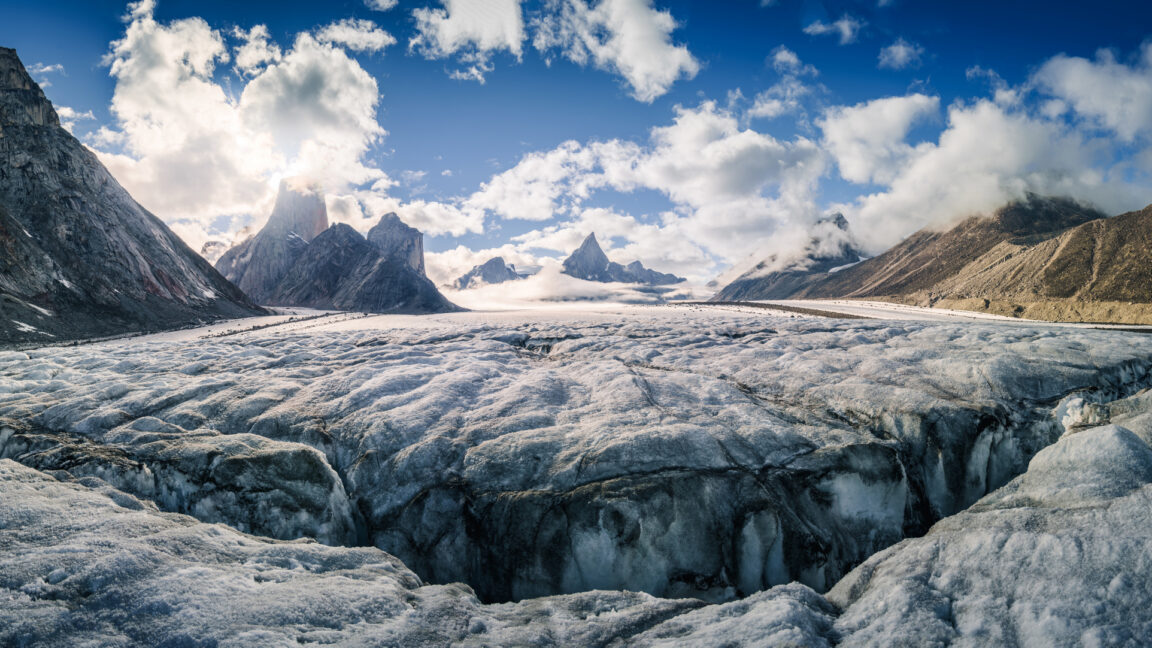
The Barnes Ice Cap, situated on the central plateau of Baffin Island in the Canadian Arctic, stands today as a singular, frozen monument to a climatic past that once dictated the pulse of the Northern Hemisphere. A recent study published in the journal Science has unveiled that this ice cap is not merely a stagnant relic of the last great glaciation, but rather the final surviving fragment of the Laurentide Ice Sheet—the colossal ice mass that, at its peak during the Pleistocene, smothered nearly the entirety of Canada under two miles of ice and sequestered enough water to lower global sea levels by approximately 80 meters. The research provides definitive evidence that this massive ice sheet, long thought to be in a state of terminal retreat since the end of the last ice age, actually attempted a comeback roughly 2,000 years ago. This aborted "second act" suggests that the Earth was on the precipice of a new, natural glaciation period until the onset of industrial-era human activity fundamentally altered the planet’s atmospheric composition.
The Mechanics of Preservation: Why Barnes Survives
The survival of the Barnes Ice Cap is an anomaly of glaciological physics. To understand how the ice cap has acted as an environmental time capsule, one must look to its thermal properties. Most of the world’s glaciers are "warm-based," meaning they possess a layer of meltwater at their bed that acts as a lubricant, allowing the ice to slide over the bedrock. This sliding motion is highly erosive; it acts like a massive sheet of sandpaper, grinding up the geological and biological history of the landscape and destroying the very evidence scientists need to reconstruct past climates.
In contrast, the Barnes Ice Cap is "cold-based." It is effectively frozen solid to the underlying bedrock, much like ice that adheres to a windshield during a sub-zero winter storm. This lack of movement has preserved the tundra landscape that existed thousands of years ago. When the Laurentide Ice Sheet retreated across the Baffin Island plateau thousands of years ago, the exposed ground was colonized by mosses and other vegetation. As the climate shifted and the ice cap began to re-expand approximately 2,000 years ago, it did not crush these plants; instead, it gently smothered them, preserving the biological remains in a state of suspended animation. Lead author Nicolás Young, a geologist at Columbia University’s Lamont-Doherty Earth Observatory, notes that this phenomenon allows the ice cap to function as a pristine archive of the transition between climate epochs.
A Chronology of Retreat and Re-expansion
The scientific team employed a dual-dating approach to establish a timeline for the Laurentide’s fluctuations. The first method utilized beryllium-10, an isotope that accumulates on the surface of rocks exposed to cosmic radiation. By measuring the concentration of this isotope on boulders surrounding the ice margin, researchers were able to pinpoint when those rocks were first liberated from the ice. The data confirmed that the Laurentide had retreated to near its modern margin by approximately 3,600 years ago, with significant further shrinkage occurring around 3,000 years ago.
The second method—radiocarbon dating of the "killed" vegetation—provided the precise timing of the subsequent re-expansion. As the ice moved over the mosses, it terminated their biological life cycle, providing a "kill date." By sampling these mosses at the current margin of the ice cap, the researchers found that the re-growth phase began roughly 2,000 years ago. This expansion reached a climax during the Little Ice Age, a period of global cooling that lasted roughly from the 14th to the 19th century. During this era, Northern Hemisphere glaciers reached their most extensive recent coverage. The study indicates that the Little Ice Age was not an isolated event but rather a late-stage acceleration of a glacial advance that had been underway for two millennia.
The Great Climate Tug-of-War
The re-expansion of the ice sheet 2,000 years ago was the result of a delicate, long-term balance between solar energy and atmospheric composition. Orbital forcing, which dictates the amount of solar radiation reaching the high northern latitudes, has been in a steady decline for the past 10,000 years, naturally steering the planet toward cooler conditions and the potential for a new glacial period. Simultaneously, atmospheric carbon dioxide levels had been slowly rising by about 20 parts per million (ppm) between 8,000 and 2,000 years ago, a trend that typically exerts a warming influence.
The study demonstrates that for two millennia, the drop in solar insolation was sufficient to overwhelm the greenhouse effect of that modest CO2 increase. The planet was essentially locked into a long-term cooling trend that favored the accumulation of ice. However, this natural cycle—one of the most consistent and stable rhythms in Earth’s history—was abruptly terminated by the Industrial Revolution.
The Anthropogenic Disruption
The introduction of massive quantities of greenhouse gases since the mid-18th century fundamentally reversed the trajectory of the Barnes Ice Cap. Atmospheric CO2 levels, which had fluctuated within a relatively narrow, natural range for millennia, surged by 12 ppm between 1750 and 1850, followed by an additional 50 ppm by 1960. By 2024, the increase had ballooned to roughly 138 ppm above pre-industrial levels.
The impact on the Barnes Ice Cap has been catastrophic. In the 1960s and 1970s, approximately 35 percent of the ice cap’s surface area remained above the snow line, allowing for the accumulation of new ice during winter. By the early 2000s, that figure had plummeted to 3 percent. Today, the entire surface of the ice cap is subject to summer melting, with no accumulation zone remaining to replenish the mass lost during the warmer months. Glaciologists conclude that the Barnes Ice Cap has effectively reached a state of terminal decline and is projected to disappear entirely within the next few centuries under any realistic climate scenario.
Implications for the Earth System
The findings of the Columbia University team raise profound questions about the nature of the current climate era. While some might argue that the human-driven warming of the planet has "saved" civilization from the hardships of an inevitable ice age, the researchers caution against such a reductive view. An ice age is a process that unfolds over tens of thousands of years; human interference has not merely postponed a natural event, but rather broken a consistent cycle that has defined the Earth’s climate system for the past 2.5 million years.
The termination of this cycle represents a significant departure from the geological norm. The rapid influx of carbon dioxide into the atmosphere has created a warming forcing of a magnitude never before seen in the geological record. The Barnes Ice Cap, once a growing testament to the planet’s natural tendency toward glaciation, now serves as a dwindling witness to the speed and severity of modern environmental change.
As the ice margin continues its rapid retreat, scientists expect to uncover older moss samples that have been buried for thousands of years, potentially revealing even finer details of the 2,000-year-old expansion. However, the fate of the ice cap itself is sealed. The study underscores that the "natural" climate trajectory of the Earth has been fundamentally redirected. Whether this disruption will lead to a new state of climatic stability or a period of prolonged, forced transition remains the central challenge for future climate modeling. For now, the Barnes Ice Cap remains the final, fleeting evidence of a world that was—a world that, until quite recently, was slowly preparing for a cold, deep sleep that humanity has now decisively canceled.