The rapid, unrelenting expansion of artificial intelligence infrastructure has sparked a nationwide debate, forcing Americans to confront how the digital age will physically alter their neighborhoods. While major technology companies and local economic development agencies routinely pitch multi-million-dollar data centers as engines for job growth and municipal prosperity, that narrative has failed to convince a majority of the public. According to recent Gallup data, a clear majority of Americans now oppose the construction of large data centers in their immediate geographic areas, driven by acute anxieties over soaring energy demands, water scarcity, and environmental degradation.
For grassroots organizers like Shawmar Pitts, these concerns are far from abstract theoretical debates about the future of technology. Pitts, managing co-director of the Philadelphia-based environmental justice organization Philly Thrive, understands intimately what it means to live in the physical shadow of heavy American industry. A lifelong resident of the Grays Ferry neighborhood in Southwest Philadelphia, Pitts grew up immediately adjacent to what was once the largest oil refinery on the East Coast—the Philadelphia Energy Solutions (PES) facility.
The Shadow of Industrial Legacy
The Grays Ferry neighborhood has long borne the environmental burdens of fossil fuel processing. For decades, the massive PES refinery processed up to 335,000 barrels of crude oil daily, shaping the local skyline and casting a permanent pall over the surrounding residential blocks. Growing up, Pitts watched family members, friends, and neighbors suffer through an array of chronic illnesses, ranging from severe respiratory issues to aggressive cancers. However, the systemic connection between their deteriorating health and the industrial neighbor looming over their backyards did not fully crystallize for him until 2018.
That year, members of Philly Thrive were tabling in his neighborhood to raise awareness about a proposed expansion of the oil refinery. Pitts stopped to read the literature distributed by the activists, which outlined the documented public health impacts of living in close proximity to massive petrochemical processing plants.

“I read the information they had on the table about how living near the refinery affects you, and I’m looking at all the sicknesses on this paper, and I’m like, ‘My mother has this, my sister has that, my next-door neighbor suffers from this’ — every house, someone has something on that list,” Pitts recalled. “From that point, I was all the way in.”
The stakes of this industrial legacy were brought into sharp, tragic relief on June 21, 2019, when a catastrophic series of explosions ripped through the PES refinery. The blasts shook homes for miles, hurled massive metal debris across the Schuylkill River, and triggered a massive fire that burned for days. While the disaster mercifully resulted in no fatalities, it marked the death knell for the facility. The refinery permanently ceased operations, throwing hundreds out of work and leaving behind a heavily contaminated 1,300-acre industrial site known today as the Bellwether District.
Yet, for families like that of Philly Thrive board president Sonya Sanders, the closure came too late to undo the damage. Sanders’ husband, a fellow Grays Ferry resident who neither smoked nor drank, died of a rare bone cancer in 2020. Sanders remains firmly convinced that decades of toxic emissions from the adjacent refinery directly caused his illness.
“In my eyes, they killed him,” Sanders said during a recent community rally outside Philadelphia’s City Hall. “The pollution killed him. I believe he would be here today if he wasn’t silently murdered, because it was the pursuit of profit that killed him.”
The New Industrial Threat: AI Infrastructure
Today, Sanders, Pitts, and a coalition of concerned residents find themselves mobilizing once again—not against oil, but against silicon and servers. Philadelphia city officials have begun eyeing potential locations for massive new data centers to support the booming AI sector, identifying two preliminary sites: one in Northeast Philadelphia and another in Grays Ferry.

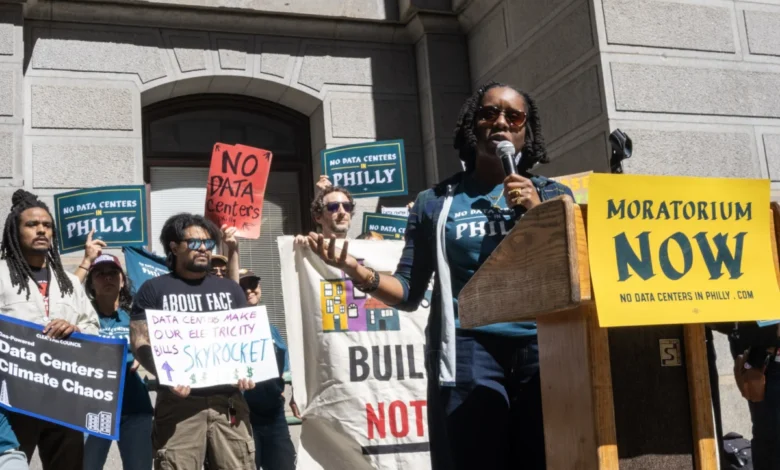
The prospect of data center development has galvanized local resistance. On a Monday morning, over 100 residents and environmental advocates gathered for the kick-off rally of the "No Data Centers in Philly" campaign, chanting slogans outside City Hall in hopes of reaching city council members working inside.
“We don’t want data centers,” Sanders told the assembled crowd. “We don’t want the pollution, we don’t want the noise, and we know they’re not going to bring us more jobs.”
While a modern data center does not process millions of barrels of crude oil or produce the same direct toxic chemical runoff as an oil refinery, the scale of the infrastructure required to power the artificial intelligence boom presents an entirely unprecedented environmental challenge. The global race among tech giants to dominate generative AI has triggered an insatiable hunger for electricity, transforming the tech sector into a major consumer of fossil fuels.
According to a comprehensive projection by BloombergNEF, U.S. data centers are on track to consume more natural gas than Germany and Japan combined by the year 2035—a projection that nearly doubles the firm’s estimates from just nine months prior. Although natural gas burns cleaner than traditional petroleum or coal, it is far from benign. The combustion of a single cubic foot of natural gas releases approximately 60 grams of carbon dioxide into the atmosphere. Industry analysts project that the surging power demands of new data centers will generate an additional one million metric tons of greenhouse gas emissions every day, amounting to roughly 12 percent of total contemporary U.S. greenhouse gas output.
Public Health and the Stressed Electrical Grid
Environmental law and public health advocates warn that the localized impacts of data centers are deeply concerning. Annie Fox, an attorney with the Clean Air Council, highlighted the heavy reliance of these facilities on auxiliary power generation during the Philadelphia rally.

“A typical data center planned in Pennsylvania has hundreds of diesel engines that spew air pollution, and even if they’re supposedly reserved for emergencies, the government has already said that the data center should use those rather than drawing from an overstressed electrical grid during some heat waves,” Fox explained. “We can expect that to get more frequent… Fossil fuel-hungry data centers will worsen climate change, making those heatwaves more frequent and severe.”
The intersection of climate change, air pollution, and human mortality is well-documented. Groundbreaking research published by Harvard University in 2021 concluded that fossil fuel-related air pollution is responsible for roughly one in five deaths globally. Activists argue that expanding fossil fuel infrastructure to power server racks housing large language models will only accelerate these grim statistics, disproportionately harming historically marginalized and low-income urban communities like Grays Ferry.
Beyond air quality and carbon footprints, local residents have raised alarms regarding severe strain on municipal utilities. Donna Greenberg, a Philadelphia resident who participated in the City Hall protest, voiced deep skepticism over the promised benefits of the developments.
“I’m worried about pollution,” Greenberg said. “I’m worried about surveillance and the fact that they’re going to have access to information they have no business knowing, and I’m concerned that they’re going to be using water and electricity that takes away from the people and the neighborhoods who need it.”
A National Wave of Moratoriums
Philadelphia is far from an isolated battleground. Across the United States, grassroots resistance to data center construction has successfully influenced local and state policymakers, resulting in a wave of regulatory pushback and legislative pauses.

In New York, Governor Kathy Hochul signed a high-profile executive order temporarily halting the state’s approval process for new permits covering large-scale data center projects.
“Progress shouldn’t arrive with a higher utility bill, deleted water supply, or noise pollution,” Hochul stated during a press conference announcing the freeze. “These data centers can only be built, should only be built in places that want them.”
Similar regulatory actions have swept through municipal governments nationwide. Cities including Denver, Indianapolis, Asheville, Charlotte, and Reno have enacted temporary moratoriums on data center development. These pauses are ostensibly designed to grant local planning commissions and zoning boards adequate time to study the long-term ecological, acoustic, and infrastructural ramifications of hosting massive server farms.
Back in Philadelphia, where city officials have yet to issue formal construction permits but continue preliminary site evaluations, the resistance movement is digging in its heels. For leaders like Shawmar Pitts, the fight is fundamentally about self-determination and the right of frontline communities to reject industrial models that prioritize corporate profits over human lives.
“I just think that our community standing up and fighting back is tremendous,” Pitts said, reflecting on the turnout at the City Hall rally. “It takes a lot of effort and a lot of people.”
Related posts: