Supreme Court Weighs Landmark Climate Liability Case as Survivors and Advocates Demand Accountability

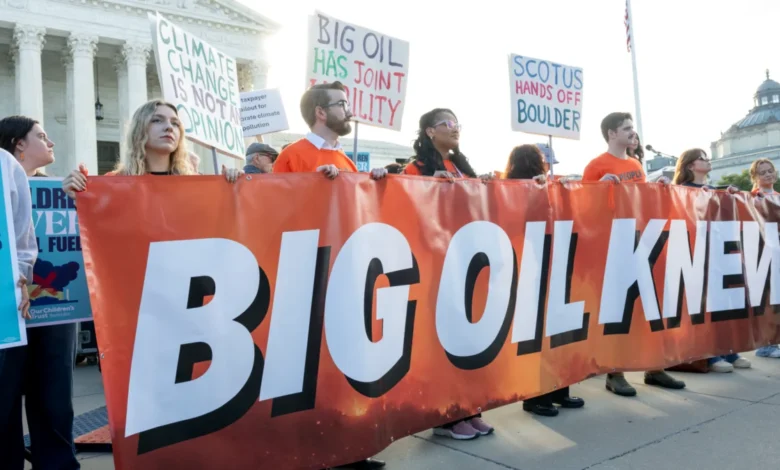
The United States Supreme Court convened on Monday, October 5, 2026, to hear oral arguments in Suncor Energy v. Boulder, a pivotal legal battle that could determine whether multinational fossil fuel corporations can be held liable in state courts for the catastrophic costs of climate change. Outside the marble columns of the courthouse, a coalition of climate disaster survivors, ranchers, and local government advocates gathered to underscore the human cost of the environmental shifts they argue were driven by decades of corporate misinformation.
The litigation, which originated in a 2018 lawsuit filed by the City and County of Boulder, seeks to compel energy giants like Suncor and ExxonMobil to pay damages for the climate-induced wildfires, droughts, and heatwaves that have plagued the region. As the justices weigh the jurisdictional reach of state courts against the global operations of the energy sector, the proceedings represent a high-stakes moment for the American legal system’s approach to environmental accountability.
A Chronology of the Legal Struggle
The path to the Supreme Court has been arduous, marked by years of jurisdictional maneuvering. The conflict began in 2018 when Boulder, along with other local jurisdictions, initiated litigation in state court, arguing that fossil fuel companies knowingly deceived the public regarding the risks associated with their products.
The industry’s strategy has consistently focused on moving these cases into federal courts, where they are often easier to dismiss or consolidate. For years, the legal back-and-forth centered on whether these complaints should be heard by state judges, who are often more receptive to consumer protection and nuisance claims, or by federal judges, who are bound by federal statutes that the industry argues preempt state-level liability.
In early 2026, the case reached a critical juncture. Following an 11th-hour recusal by Justice Samuel Alito, the court moved to hear arguments on whether a state court possesses the authority to hold multinational corporations accountable for global climate harms. This decision is expected to set a precedent for dozens of other pending climate liability cases across the United States, including major litigation currently underway in California.
The Human Cost: Survivors Speak Out
The demonstration outside the court served as a visceral reminder of the tangible consequences of a warming planet. Among those present was Louie Delaware, a resident who lost his home in the 2021 Marshall Fire, a disaster that decimated neighborhoods in Boulder County and left hundreds of families displaced.
“No company or industry should gain an advantage by hiding facts that people need to protect their health, their communities, and their future,” Delaware stated during the rally. His sentiment was shared by Zaire Calvin, who traveled to Washington to represent victims of the 2025 Eaton Fire in Altadena, California. Calvin’s testimony highlighted the tragic human toll of these events, noting the loss of his sister, Evelyn McClendon, in the disaster. “From Altadena to Boulder, we carry different stories. Today, we stand together in one demand: Let the evidence be heard,” Calvin remarked.
The personal testimonies highlight a central pillar of the plaintiffs’ argument: that fossil fuel companies were aware of the catastrophic potential of their products as early as the 1970s. Scientific evidence suggests that internal research conducted by these companies accurately predicted global temperature rises, yet the industry invested millions in public relations campaigns designed to sow doubt about climate science and delay regulatory action.
Economic and Agricultural Implications
Beyond the direct destruction caused by wildfires, the case highlights the mounting economic pressure on the agricultural sector. Deirdre Macnab and Dr. Kathryn Bedell, regenerative cattle ranchers from Rio Blanco County, provided a grim outlook on the future of food security.

Dr. Bedell, a sixth-generation rancher, noted that the impacts of extreme heat and prolonged drought have rendered her land increasingly unproductive, forcing her to sell a herd that her family has maintained for generations. “If you can’t grow food, we have to import it, and we won’t have any food security or control over the price,” Bedell explained. “People should be terrified. It terrifies me.”
Economic data supports the ranchers’ concerns. The USDA has reported increasing volatility in livestock production costs due to climate-linked pasture degradation. The legal theory presented by Boulder suggests that the fossil fuel industry should internalize the costs of these damages, effectively treating climate impacts as a liability rather than an unavoidable externality.
Official Responses and the Industry Defense
The fossil fuel industry maintains that climate change is a global phenomenon that cannot be addressed through localized litigation. In their filings, representatives for Suncor and Exxon have argued that state courts are ill-equipped to govern global energy policies or emissions standards. They maintain that the regulation of carbon emissions is a matter for federal oversight and international policy, not for tort claims in county courts.
Former Washington Governor Jay Inslee, who has become a prominent voice in the movement for climate accountability, pushed back against this narrative during the demonstration. “The fossil fuel industry malignantly and maliciously lied to the American people, and I’ll be damned if I let them take away an American right to hold industries accountable,” Inslee said. His involvement underscores the broader political dimension of the case, as states seek to bypass federal gridlock by using the judicial system to extract financial settlements from major emitters.
Fact-Based Analysis: The Broader Impact
The Supreme Court’s eventual ruling in Suncor Energy v. Boulder will likely hinge on the doctrine of federal preemption. If the court rules in favor of the energy companies, it could effectively terminate a wave of litigation that has been gaining momentum since 2017. Such a decision would signal that climate-related harms are outside the purview of state-level nuisance and consumer protection laws.
Conversely, a ruling that allows these cases to proceed in state courts would represent a historic shift in corporate accountability. It would open the door for discovery processes, potentially forcing energy companies to release internal documents that have been shielded from public view for decades. This would mirror the legal strategies used against the tobacco industry in the 1990s and, more recently, against pharmaceutical companies regarding the opioid crisis.
Legal analysts suggest that the court’s focus on the jurisdictional question masks the underlying issue: the extent to which the judiciary will permit the public to hold private entities responsible for long-term ecological damages. With dozens of lawsuits currently frozen in lower courts awaiting this decision, the stakes for both the energy industry and climate advocates could not be higher.
Looking Toward the Future
As the court deliberates, the atmosphere remains one of cautious anticipation. For the families who lost homes and livelihoods to the fires of the last few years, the lawsuit represents more than just a quest for financial compensation; it is a search for institutional recognition of their reality.
“One of the tenets of a free democracy is that ‘the David’ can go after ‘the Goliath’,” Louie Delaware noted as the oral arguments concluded. Whether this particular David will succeed in navigating the complex legal landscape of the Supreme Court remains to be seen. However, the intensity of the rally and the persistence of the plaintiffs indicate that regardless of the court’s ruling, the movement to hold the fossil fuel industry accountable for its role in the climate crisis has reached a level of public scrutiny that will be difficult to ignore.
The decision, expected in the coming months, will define the parameters of climate litigation for the next decade, setting the tone for how American law addresses the intersection of private profit, public policy, and the survival of the planet.
Related posts: