Supreme Court Intervenes in Missouri Redistricting Dispute, Mandating 2022 Congressional Map for 2026 Midterms

WASHINGTON — The Supreme Court of the United States issued a definitive and unanimous unsigned order on Friday, dictating that the state of Missouri must utilize its 2022 congressional district map for the upcoming 2026 midterm elections. This decisive judicial action effectively halts a newly drawn 2025 map that had been championed by state lawmakers, which analysts suggested could have significantly altered the partisan balance and favored Republican candidates in the state’s federal House delegation.
The high court’s intervention brings a sudden, temporary halt to months of bitter litigation and legislative maneuvering that had thrown Missouri’s election administration into chaos just as candidates and election administrators were trying to prepare for the voting cycle. By instructing both federal district courts and appellate courts to refrain from enjoining the 2022 boundaries or mandating the 2025 alternative, the Supreme Court has removed immediate ambiguity, securing the established map for the immediate electoral horizon.
The Background and Origins of Missouri’s Redistricting Mess
To fully understand the gravity of the Supreme Court’s emergency order, one must examine the complex landscape of American redistricting following the decennial census. Every ten years, states across the nation redraw their congressional boundaries to account for population shifts captured by the U.S. Census Bureau. Following the 2020 Census, Missouri retained its eight seats in the House of Representatives, but the process of drawing lines to reflect demographic shifts became heavily politicized.
In 2022, after a prolonged legislative stalemate that featured intense infighting within the state’s Republican-controlled General Assembly, Missouri ultimately adopted a congressional map that preserved a 6-2 Republican majority. Six districts favored safe Republican candidates, while two districts leaned reliably Democratic—one centered around St. Louis and the other around Kansas City.
However, the political appetite among some conservative lawmakers in Jefferson City for a more aggressive map did not dissipate. Proponents of a redrawn map argued that the state legislature possessed the constitutional authority to refine district lines more frequently than once every decade, provided it did not violate federal voting rights laws or the U.S. Constitution. Critics, conversely, argued that reopening the redistricting process outside of the standard post-census window was an unprecedented partisan maneuver designed purely to squeeze out Democratic representation and secure a structural advantage ahead of the tightly contested 2026 midterms.
The Evolution of the 2025 Map and Ensuing Legal Battles
The dispute escalated significantly in late 2024 and into 2025, when the Missouri General Assembly advanced a revised congressional map. The newly engineered 2025 map aimed to reconfigure the boundaries in a manner that critics asserted would fracture urban voting blocs and dilute minority voting power, potentially putting the Democratic seat in Kansas City or St. Louis at risk.
As soon as the 2025 map cleared the legislature and was signed into law, civil rights organizations, voting rights advocates, and Democratic groups rushed to federal and state courts. Plaintiffs filed multiple lawsuits alleging that the newly minted boundaries violated the U.S. Constitution, specifically citing equal protection violations and claims of unlawful racial and partisan gerrymandering.
Lower federal courts were quickly inundated with emergency petitions, injunction requests, and expedited discovery schedules. A federal district court eventually stepped in, casting doubt on the legality of the 2025 map and signaling that it might block its implementation. This triggered an appeal by state officials who argued that federal courts were improperly usurping the authority of state legislatures to regulate federal elections under the Elections Clause of the U.S. Constitution.
As the legal ping-pong match intensified between the district court, the Eighth Circuit Court of Appeals, and state-level entities, Missouri election officials warned that time was running dangerously short. Candidate filing deadlines, petition requirements, and the reprogramming of voting machines all rely on stable, legally finalized district boundaries. With the 2026 midterms looming, the chaotic legal landscape meant local election authorities did not know which maps to program into their systems.
Chronology of Key Events
The path to the Supreme Court’s Friday ruling unfolded across a rapid succession of legal and legislative milestones:
- 2022: Following the 2020 Census, Missouri adopts a congressional map that establishes a 6-2 Republican-leaning split among its eight U.S. House seats.
- Late 2024 – Early 2025: Missouri lawmakers push forward with a controversial initiative to redraw the state’s congressional boundaries outside the traditional post-census cycle, culminating in the passage of the 2025 map.
- Spring 2025: Civil rights groups and voters file federal lawsuits challenging the 2025 map, arguing it constitutes illegal gerrymandering and dilutes minority voting strength.
- Summer and Fall 2025: Lower federal courts wrestle with emergency injunctions, creating uncertainty for state election administrators trying to prepare for candidate filing periods.
- Early 2026: The legal battle reaches a crescendo, prompting emergency appeals to the Supreme Court as the window to administer the upcoming midterms narrows dangerously.
- Friday, September 2026: The Supreme Court issues an unsigned, unanimous order mandating the use of the 2022 map and barring lower courts from interfering with that directive for the 2026 election.
Legal Analysis and the Absence of Dissents
One of the most notable aspects of the Supreme Court’s Friday order was the complete absence of noted dissents. In an era where the nation’s highest court is frequently divided along ideological lines on major political and constitutional questions, a unanimous, unsigned order suggests that the justices recognized an overriding, pragmatic need for judicial stability and administrative certainty.
Legal scholars note that the Supreme Court often intervenes via the "shadow docket"—its emergency injunctive relief process—when lower courts threaten to disrupt elections too close to voting day. Under the Purcell principle, a well-established jurisprudential doctrine, federal courts generally should not alter election laws or change voting rules close to an election, as doing so tends to confuse voters and burden election administrators.
By applying this logic, the Supreme Court effectively prioritized the predictability of the electoral process over the substantive merits of whether a state can unilaterally redraw its maps between censuses. The justices did not issue a sweeping, permanent ruling on the constitutionality of mid-decade redistricting in general; rather, they tailored their injunction specifically to prevent the 2025 map from causing immediate disruption to the 2026 midterms.
Reactions from Stakeholders and Political Implications
The Supreme Court’s decision drew immediate and contrasting reactions from political figures and advocacy groups across Missouri and the nation.
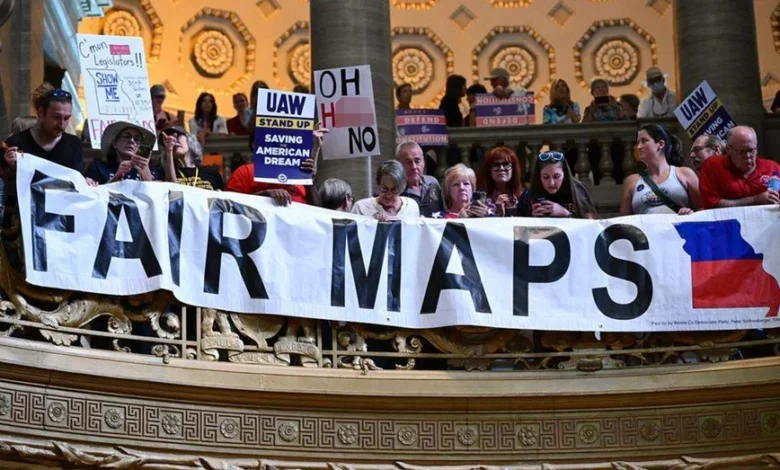
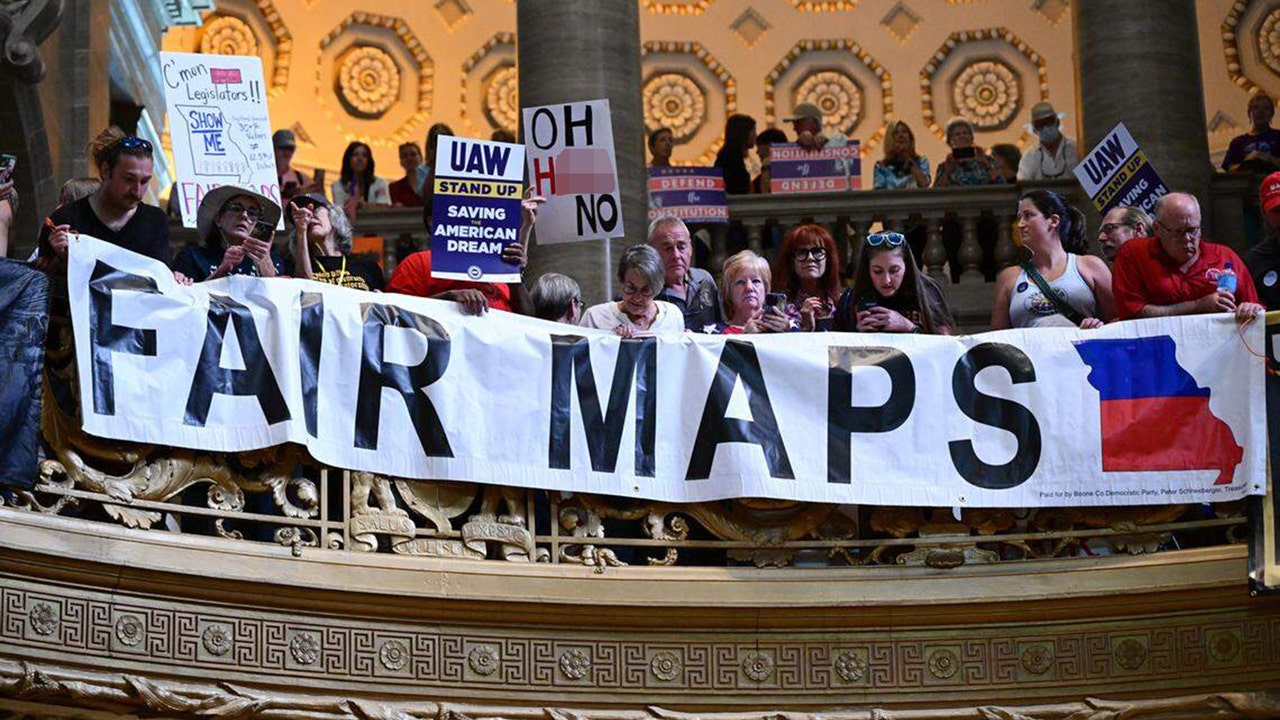
Proponents of fair maps and voting rights advocates lauded the decision as a critical victory for the rule of law and voter stability. Organizations that had spearheaded the litigation against the 2025 map argued that the ruling prevents a last-minute, partisan power grab that would have disenfranchised voters and undermined trust in democratic institutions. For Democratic operatives and incumbents, the preservation of the 2022 map ensures that their current footholds in the state’s congressional delegation remain protected from artificial reconfiguration.
Conversely, Republican state lawmakers and defenders of the 2025 map expressed frustration, viewing the court’s intervention as an unwarranted intrusion into the constitutional prerogatives of the state legislature. Supporters of the newer map maintained that the General Assembly was fully within its rights to update districts to better reflect population shifts and political preferences within the state. However, because the order focuses strictly on the 2026 election, the broader legal debate regarding the theoretical limits of mid-decade redistricting may linger for future judicial cycles.
Broader Impact on the 2026 Midterms
The national implications of Missouri’s redistricting saga cannot be overstated. With the balance of power in the United States House of Representatives resting on razor-thin margins, every single congressional district across the country is fiercely contested.
In a typical election cycle, national parties pour tens of millions of dollars into key battleground districts. By keeping the 2022 map in place, the electoral playing field in Missouri remains frozen in its current configuration: six safe Republican seats and two safe Democratic seats. This removes Missouri from the list of states where mid-decade redistricting fights could dramatically alter the national calculus for control of the House.
Furthermore, county clerks and local election authorities across Missouri breathed a collective sigh of relief following the high court’s announcement. Administering an election requires months of meticulous preparation, including updating voter registration files, verifying precinct boundaries, training poll workers, and printing ballots. With the Supreme Court definitively settling which map will govern the contest, election officials can proceed with administrative duties without the paralyzing fear of a sudden judicial reversal.
Looking Ahead
While Friday’s order resolves the immediate crisis for the 2026 midterm elections, the underlying legal questions regarding the frequency and permissible parameters of redistricting remain open for future litigation. State legislatures across the United States will continue to watch how federal courts interpret the boundaries of state authority in federal elections.
For now, Missouri voters, candidates, and election administrators know precisely where they stand. As the state pivots toward the primary season and the final sprint to the November 2026 midterms, the 2022 congressional map will serve as the undisputed blueprint for the state’s representation in Washington.