President Trump suggests Irish reunification during diplomatic visit as he attends Irish Open golf tournament in Dublin

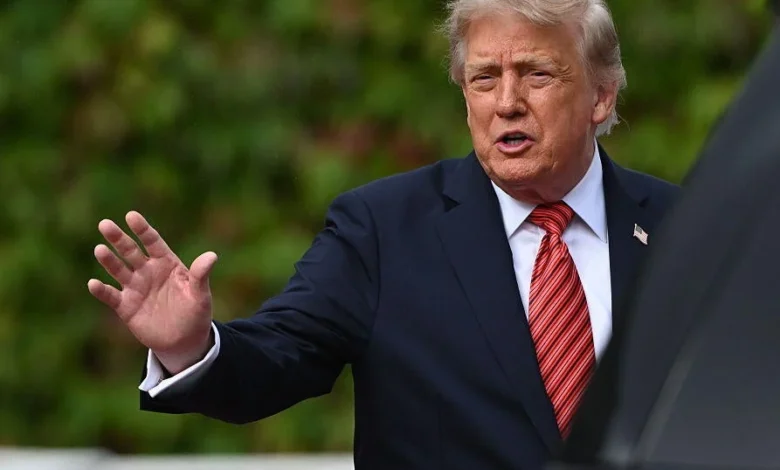
President Donald Trump’s visit to Ireland this weekend has sparked intense international debate after the U.S. leader publicly advocated for the unification of the Republic of Ireland and Northern Ireland. During high-level diplomatic engagements in Dublin on Saturday, September 12, 2026, the president suggested that the long-standing partition between the two regions "may as well happen now," a remark that has elicited swift reactions from political leaders across the United Kingdom and Ireland. The visit, which serves as a dual-purpose diplomatic mission and a personal trip to his private business interests, highlights the complexities of the post-Brexit landscape and the delicate nature of U.S.-Irish relations.
A Diplomatic Departure from Precedent
For decades, the official stance of the United States regarding the status of Northern Ireland has been one of careful neutrality. While the U.S. played a pivotal role in brokering the 1998 Good Friday Agreement—a peace accord that largely ended three decades of sectarian violence known as "The Troubles"—American presidents have historically refrained from taking a definitive position on whether Northern Ireland should remain part of the United Kingdom or join the Republic.
Mr. Trump’s comments to Irish Prime Minister Micheál Martin, made during a bilateral meeting in Dublin, represent a significant break from this precedent. Describing the prospect of a unified Ireland as a "fantastic thing," the president acknowledged that the United Kingdom would have a significant say in the matter, yet he maintained his support for the concept. By Sunday, while addressing a gathering of business leaders at the U.S. ambassador’s residence, the president adopted a slightly more tempered tone, acknowledging that there is "no good answer" to the complex geopolitical question of reunification.
Historical Context and the Good Friday Agreement
To understand the weight of these remarks, one must consider the historical divide. When the Irish Free State achieved self-governance in the early 20th century, the island was partitioned. Six counties in the north, which maintained a Protestant majority, remained under British sovereignty. This division fueled decades of conflict between unionists, who identify as British, and nationalists, who identify as Irish.
The 1998 Good Friday Agreement created a framework for peace, establishing power-sharing institutions and a path for potential constitutional change. Under the terms of the agreement, a referendum on unification—a "border poll"—can be triggered if it appears that a majority of the population in Northern Ireland would vote in favor of such a move. However, the mechanism for triggering this vote remains subjective, relying on the discretion of the U.K. Secretary of State for Northern Ireland.
Official Responses and Political Fallout
The response to Mr. Trump’s comments was immediate and polarized. Gavin Robinson, leader of the Democratic Unionist Party (DUP) in Northern Ireland, took to social media platform X to reject the notion entirely. "As unionists, we are not interested in the destruction of our country by joining with the Irish Republic," Robinson stated, reflecting the staunch opposition of a significant portion of the Northern Irish electorate.
In London, the office of U.K. Prime Minister Andy Burnham reiterated the government’s established policy. Last month, Prime Minister Burnham explicitly stated that a unity referendum was "off the table," emphasizing that the U.K. would only consider such a move if there was a definitive and sustained shift in public opinion. The U.K. government declined to comment further on Mr. Trump’s specific remarks, opting instead to point back to the Prime Minister’s recent declarations regarding the integrity of the Union.
The meeting between Mr. Trump and Irish President Catherine Connolly provided another layer of tension. President Connolly, a figure known for her left-wing politics and past vocal opposition to Mr. Trump’s administration, utilized the meeting to deliver a pointed message regarding global conflicts. In a statement released following their encounter, Connolly noted that she had communicated the Irish people’s view that the "normalization of war and genocide" is unacceptable. As a gesture of symbolic diplomacy, she presented the president with a collection of works by Irish poet Michael Longley, notably featuring the poem "Ceasefire."
The Economic and Business Dimension
While the political rhetoric dominated headlines, the president’s itinerary also underscored the intersection of his official duties and his private business interests. Following his sessions in Dublin, the president traveled to his oceanfront golf resort in Doonbeg to attend the Irish Open.
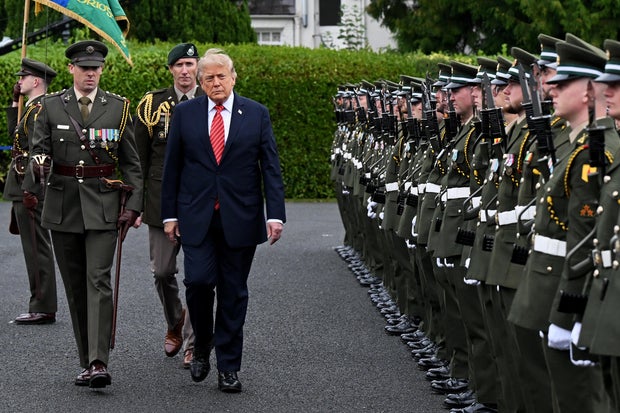
This trip continues a pattern seen throughout his presidency, where high-profile international travel is combined with appearances at properties bearing his name. The Irish Open marks the second European Tour event hosted at a Trump-owned property this year, following the Nexo Championship in Aberdeen, Scotland, held last month. Critics have long argued that such travel choices present a conflict of interest, while supporters maintain that the president’s presence brings global attention and economic investment to the venues.
Implications for Future Relations
The implications of Mr. Trump’s comments extend beyond the immediate political news cycle. Analysts suggest that by wading into the sensitive topic of Irish sovereignty, the administration may complicate future trade and diplomatic negotiations with the United Kingdom. With the U.K. navigating a complex post-Brexit economic environment, any perceived U.S. support for the dissolution of the Union is likely to be viewed with suspicion in Downing Street.
Furthermore, the visit has acted as a catalyst for widespread protest. Various coalitions, including anti-war groups, environmental activists, and pro-Palestinian organizations, have organized demonstrations in Dublin. These protests serve as a barometer for the broader public sentiment toward the current U.S. administration’s foreign policy, particularly in the Middle East—a topic that President Connolly explicitly broached during her meeting with Mr. Trump.
Chronology of the Visit
- September 12, 2026: President Trump arrives in Dublin for a series of diplomatic meetings.
- Morning, September 12: Bilateral discussions held with Prime Minister Micheál Martin, where the president first publicly voices support for a unified Ireland.
- Afternoon, September 12: Meeting with Irish President Catherine Connolly at Áras an Uachtaráin, characterized by formal protocol and pointed exchanges regarding international humanitarian issues.
- September 13, 2026: President addresses business leaders at the U.S. ambassador’s residence, acknowledging the complexities of the reunification question.
- September 13, 2026: Departure for Doonbeg to attend the Irish Open golf tournament.
Looking Ahead
As the president wraps up his visit to Ireland, the long-term impact of his remarks remains to be seen. While the White House may view the comments as a reflection of personal belief or an attempt to foster regional stability, the reality on the ground is far more nuanced. The delicate balance maintained by the Good Friday Agreement relies on the careful management of competing national identities. Whether these comments will be dismissed as diplomatic static or will be cited in future policy debates remains a question for international observers.
For the people of Ireland and the United Kingdom, the visit serves as a reminder that the status of Northern Ireland remains an unfinished chapter in the history of the British Isles—one that continues to draw interest and opinion from the global stage, even when such interest disrupts the established diplomatic order. As the president returns to his domestic agenda, the political landscape in Ireland remains as divided as it was before his arrival, underscoring the enduring difficulty of resolving historical grievances through external political intervention.