Shedding Light on the Invisible Giant: Groundbreaking Study Quantifies the Staggering Energy Footprint of the Artificial Intelligence Boom

The unprecedented proliferation of artificial intelligence technologies has triggered a massive, sprawling industrial expansion centered on computing campuses designed to process endless streams of data. Powering these modern colosseums of technology requires astronomical amounts of electricity—not merely to run banks of advanced servers, but to cool sensitive processors, maintain complex networking infrastructure, and sustain the physical facilities themselves. Yet, calculating the exact energy toll of this digital gold rush has historically remained a formidable challenge. While industry insiders freely acknowledge that the sector consumes a vast amount of power, transforming general statements into precise, facility-level data has been stymied by the reluctance of major tech operators to publicly disclose detailed usage statistics.
A newly published study in the journal Nature Sustainability, spearheaded by researchers at Harvard University, has pierced this veil of corporate secrecy, bringing investigators significantly closer to concrete consumption figures. By meticulously extracting physical locations and building footprints for as many verified U.S. hyperscale data centers as possible, the study’s authors successfully catalogued 403 warehouse-sized computing facilities scattered across the United States. By converting the calculated power capacity of these sites into theoretical annual electricity usage, the researchers estimated that these facilities collectively consume roughly 82 terawatt-hours (TWh) of electricity every year. To put this staggering figure into perspective, it roughly equates to the total annual electricity consumption of nearly 8 million American households, carrying an associated carbon footprint of approximately 26 million metric tons of carbon dioxide emissions.
A National Average Masking Local Realities
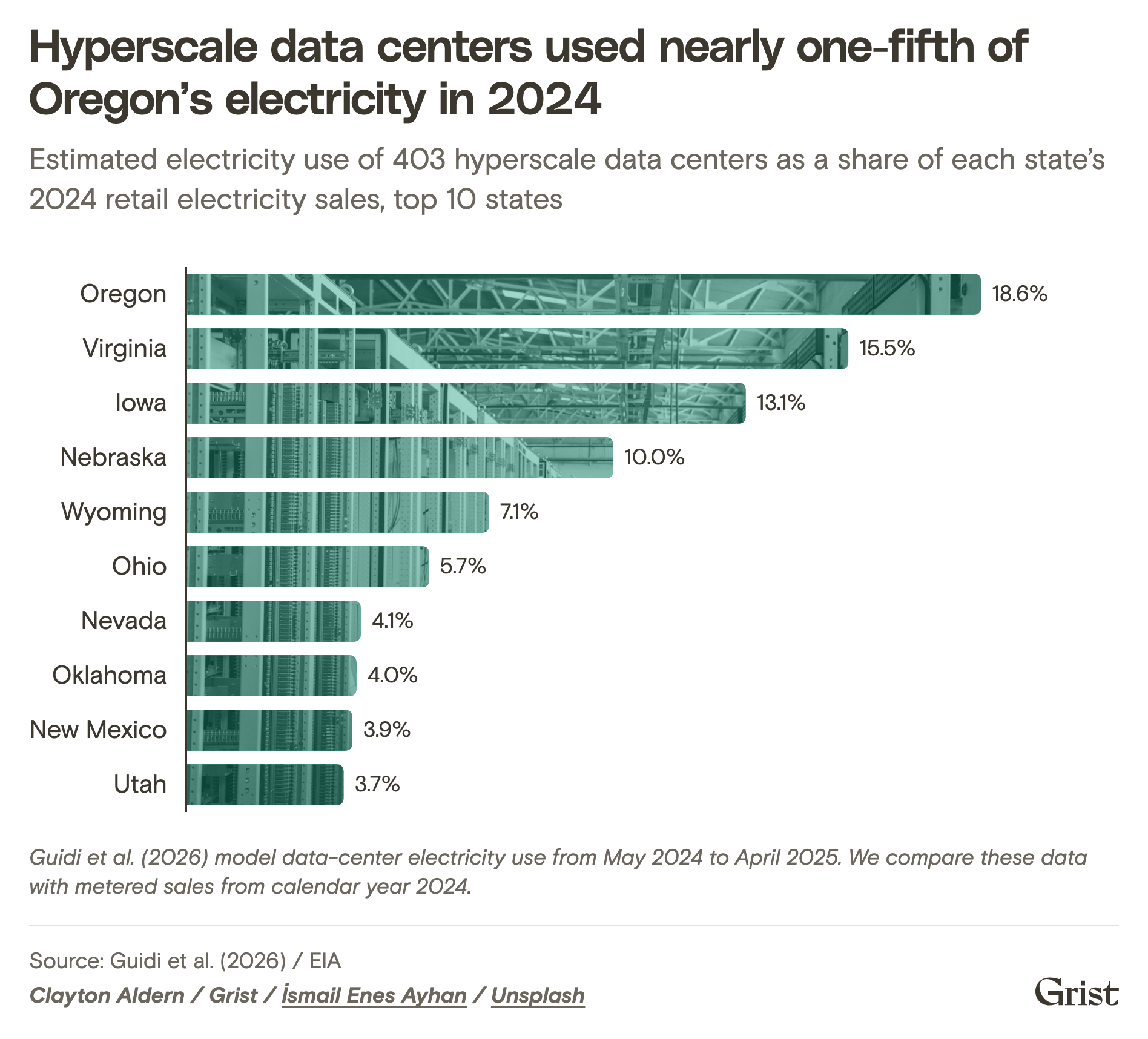
While the aggregate national consumption figure of 82 TWh accounts for roughly 2 percent of total U.S. electricity generation, that broad metric obscures dramatic state-to-state variations. In numerous regions across the country, the proliferation of hyper-scale digital infrastructure means that data centers account for double-digit percentages of total local electricity consumption. When compared against retail electricity sales reported to the U.S. Energy Information Administration (EIA) for 2024, the footprint of these facilities becomes glaringly apparent in specific energy markets.
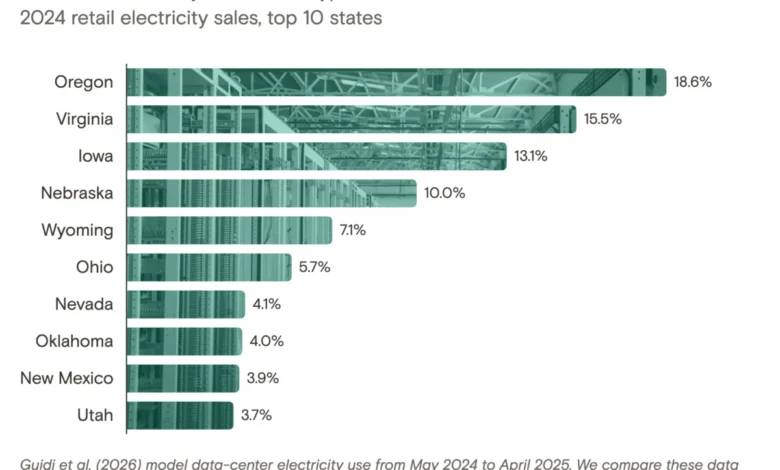
According to the study, data centers operating within Oregon consumed the equivalent of 18.6 percent of all retail electricity sold across the entire state. Virginia and Iowa followed closely behind, with data center consumption accounting for 15.5 percent and 13.1 percent of their respective state retail sales, while Nebraska stood at an even 10 percent.
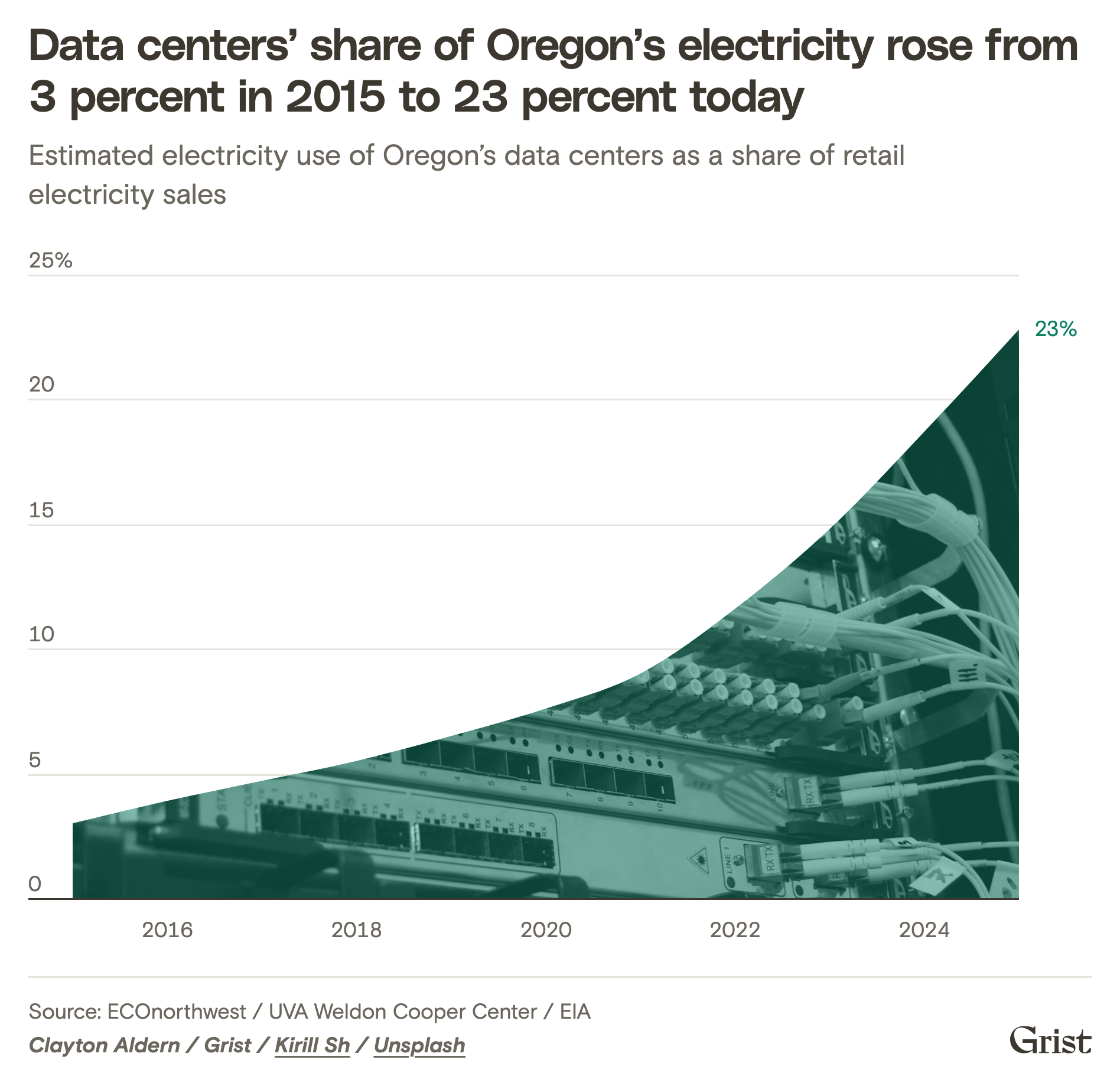
These localized surges present acute challenges for regional utility planning, grid reliability, and electricity pricing, which vary drastically by jurisdiction. Furthermore, the blinding speed at which the hyperscale industry expands means that static snapshots quickly become obsolete. In Oregon, for instance, independent analyses presented by the energy economics firm ECOnorthwest and researchers at the University of Virginia reveal a meteoric rise. Data centers accounted for a modest 3 percent of the state’s electricity consumption in 2015, a figure that climbed to roughly 23 percent by 2025. Even more striking, analysts estimated that the explosive growth of these facilities drove approximately 96 percent of Oregon’s total electricity sales growth between 2020 and 2025.
Local energy regulators have increasingly sounded the alarm, noting that the traditional mechanisms governing public utilities are ill-equipped to handle this digital influx. In its most recent biennial energy report, the Oregon Department of Energy cautioned that the state currently lacks effective policy mechanisms specifically designed to address the carbon emissions and grid strain driven by runaway data center load growth.
The Chronology of an Unprecedented Infrastructure Rush
To fully understand the current friction between tech enterprises and electrical grids, it is necessary to examine the timeline of the modern hyperscale boom. For decades, traditional data centers grew at a steady, manageable pace alongside corporate enterprise computing and the early expansion of cloud storage. However, the commercial explosion of generative artificial intelligence models in the early 2020s fundamentally altered this trajectory. Technology giants embarked on a multi-billion-dollar race to construct massive computing clusters capable of training and deploying complex large language models.
By 2023, regional grid operators began noticing unprecedented spikes in demand forecasts that completely shattered long-term energy projections. States like Virginia—historically dubbed "Data Center Alley" due to Northern Virginia’s heavy concentration of cloud infrastructure—faced sudden threats of grid capacity constraints. Dominion Energy, the state’s largest electric utility, reported that data centers purchased an astonishing 28 percent of all electricity sold by its Virginia subsidiary last year, a figure significantly higher than the 15 percent baseline captured by the Harvard study’s verified facility count alone.
Recognizing the regulatory blind spots inherent in this rapid buildout, federal lawmakers began pushing for legislative transparency in early 2026. In March, Senators Elizabeth Warren and Josh Hawley addressed a formal letter to the EIA, arguing that traditional federal data collection methods lump industrial, commercial, and residential sectors together without separating out the massive electricity draws of hyperscale computing.
"Without this data, policymakers, utility companies, and local communities are operating in the dark," the senators wrote. This bipartisan push found legislative traction within the American Affordability and Jobs Act, an infrastructure permitting bill under consideration in the Senate that would direct federal agencies to explicitly measure and report data-center electricity consumption.
Carbon Implications and the Grid Divide
The environmental consequences of this power consumption depend heavily on the regional energy mixes that feed individual data centers. The Harvard research team paired facility locations with federal power-plant data from the Environmental Protection Agency to calculate average carbon dioxide emission rates per kilowatt-hour.
The resulting disparities are vast. Facilities operating in Washington state benefit from a hydropower-heavy grid that produces a relatively modest 10 grams of carbon dioxide per kilowatt-hour. Conversely, data centers situated in regions reliant on fossil-fuel-backed grids, such as Virginia, face emission rates soaring up to 325 grams per kilowatt-hour. Across the board, the collective emissions of the catalogued facilities rival the annual greenhouse gas output of sovereign nations like Jordan, Kenya, and Guatemala.
Yet, even regional grid averages fail to capture a rapidly accelerating trend that threatens to bypass public oversight entirely: the construction of on-site, behind-the-meter power plants.
The Rise of Behind-the-Meter Power Generation
To circumvent prolonged interconnection queues and grid capacity bottlenecks, numerous tech developers are increasingly building dedicated, on-site power generators directly adjacent to or inside their computing campuses. Frequently powered by natural gas, these localized power plants generate electricity exclusively for the data centers, meaning the electrons often never touch the public transmission grid.
This behind-the-meter phenomenon introduces profound measurement challenges for regulators. According to data compiled by watchdog groups like the Environmental Integrity Project (EIP), approximately 2 gigawatts (GW) of gas-fired generation powered four major data center campuses nationwide as of mid-2026, including high-profile sites associated with Elon Musk’s xAI operations in Memphis, Tennessee. Furthermore, EIP identified an astounding 143 GW of new gas-fired power plant capacity proposed specifically to support data centers across the United States.

This shift threatens to fundamentally alter the geography of the American data center footprint. For example, West Virginia hosts precisely zero of the hyperscale campuses confirmed by the initial Harvard study. However, the state ranks second only to Texas in proposed on-site gas generation capacity, with over 15 GW tagged by environmental watchdogs eager to feed upcoming computational facilities.
While many of these proposed plants may face regulatory hurdles—with only a couple of dozen currently holding active construction permits under the Clean Air Act—the sheer volume of applications underscores an industry desperate for unfettered energy. Gianluca Guidi, lead author of the Nature Sustainability study, emphasized that published estimates represent merely a conservative baseline. "What we’re seeing is already striking, but it’s only a snapshot of a rapidly expanding industry," Guidi noted in a statement, warning that actual consumption figures and emissions metrics for late 2026 are likely substantially higher.
As federal lawmakers, state regulators, and utility executives race to adapt to an energy landscape reshaped by artificial intelligence, the central question remains whether public infrastructure can sustainably shoulder the immense, unyielding electrical appetite of the digital age.
Related posts: