The Financial Enticement of Federal Immigration Enforcement: Texas Police Departments Balance Budgets with Deportation Agreements

Last spring, the police chief in the tiny North Texas suburb of Pantego stood before his town council to propose a controversial strategy for bolstering local police coffers: entering the federal government’s 287(g) program to actively participate in immigration enforcement. Chief Robert Rife’s pitch was framed through the lens of fiscal necessity, assuring officials that while the federal funding stream wasn’t bottomless, it was substantial enough to provide relief for the town’s $2.1 million annual police budget. The council, seeking to maximize resources for a population of just 2,500, approved the agreement. Within months, the gamble appeared to pay off; following a single immigration-related arrest in June, the town secured $100,000 in federal funds. Projections suggest that Pantego could ultimately net as much as $720,000, a figure that represents roughly 40% of its total police budget—a transformative injection of capital for a small municipality.
This arrangement is not an anomaly. As of mid-September, 429 law enforcement agencies across Texas had entered into similar 287(g) agreements with U.S. Immigration and Customs Enforcement (ICE). These partnerships, which authorize local officers to perform immigration enforcement duties during their routine patrol operations, have become a cornerstone of federal efforts to accelerate deportations under the current administration. Texas leads the nation in these partnerships, turning local police and sheriff’s departments into a decentralized arm of federal immigration policy, fueled by a promise of recurring financial rewards.
The Evolution of the 287(g) Program
The 287(g) program, named after a section of the Immigration and Nationality Act, allows state and local law enforcement to enter into memoranda of agreement with the federal government to perform specific immigration enforcement functions. The program operates under three primary models: the Jail Enforcement Model, the Warrant Service Officer Model, and the controversial Task Force Model.

The Task Force Model, which ICE largely phased out in 2012 following investigations by the Department of Justice into civil rights abuses in jurisdictions like Maricopa County, Arizona, and Alamance County, North Carolina, has seen a massive resurgence. Upon returning to office, the Trump administration reinvigorated this model, which allows local officers to conduct proactive immigration enforcement, including making stops and arrests in the field. In 2026 alone, at least 241 new task force agreements were signed in Texas, dwarfing the 30 agreements signed under the other two models combined during that same period.
For cash-strapped departments, the financial incentives are often the primary selling point. KXAN’s analysis of local government meeting minutes reveals a pattern: law enforcement officials frequently pitch these programs to elected councils as "windfalls" that offset the costs of equipment, vehicle maintenance, fuel, and overtime pay—expenses that would otherwise fall squarely on local taxpayers.
Financial Dynamics and Lack of Oversight
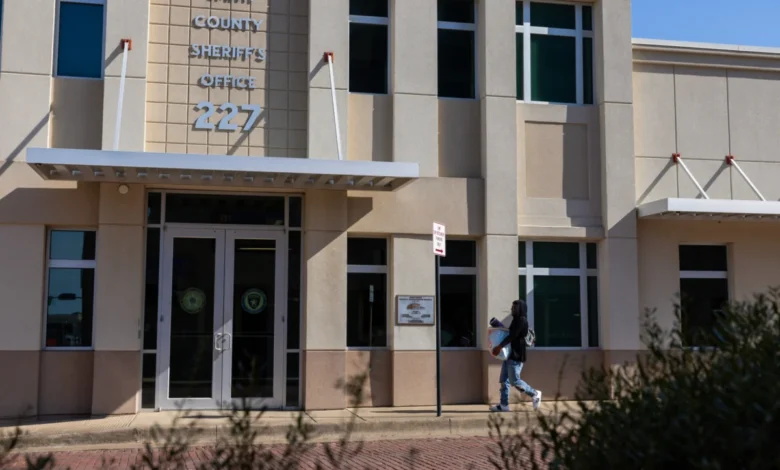
The fiscal allure of the program is immense, yet it arrives with significant questions regarding transparency and accountability. In Smith County, for example, Sheriff Larry Smith successfully advocated for the program by emphasizing that it would cover equipment, fuel, and mileage, while providing $100,000 for two new vehicles and supplemental overtime funds. When a county commissioner asked, "How often do the feds offer us money for anything?" the sheriff replied simply, "Not very often."
The scale of the funding is unprecedented. Smith County received nearly $2.2 million in federal 287(g) funding between January 2025 and June 2026, an amount equivalent to approximately 12% of its entire fiscal year 2025 budget. Other departments, such as those in the Texas Panhandle, have reported that federal funds are being absorbed directly into general operational expenses, covering everything from payroll taxes and retirement contributions to "fleet purchases."

Critics, including legal experts and civil rights advocates, point out that the federal government requires few measurable outcomes in exchange for these millions. There is minimal tracking regarding how the funds are spent, and little in the way of performance metrics beyond the raw number of arrests. Furthermore, service agreements typically allow for termination with 60 days’ notice, yet none of the documents reviewed indicate that the federal government can claw back funding if a department decides to leave the program, meaning towns like Pantego can effectively treat the federal money as a permanent gain while retaining the equipment purchased with it.
The Human Cost: A Case Study in Tyler
The real-world application of these agreements is often felt most acutely by immigrant communities. In late June, Jose Rodriguez and his 23-year-old son, Pablo, were traveling along Loop 323 in Tyler when they were pulled over by a detective from the Smith County Sheriff’s Office. The reason cited for the stop was a missing license plate on the trailer attached to their work truck and a missing mud flap.
Body camera footage captured the ensuing encounter. The detective, after learning that Jose Rodriguez had limited English proficiency, asked, "Are you a U.S. citizen?" When Rodriguez answered "No," he was immediately handcuffed and detained. According to records, there were no criminal charges on his record at the time of his arrest. He was subsequently transferred to an ICE detention facility and, after three months, deported to Mexico.
For Pablo Rodriguez, the incident was a stark reminder of the vulnerability created when local police act as immigration agents. "They portray us as criminals, rapists, violent people," he told reporters. "We’re just regular people trying to find a better life. The only difference is our skin." Data obtained by researchers suggests this is not an isolated experience; in Smith County, more than 100 of the 124 immigration enforcement actions taken by the sheriff’s office between October 2025 and July were not associated with any specific criminal charge.

Shifting Political Landscapes and Future Uncertainty
The future of the 287(g) program in Texas now faces a period of profound uncertainty following recent election results. While the outgoing administration pushed for the expansion of these agreements, the incoming state leadership and a shifting legislative majority have signaled a potential pivot.
Governor-elect Gina Hinojosa has previously called for an end to the "terrorizing" of communities through these operations, and while she has not explicitly outlined a plan to dismantle the 287(g) program, her administration is expected to apply stricter scrutiny to the state’s participation. Similarly, incoming Attorney General Nathan Johnson has voiced strong opposition to the practice of "outsourcing" state employees to federal agencies for duties outside their traditional scope. Johnson has suggested he will evaluate whether to continue the attorney general’s own participation in the program, which began under his predecessor, Ken Paxton.
On the local level, newly elected Comptroller Sarah Eckhardt has promised an audit of the state’s $20 million grant program, which was designed to subsidize the costs of 287(g) participation for sheriff’s offices. Eckhardt has characterized the current spending as "unsustainable" and has warned that the long-term fiscal burden may ultimately fall on property taxpayers rather than the federal government.
Despite this, some local officials remain committed to the program. In Fayette County, law enforcement representatives have argued that if the federal government is willing to provide compensation for immigration enforcement, it is a prudent financial decision to accept those funds to offset local budget shortfalls.

Implications for Public Safety and Community Trust
The reliance on federal funding to subsidize local policing creates a complex web of incentives. By linking police budgets to the volume of immigration enforcement actions, departments may find themselves tethered to a program that, while financially beneficial in the short term, alters the fundamental relationship between law enforcement and the communities they serve.
As the state enters a new legislative session, the debate will likely focus on whether the benefits of the 287(g) program—specifically the financial relief it offers to local governments—outweigh the social and legal costs. With conservative think tanks advocating for the expansion of the mandate to include all police departments, and a new state government questioning the efficacy and morality of the program, Texas stands at a critical juncture.
For the small towns that have integrated this federal funding into their long-term budget planning, the possibility of a policy reversal presents a significant risk. If the federal flow of cash is curtailed or the state mandates are repealed, these municipalities may find themselves with expensive equipment and a reliance on funds that no longer exist, forcing a difficult conversation about the true cost of local participation in national immigration policy. The coming months will likely see a battle of wills between local agencies seeking financial autonomy and a new state administration determined to recalibrate the state’s role in the lives of its residents.