Mechanical engineer builds his own four-seater plane from a kit during the pandemic to fly his family across Europe


The dream of personal aviation, once the exclusive domain of the wealthy or the military, is undergoing a quiet transformation as advancements in kit-built aircraft technology allow private individuals to construct sophisticated machines in their own backyards. Among those leading this DIY movement is Ashok Aliseril Thamarakshan, an Essex-based mechanical engineer whose ambitious project to assemble a four-seater Sling TSi aircraft during the Covid-19 pandemic has turned into a blueprint for accessible, small-scale aviation.
The Genesis of a Personal Aviation Project
Aliseril’s journey into the skies began over a decade ago after he moved near an active airfield in the United Kingdom. The proximity to aviation operations sparked a dormant interest, but it was a birthday gift from his wife, Abhilasha—a 30-minute flight experience—that transformed a passive hobbyist into a licensed pilot. By 2019, Aliseril had earned his private pilot’s license, but he quickly encountered a common hurdle for aviation enthusiasts: the scarcity and cost of suitable, modern aircraft available for hire.
As his family grew to include two young daughters, the typical two-seater rental planes became inadequate for family excursions. While he initially explored the secondary market for vintage aircraft, his professional background as a mechanical engineer led to a pragmatic conclusion: older planes built in the 1960s and 1970s presented too many unknowns regarding maintenance and structural integrity. Seeking a balance between safety, reliability, and cost-efficiency, Aliseril turned his attention to the world of kit-built aircraft, specifically the high-performance four-seaters manufactured by the South African company, Sling Aircraft.
The Pandemic Build: A Garden Engineering Feat
In early 2020, just months before the global onset of the Covid-19 pandemic, Aliseril traveled to Johannesburg to conduct a test flight of the Sling TSi. Impressed by the aircraft’s performance and engineering standards, he purchased the assembly kit. When the shipment arrived in the UK, the country was in the grips of its first national lockdown.
The restrictions proved to be a significant logistical challenge. The expert assistance he had anticipated from colleagues—some of whom were experienced aircraft builders—was rendered impossible by social distancing mandates. Undeterred, Aliseril constructed a custom workshop in his back garden. This space became the site of an intensive 18-month project. The construction was not a solitary endeavor of guesswork; it was a rigorous, monitored process overseen by the Light Aircraft Association (LAA) in coordination with the UK Civil Aviation Authority (CAA).
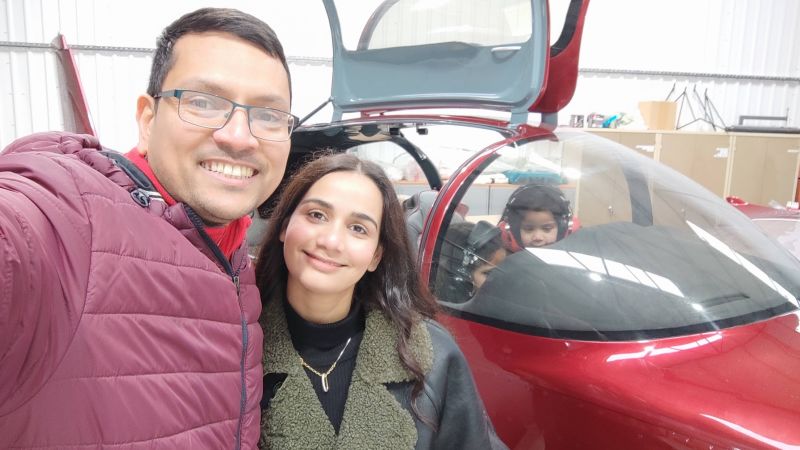
The project required strict adherence to safety protocols. Each phase of the build, from the tail and wings to the fuselage, necessitated formal sign-offs from LAA inspectors. In total, the project underwent approximately 12 independent inspections to ensure the aircraft met airworthiness standards before the final assembly. Aliseril’s daughter, Tara, even participated in the process, performing essential tasks such as removing protective film from components, turning the engineering challenge into a family-centric endeavor.
Chronology of the G-Diya
The construction of the aircraft, which Aliseril named "G-Diya" after his youngest daughter, followed a meticulous timeline:

- January 2020: Test flight in South Africa and purchase of the kit.
- April 2020: Commencement of construction in the home garden shed following initial CAA/LAA clearance.
- Summer 2020: Completion of the tail and wing sections.
- October 2020: Beginning of the fuselage construction.
- Late 2021: Relocation of components to a hangar near Cambridge for engine installation and final integration.
- January 2022: Successful maiden test flight.
- May 2022: Issuance of the final Permit to Fly by the CAA.
The maiden flight was a milestone of psychological and mechanical significance. Aliseril recalls the tension of watching a test pilot take the machine he had spent 18 months building into the air for the first time. The success of that 20-minute flight transitioned the project from a "work-in-progress" to an official, registered aircraft.
Economic Implications and Shared Ownership
One of the most compelling aspects of Aliseril’s project is the financial model he adopted to mitigate the costs of private aviation. The total cost of the project reached approximately £180,000 ($203,000), covering the £80,000 kit price, high-end avionics, a Rotax engine, and specialized tools. To manage these expenses, Aliseril entered into a shared-ownership arrangement with three other partners.
This communal approach has reduced the financial burden to roughly the equivalent cost of a high-end SUV. Furthermore, the aircraft is notably fuel-efficient, consuming only about 20 liters of unleaded fuel per hour of flight—an efficiency level that makes air travel costs competitive with standard automobile fuel expenditures. This model of "fractional ownership" is increasingly viewed by aviation experts as a viable path for non-wealthy enthusiasts to maintain access to private aircraft.
Broader Impact on General Aviation
The success of the G-Diya project highlights a growing trend in the UK and abroad: the democratization of small-scale aviation. The LAA and similar international bodies, such as the FAA in the United States, provide the regulatory framework that allows amateur-built aircraft to coexist with commercial and standard private traffic.

By proving that a four-seater, long-range aircraft—capable of traveling 1,389 kilometers—can be constructed by an amateur with dedication and adherence to engineering standards, Aliseril has provided a compelling case study. His family’s subsequent trips, including journeys to the Isle of Wight, Skegness, and even an international flight to Bergerac, France, underscore the functional utility of home-built planes. The family’s experiences, documented via their social media platform, serve as an educational resource for aspiring builders.
Technical and Regulatory Context
In the United Kingdom, the distinction between a factory-built plane and an amateur-built one is bridged by the "Permit to Fly." Unlike a standard Certificate of Airworthiness, which is granted to mass-produced aircraft, a Permit to Fly is specific to experimental, historic, or kit-built aircraft. It confirms that the machine is "fit to fly" following rigorous scrutiny of its construction methods and materials.
The Sling TSi, specifically, is a modern high-wing aircraft designed for ease of assembly. The manufacturer provides detailed, intuitive documentation, often compared to the clarity of flat-pack furniture instructions, which significantly lowers the barrier to entry for individuals with mechanical aptitude but no prior aerospace manufacturing experience.
Conclusion: A Future of Collaborative Aviation
As of 2024, the G-Diya has logged over 300 flight hours, with journeys extending as far as Norway. Aliseril’s project is not just a personal achievement; it is a testament to the viability of DIY aviation in the 21st century. By building a new hangar in Essex in 2023 to accommodate the aircraft, he has established a permanent base for his family’s aviation adventures.

For those considering similar projects, Aliseril emphasizes that the endeavor is less about innate genius and more about patience, meticulous planning, and the willingness to learn from the community of builders and pilots. As shared ownership models continue to proliferate, the barrier to the skies may continue to lower, allowing more families to reclaim the freedom of personal flight. The story of the G-Diya serves as a modern reminder that with the right regulatory guidance and mechanical dedication, the distance between one’s garden and the continent is smaller than it has ever been.