Haida Nation leads innovative bear den restoration project to counter impacts of historic industrial logging on Haida Gwaii

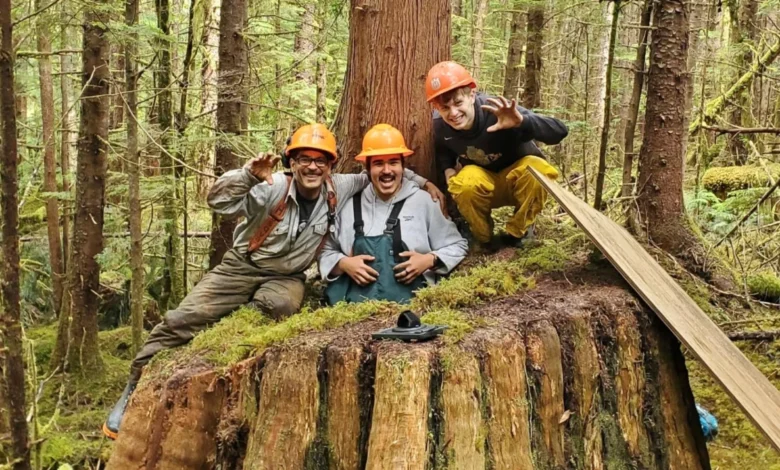
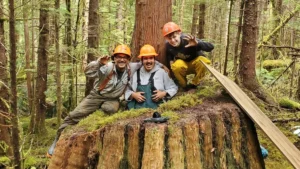
Elijah Washington navigates the dense, mist-laden undergrowth of Haida Gwaii, his boots sinking into the soft moss that blankets the forest floor. He is not merely trekking; he is conducting a mission of restoration. Kneeling beside a massive, decaying western red cedar stump—a remnant of the aggressive industrial logging era that reshaped this British Columbia archipelago decades ago—he inspects his team’s handiwork. The stump has been meticulously retrofitted: a chainsaw-cut entrance, a reinforced plywood roof, and a layer of weather-resistant material topped with natural moss. Inside, the hollow is perfectly sized for a mother black bear and her cubs. This site is one of seven newly constructed dens designed to provide critical winter sanctuary for the coastal black bear, a unique subspecies found only in this region.
The project, spearheaded by the Council of the Haida Nation, represents a profound intersection of traditional ecological knowledge and modern wildlife conservation. As the coastal black bear, known as taan in the Haida language, faces an existential threat from the loss of natural old-growth habitat, the Haida are attempting to bridge the gap between what was lost and what is needed for the species to survive.
The Ecological Crisis of Lost Old-Growth
The coastal black bear is among the largest of its kind in North America, and its life cycle is deeply intertwined with the architecture of ancient forests. For centuries, these bears relied on the massive, hollowed-out cavities of veteran western red cedars to serve as winter dens. These trees, often centuries old, provide the thermal insulation and structural security necessary for female bears to nurse cubs through the harsh winter months.
However, the rapid expansion of the logging industry in the 20th century decimated the old-growth stands that characterized Haida Gwaii. The replacement forests—second-growth stands dominated by younger, uniform timber—lack the biological maturity required to form natural hollows. According to wildlife biologist Helen Davis, who has studied these bears since the early 1990s, the current forest composition leaves a critical "denning void."

"The only place where bears can have babies is in a den," Davis explains. "These dens are the fundamental requirement for population sustainability. When you remove the ancient trees, you aren’t just removing timber; you are removing the maternity wards of the forest."
A Chronology of Conservation and Conflict
The realization that human intervention might be necessary for bear survival did not emerge in a vacuum. It was the byproduct of decades of tension between the logging industry and the Haida Nation.
- 1990s: Helen Davis begins systematic research into denning habits, using radio-collared bears to track den locations. Her findings definitively link bear survival to the presence of large, hollow old-growth trees.
- 2019: The Haida-owned forestry firm, Taan Forest, shifts its operational mandate to prioritize conservation. Davis begins training staff to identify and restore natural denning sites.
- 2023: Initial successes are recorded. Bears begin using modified stumps, with some individuals returning to the same sites annually.
- Summer 2026: The Council of the Haida Nation scales up the program, securing funding from the Habitat Conservation Trust Foundation to train a specialized crew, including stewardship technician Elijah Washington, to expand the network of artificial dens.
This shift in management is not merely technical; it is ideological. For the Haida, the land is a relative, not a resource. Lisa White, a councillor with the Old Massett Village Council, recalls the deep emotional toll of witnessing the landscape degradation. "I actually cried," White says, reflecting on the sight of plywood roofs on cedar stumps. "It shows how deeply the land has been damaged that we must now act as the architects of their survival."
Scientific Methodology and Implementation
The construction of an artificial den is a precise, albeit somber, science. The team scouts the forest for stumps that possess the structural integrity to support a hollow. They use chainsaws to open entrances that must be precise—"Goldilocks-sized," as Washington describes it—large enough for a bear but small enough to exclude predators and retain heat.
To further increase the likelihood of occupancy, the crews employ a sensory strategy: they place hair samples collected from deceased bears at the den entrances. This olfactory signal serves as a biological cue that the location is a safe, established site for other bears.

Monitoring is the final, crucial phase. The project utilizes motion-activated cameras positioned to record activity while the crew remains entirely absent from the sites between October and April. This "hands-off" approach ensures that the bears are not disturbed during their most vulnerable period of hibernation. DNA analysis from hair left at the entrance will allow biologists to track occupancy rates and determine if the dens are successfully supporting breeding females over multiple years.
Industry Pressures and Economic Realities
The debate over logging on Haida Gwaii remains contentious. In August 2026, BC Forests Minister Ravi Parmar stated that an immediate, total cessation of logging would cripple the province’s economic sector. Yet, critics argue that such a position ignores the long-term ecological debt incurred by the industry.
Jeff Mosher, chief forester at Taan Forest, acknowledges the difficulty of balancing these interests. "Protecting bears is a priority, even if it means a lower dividend," Mosher says. This ethos is shared by the Haida leadership, who emphasize that the current efforts are a stop-gap measure. The ultimate goal remains the protection of standing old-growth forests, which provide not just denning sites, but a complex ecosystem of food sources, including salmon streams and specific native flora.
Broader Implications: Beyond the Den
The project has drawn attention from conservationists globally, who see it as a potential model for human-wildlife co-existence in heavily managed landscapes. However, there are significant concerns about the long-term sustainability of this approach.
Noel Bellis, a carver and Haida Nation member, points out that shelter is only one half of the equation. "It’s also the forest around them that needs to be strong," he notes. If a den is provided in a forest devoid of native forage—such as horsetail, fireweed, or salmonberry—the bear will still struggle. The over-browsing of these plants by deer populations, which have surged in the absence of traditional predators, threatens the bears’ spring food supply.

Furthermore, there is the fear that such interventions provide a "moral license" for continued deforestation. If the industry can "build" a den, does that justify cutting down a thousand-year-old tree? Both the Haida leadership and biologists like Davis are wary of this narrative, maintaining that artificial dens are a corrective measure for past damage, not a substitute for the preservation of pristine ecosystems.
Cultural Continuity and the Spirit of the Land
For elders like Barney Edgars, the initiative is a return to a philosophy of stewardship that existed long before the first chainsaw touched the island. "We were taught that everything we grew up with had a spirit," Edgars says. He recalls a time when the relationship between the Haida and the bears was defined by mutual respect and shared territory, rather than fear or conflict.
The encroachment of bears into human settlements—an increasing phenomenon as their natural foraging grounds shrink—has led to new fears of human-bear conflict that were historically absent. By providing secure, isolated denning sites, the Haida hope to reduce these interactions and restore a degree of natural order to the archipelago.
As the crew prepares to complete their tenth site by the end of October, the project stands as a testament to the resilience of both the species and the people working to save them. It is a quiet, deliberate effort to mend a fragmented landscape, one cedar stump at a time. Whether this initiative can scale sufficiently to save the coastal black bear from the broader pressures of climate change and continued habitat loss remains a question for the coming decades. For now, however, in the quiet mossy corners of Haida Gwaii, the taan have a place to sleep.