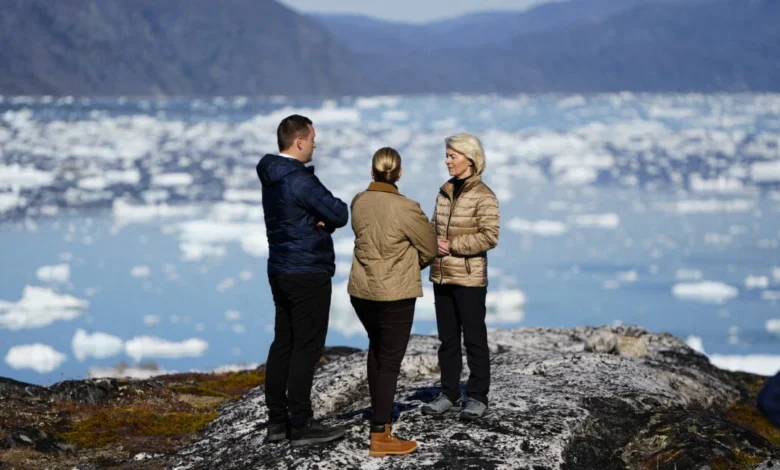
The European Union has unveiled an ambitious, high-stakes infrastructure initiative to establish the first direct subsea internet cable connecting mainland Europe to Greenland. This "Pan-Arctic Cable" project, formally introduced in a European Commission joint communication on October 20, 2026, represents more than a technological upgrade; it is a strategic geopolitical maneuver. By creating a digital bridge that links Greenland to the European Union and potentially extending that reach to Canada, Japan, and South Korea, the bloc is effectively constructing a communications corridor that bypasses the United States, signaling a significant shift in transatlantic digital reliance.
This initiative emerges at a moment of profound uncertainty in international relations. As trade tensions between the United States and its traditional allies continue to simmer and the U.S. government maintains an increasingly isolated, pro-Russia stance regarding the ongoing war in Ukraine, European leaders have begun to prioritize "digital sovereignty." The project aims to ensure that Europe’s communications backbone remains secure, resilient, and, crucially, independent of the volatility currently characterizing Washington’s foreign policy.
A Geopolitical Pivot in the Arctic
The decision to route fiber-optic connectivity through the Arctic is a response to both economic necessity and the hardening of international borders. For decades, the global internet backbone has relied on established, commercially driven routes that prioritized efficiency over national security. Today, those priorities have inverted.
Elisabeth Braw, a senior fellow at the Atlantic Council and an expert on threats to global maritime order, notes that while such a project would have been deemed commercially unviable only five years ago, it is now perfectly aligned with current geopolitical realities. "The fact that it’s being considered is very much on trend and a sign of our times," Braw observed.
The project gained critical momentum following a trilateral security agreement in September 2026 between the United States, Greenland, and Denmark. This agreement resolved long-standing friction over American territorial claims to Greenland, preserving the island’s autonomous status while granting the U.S. expanded military access. Despite the resolution of the sovereignty dispute, the political distance between Brussels and Washington has only widened. The European Union’s move to invest €107 million ($119 million) into Greenland’s connectivity infrastructure is a clear message that Europe intends to maintain its own strategic interests in the High North.
The Vulnerability of Global Chokepoints
The push for a new Arctic route is also driven by the fragility of current trans-continental infrastructure. According to data from TeleGeography, over 90 percent of data traffic between Europe and Asia currently transits through the Red Sea and the Suez Canal. This corridor has become a high-risk zone since the resumption of open conflict between the Yemeni government and Houthi factions.
The Bab el-Mandeb Strait, a vital chokepoint, has seen repeated missile and drone attacks on commercial shipping, creating an environment where subsea cable maintenance—or even the cables themselves—could be targeted with ease. The European Union’s strategy document highlights this reliance on a single, precarious route as an unacceptable security risk. The Pan-Arctic Cable, therefore, serves as a vital redundancy, offering an alternative path that traverses the stable waters of the North Atlantic and the Arctic Circle, far removed from the volatile Middle East.
Chronology of the Pan-Arctic Ambition
The development of the Pan-Arctic Cable project follows a distinct timeline of growing European self-reliance:
- May 2021: The "Arctic Connect" project, which aimed to link Europe and Asia via the Northern Sea Route along the Russian coastline, is officially halted. The subsequent Russian invasion of Ukraine renders any cooperation with Moscow in the Arctic impossible.
- 2025: A consortium of European research organizations and private companies signs a development agreement with a Greenlandic telecom operator, laying the technical foundation for the current project.
- February 2026: Tensions in the Middle East escalate as the United States and Israel initiate military strikes against Iran, leading to widespread concerns over the security of submarine cables in the Strait of Hormuz.
- September 2026: A trilateral security agreement between the US, Denmark, and Greenland secures the legal framework for infrastructure development in the region.
- October 20, 2026: The European Commission publishes its new Arctic Strategy, designating the Pan-Arctic Cable as a flagship project for European digital sovereignty.
- Late 2026: Norwegian firm Bulk Infrastructure Group AS launches the "Leif Erikson" system, seeking Canadian partners to finalize a direct Europe-to-Canada fiber link.
Technical and Operational Challenges
While the strategic rationale is sound, the engineering challenges are immense. Operating in the Arctic requires specialized, ice-hardened vessels capable of navigating extreme conditions. Maintenance of a subsea cable in ice-covered waters is significantly more expensive and technically demanding than in temperate zones.
Furthermore, the goal of connecting to Japan and South Korea requires deep cooperation with Canada. While the EU is eager to foster "like-minded" partnerships, the logistical hurdles of laying thousands of miles of cable across the Arctic seabed are substantial. The European Commission has acknowledged these challenges, stating that the project will require both advanced "smart technologies" to monitor cable integrity and a robust fleet of support vessels.
Security and Surveillance Concerns
The backdrop of this project is a growing epidemic of "undersea sabotage." In recent years, NATO forces have reported Russian submarines conducting drills specifically aimed at disabling subsea cables near Norway. Similarly, Chinese-linked commercial vessels have been linked to suspicious activities near cables in the Baltic Sea and the Pacific, often involving the dragging of anchors over sensitive infrastructure.

The EU’s response is to create an "Arctic Cable Hub," an integrated security layer designed to monitor, protect, and facilitate the rapid repair of subsea infrastructure. By embedding early-warning systems into the cable design, the EU hopes to preemptively detect tampering. This shift acknowledges a grim reality: the internet’s physical backbone is no longer neutral territory.
"We are going to see more cables that connect friendly countries, and then you have to figure out how you can connect them without going through unfriendly countries’ exclusive economic zones or territorial waters," says Braw. This sentiment is driving a "balkanization" of the internet, where traffic is increasingly routed through trusted jurisdictions to avoid interception or physical disruption by adversaries.
Broader Economic and Global Implications
The shift toward an Arctic-centric communications network has profound implications for global trade and digital governance. For Big Tech companies like Google and Meta, which have historically funded their own trans-Pacific and trans-Atlantic cables, the landscape is changing. With the rise of state-sponsored sabotage and the threat of regional powers like Iran demanding "transit fees" for cables in their waters, the private sector may find itself increasingly reliant on state-backed, secure infrastructure.
The European Union’s investment also suggests a long-term plan to turn Greenland into a digital hub. By securing a high-capacity link to the island, the EU is not only connecting itself to Asia but also positioning Greenland as a potential location for data centers that benefit from the region’s natural cooling and renewable energy potential.
As the project moves from policy document to reality, it serves as a litmus test for the European Union’s ability to act as a unified geopolitical actor. By bypassing the United States, the EU is making a calculated bet that the future of its security lies in its own hands, and in the strength of its alliances with Canada and Pacific partners. The Pan-Arctic Cable is, in essence, a digital manifestation of a post-Atlantic order—one where the physical paths of the internet are increasingly dictated by the map of global trust rather than the map of commerce.
Whether the project can overcome the formidable environmental barriers of the Arctic remains to be seen. However, the political will behind it is clear: Europe has decided that when it comes to the safety of its data, the safest route is one that avoids the unpredictable currents of contemporary American politics and the increasingly contested waters of the world’s traditional maritime chokepoints.
Related posts: