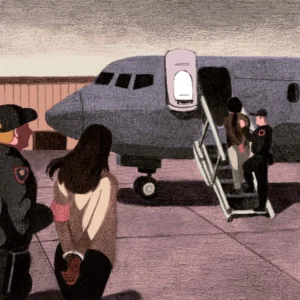
Breaking the Cycle of Silence Generational Abuse and the Doctrine of Forgiveness in the Old Apostolic Lutheran Church


The boundaries of safety for two sisters raised within the insular world of the Old Apostolic Lutheran Church (OALC) were not defined by the external threats they were taught to fear. Instead, the danger resided within the walls of their own home. For Lynn and Katherine, who grew up in a family of 11 children moving between Washington state and South Dakota, the warnings issued by their religious community about the "world" and its "sinful" outsiders proved to be a diversion from a grim reality: the primary threat came from their own brothers in the next bedroom.
Now aged 55 and 43 respectively, the sisters—identified by their middle names to protect their privacy as victims—are part of a growing number of former members speaking out against what they describe as a culture of systemic sexual abuse and institutional silence. Their experiences, characterized by early childhood trauma and a subsequent struggle with the church’s "forgive and forget" doctrine, highlight a cycle of abuse that has persisted across generations within the OALC.
A Legacy of Internalized Trauma
Lynn’s account of her childhood is one of early and sustained victimization. She reports that her abuse began while she was still in diapers. Though her older sisters witnessed a brother touching her and informed their mother, Lynn states that no action was taken by her parents. The abuse continued for years, ending only when the brother turned 16 and Lynn was 10. Years later, a disturbing context emerged: Lynn’s sisters believed that this brother had himself been sexually abused by a neighbor, suggesting a pre-existing cycle of trauma.
Katherine’s experience mirrored her sister’s. She reports that her abuse began at age two, perpetrated by a different brother. According to Katherine, this brother had also been a victim, allegedly abused by an older cousin. This pattern of victims becoming perpetrators is a central theme in the accounts of former OALC members. By the age of 10, Lynn found herself repeating the behavior, involving a younger brother in a sexualized incident behind a shed. Katherine recalls a similar event at age five involving a young nephew.
For decades, these incidents were managed through a "suffocating silence." Within the OALC, such events are frequently minimized or swept away under the guise of religious forgiveness, leaving victims to grapple with their trauma without professional intervention or legal recourse.
The Scope of the Investigation
The accounts provided by Lynn and Katherine are not isolated incidents. Over the past year, an extensive investigation by ProPublica and the Minnesota Star Tribune has uncovered a pattern of generational sexual abuse within the Old Apostolic Lutheran Church. Reporters interviewed 20 former members who reported being sexually abused, alongside parents of victims, and analyzed thousands of pages of police and court records.
The findings describe a culture where sexual abuse is often normalized and where the religious doctrine of immediate forgiveness serves as a barrier to justice. The investigation identified several key factors contributing to the persistence of abuse:
- Mandated Reporting Failures: Church leaders, when informed of abuse, frequently failed to report the allegations to law enforcement, despite state laws requiring such action.
- Spiritual Coercion: Victims were often encouraged to "forgive and forget," a practice that critics argue prioritizes the reputation of the church and the soul of the perpetrator over the safety and healing of the child.
- Isolationism: The church’s emphasis on separation from "the world" discourages members from seeking help from secular authorities or mental health professionals.
The Theological Barrier: "Forgive and Forget"
At the heart of the OALC’s handling of abuse is a specific interpretation of scripture that emphasizes unconditional forgiveness. For Lynn and Katherine, this doctrine was used as an "umbrella" to cover any transgression, regardless of its severity or its impact on the victim.
Sandy Stevens, executive director of the North East Wyoming Advocacy Resource Center, notes that the use of scripture to assert authority in these contexts can constitute "spiritual abuse." According to Stevens, the "forgive and forget" doctrine is actively harmful to victims. "Forgiveness without accountability is not healing," she stated. "And you can’t pray away a crime."
In the OALC, the pressure to forgive is often immediate. When Lynn recently confronted the younger brother she had abused decades ago to offer an apology and take responsibility, his response was a hug and a statement that her sins were forgiven. While intended as a gesture of grace, Lynn found the response "par for the course," noting that it bypassed the necessary conversation about the impact of the trauma. "I don’t think we should forget," she said. "That’s part of the problem. Forgetting is perpetuating the cycle."
Case Studies in Generational Impact
The investigation highlighted several criminal cases that illustrate how untreated childhood trauma can manifest in adulthood. One prominent case is that of Clint Massie, an OALC member from South Dakota who pleaded guilty in 2024 to four counts of sexual conduct with victims under the age of 13 in Duluth, Minnesota.
During a videotaped police interview, Massie described his own childhood in the church as being marked by sexual contact with relatives, which he viewed as a routine part of growing up. He referred to it as "kids our age, playing around." However, as investigators pressed for details, Massie became visibly shaken, admitting the memories were "disgusting" and acknowledging that they likely left an "imprint" on his brain.
In another case from January 2023, a church member in Minnesota turned himself in to police, confessing to the abuse of his own children because he "did not want it to happen anymore." At his sentencing, the judge noted that the man and his siblings had all been victims of abuse as children within the church community. The judge remarked that it was "almost incomprehensible" that no adults intervened, concluding that "faith didn’t help stop that."
Data and Chronology of Church Responses
The OALC, which has congregations across the United States and Canada, has historically maintained a low profile. However, the recent investigation has forced a rare, albeit guarded, response from church leadership.
- 2023-2024: ProPublica and the Minnesota Star Tribune conduct a year-long investigation into abuse allegations spanning multiple states, including Washington, South Dakota, and Minnesota.
- January 2023: A Minnesota church member confesses to police, breaking the internal cycle of silence.
- 2024: Clint Massie is sentenced to nearly eight years in prison for child sexual abuse.
- Church Position: Officials with the OALC have stated that they do not believe sexual abuse is more prevalent in their church than in society at large. They maintain that the church complies with local recommendations and that they were unfamiliar with the specific claims made by Lynn and Katherine.
Experts in child protection, such as former prosecutor Victor Vieth, argue that the church’s internal culture directly contributes to these outcomes. Vieth, who trains child-abuse investigators, noted that a culture of "looking the other way and brushing it off" prevents true repentance and contributes to the development of sexual behavior problems in children.
Seeking Accountability and Breaking Away
For Lynn and Katherine, the path to healing required leaving the OALC entirely—a move they made 20 years ago. They have since utilized secular therapy to address their trauma and have chosen to raise their children outside the faith to protect them from the generational cycle.
Lynn’s attempts to seek institutional accountability have been met with mixed results. Eight years ago, she learned that the older brother who abused her—and who reportedly teaches Sunday school at an OALC congregation—had been accused by another family member of abuse. Lynn wrote letters to sheriff’s departments and OALC congregations in Washington, hoping to force an intervention.
"I wanted to make sure that you are aware of what has happened and try to do what I can to protect others from having to live this hell," she wrote in her letter to authorities. However, the investigation stalled when the other family member withdrew her claim, a common occurrence in tight-knit religious communities where familial and social pressure to remain silent is immense.
Broader Implications and Analysis
The situation within the Old Apostolic Lutheran Church reflects a broader challenge facing religious institutions globally: the tension between internal doctrine and external legal requirements. The "forgive and forget" model, while perhaps intended as a spiritual ideal, often functions as a systemic failure in the context of child protection.
From a sociological perspective, the OALC’s isolationist tendencies create a "closed system" where perpetrators are shielded and victims are marginalized. The lack of a centralized hierarchy—unlike the Catholic Church—means that accountability is often left to local lay leaders who may lack the training or the will to report abuse to secular authorities.
The stories of Lynn and Katherine serve as a call for greater transparency and the enforcement of mandated reporting laws within religious enclaves. Their decision to speak out represents a significant rupture in the "suffocating silence" that has defined their family for generations. As Lynn stated, "I can’t have my girls thinking that this kind of behavior is OK." For these survivors, the goal is no longer to "forget," but to remember, to speak, and finally, to break the cycle.