Allegations of Voter Fraud Against Texas Attorney General Ken Paxton Reshape U.S. Senate Race as Opponent James Talarico Questions Legal Integrity

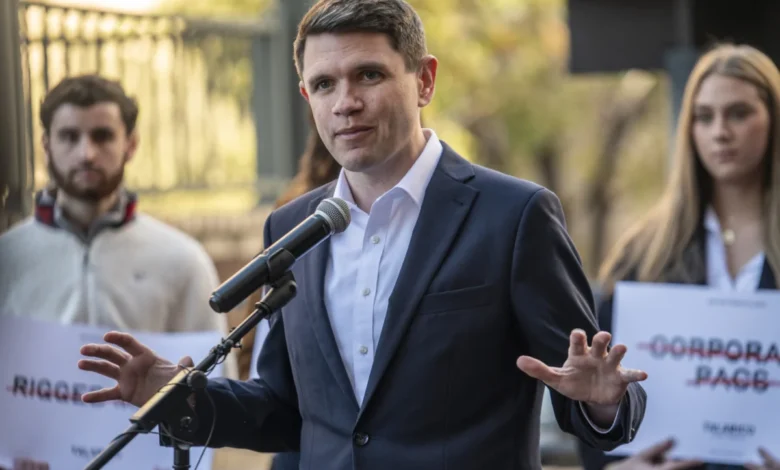
The high-stakes race for the United States Senate in Texas has taken a sharp turn toward the controversial as Democratic challenger James Talarico levels accusations of systemic voter fraud against the incumbent Republican Attorney General Ken Paxton. During a recent campaign swing through Houston, Talarico, currently a state representative, alleged that Paxton—the state’s chief legal officer and a vocal advocate for strict election security—has been violating the very laws he has spent years claiming to defend. The allegations center on reports that Paxton has been voting from a residence where he no longer lives, a practice that legal experts suggest could constitute a felony under Texas law.
The confrontation marks a significant escalation in the contest to replace U.S. Senator John Cornyn, as Talarico attempts to weaponize Paxton’s own political brand against him. For nearly a decade, Paxton has made the pursuit of "voter integrity" a cornerstone of his administration, frequently launching investigations into alleged irregularities in Democratic strongholds like Harris County. Now, Talarico argues that Paxton’s own conduct demonstrates a pattern of "rank hypocrisy" that undermines the office of the Attorney General.
The Core Allegations and Investigative Findings
The catalyst for the current firestorm was an investigative report published by ProPublica and The Texas Tribune, which detailed a discrepancy between Paxton’s voter registration and his actual residency. According to the report, Paxton moved out of the McKinney home he shared with his wife, State Senator Angela Paxton, in early 2024. Despite this relocation, Paxton allegedly continued to cast ballots using that address, most notably during the March 2024 Republican primary.
Under the Texas Election Code, a voter’s "residence" is defined as the place where they inhabit and to which they intend to return after any period of absence. While the law allows for temporary absences—such as for students or military personnel—legal experts noted that Paxton’s ongoing and public marital separation makes the "intent to return" argument difficult to sustain. The investigation revealed that Paxton had voted in six consecutive elections from the McKinney address while reportedly residing elsewhere.
The Collin County Democratic Party has since escalated the matter by filing a formal complaint with the Texas Secretary of State’s office. The complaint urges a full investigation into Paxton’s voting history, citing potential violations of state laws regarding illegal voting. If substantiated, such charges could carry significant legal penalties, including a second-degree felony charge under Texas’s strict election laws—laws that Paxton himself lobbied to strengthen.
A Chronology of the Controversy
The timeline of the current dispute highlights a series of legal maneuvers and political deflections that have characterized the Texas Attorney General’s tenure:
- January 2024: Reports surface regarding a rift in the Paxton household, coinciding with the Attorney General’s move to a different residence.
- March 2024: Paxton casts a ballot in the Republican primary using his McKinney home address.
- Late 2024: An investigative report by ProPublica and The Texas Tribune exposes the residency discrepancy, citing three election law experts who suggest the conduct may be illegal.
- November 2024: The Collin County Democratic Party officially files a complaint with the Secretary of State, requesting a criminal referral.
- December 2024: James Talarico holds a press conference in Houston, accusing Paxton of a "voter fraud witch hunt" while committing the same offense himself.
- December 2024: Outgoing Secretary of State Jane Nelson confirms the complaint is "under review" by staff attorneys just days before her departure from office.
The "Election Integrity" Paradox
To understand the weight of these allegations, one must look at Paxton’s record regarding election law. Since taking office in 2015, Paxton has dedicated millions of dollars in taxpayer funds to his "Election Integrity Unit." Despite this massive investment, critics point out that the unit has largely failed to uncover widespread organized fraud, instead often focusing on technical errors made by individual voters.
Data from the Attorney General’s office shows that between 2015 and 2022, the unit spent over $2 million annually but resulted in very few convictions. Many of the cases pursued by Paxton involved individuals who were confused about their eligibility, such as Crystal Mason, a Tarrant County woman who was sentenced to five years in prison for casting a provisional ballot while on supervised release (a conviction that was later overturned).
Talarico and other critics argue that Paxton’s pursuit of such cases makes his own alleged residency violation particularly egregious. "He has spent years trying to put Texans in jail for honest mistakes at the ballot box," Talarico stated. "Yet he feels he is above the law when it comes to his own registration."
Institutional Silence and Potential Stalling
The response from the Texas state government has been characterized by a notable lack of transparency. When asked about the residency allegations during a press conference intended to tout law enforcement endorsements, Paxton refused to comment. A campaign aide intervened, stating the Attorney General would only address topics related to law enforcement.
The mechanism for investigating such a complaint presents a unique legal challenge. Under Texas law, the Secretary of State must refer suspected criminal election conduct to the Attorney General’s office. This creates an inherent conflict of interest, as Paxton would essentially be tasked with investigating himself. While the law allows for the appointment of a special prosecutor, Paxton’s office has remained silent on whether such a step will be taken.
Jon Taylor, a political science professor at the University of Texas at San Antonio, suggests that the slow pace of the investigation may be intentional. "The silence from the Republican-led state government suggests an effort to slow-walk investigating Paxton," Taylor noted. He added that the refusal to address the allegations directly "smacks of rank hypocrisy" given the administration’s public rhetoric on election security.
Political Context: The 2023 Impeachment and Its Shadow
The current allegations do not exist in a vacuum. They follow a tumultuous period for Paxton, who was impeached by the Texas House of Representatives in 2023 on twenty counts of bribery, unfitness for office, and abuse of public trust. The charges were largely centered on Paxton’s relationship with a real estate developer and donor, Nate Paul.
Although the Texas Senate ultimately voted to acquit Paxton, the trial exposed significant internal rifts within the Texas Republican Party. Cal Jillson, a political science professor at Southern Methodist University, believes the voter fraud allegations reinforce a pre-existing narrative of Paxton "playing fast and loose" with the law.
"There’s been a whole series of legal challenges he’s been able to slip out of, but voters are at least vaguely aware of them," Jillson said. "This latest reporting is just another example of a high-ranking official appearing to ignore the rules that apply to everyone else."
The Talarico Strategy
James Talarico’s decision to center his campaign on Paxton’s legal troubles is a calculated move. Talarico, a former teacher who gained national attention for his role in the 2021 Democratic quorum break to protest restrictive voting laws, is positioning himself as a "law and order" alternative who respects the spirit of the constitution.
In response to Paxton’s attempts to paint him as "soft on crime," Talarico has leaned into his legislative record. He has emphasized his votes in favor of billions of dollars in law enforcement funding and has argued that true public safety requires an Attorney General who is not constantly mired in personal legal scandals. By framing Paxton’s alleged voter fraud as a betrayal of the office’s primary duty, Talarico hopes to appeal to moderate voters and independents who may be weary of Paxton’s polarizing tenure.
Broader Implications for Texas Governance
The outcome of the complaint filed by the Collin County Democrats could have lasting implications for how election laws are enforced in the Lone Star State. If the Secretary of State’s office—now led by Governor Greg Abbott’s appointee Robert Howden—fails to refer the case, it could lead to accusations of partisan protectionism. Conversely, a full investigation could jeopardize Paxton’s political future and his standing within the national Republican Party.
The case also highlights the complexities of residency requirements in an era where high-profile officials often maintain multiple properties. However, for a state that has positioned itself as the national leader in "election integrity," the appearance of a double standard could damage public trust in the democratic process.
As the review by the Secretary of State’s staff attorneys continues, the Texas public remains in a state of uncertainty. Whether Paxton will face a formal investigation or if the allegations will be dismissed as a political maneuver remains to be seen. What is clear, however, is that the 2026 U.S. Senate race has become a referendum not just on policy, but on the personal conduct and legal accountability of one of Texas’s most powerful figures.
The silence from the Attorney General’s office continues to fuel the debate, leaving voters to decide whether the allegations are a "witch hunt," as Paxton supporters claim, or a necessary reckoning for an official who has long lived on the edge of legal propriety. For now, the "Election Integrity" champion finds himself in the crosshairs of the very laws he helped craft, creating a political irony that will likely dominate the Texas headlines for months to come.