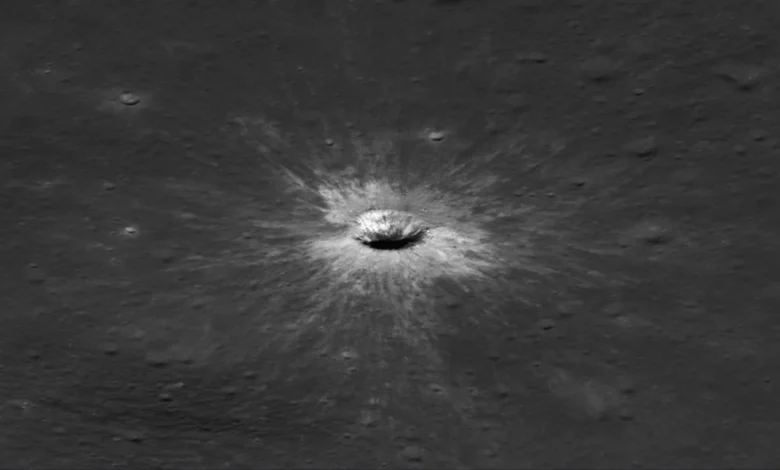
Deep space is far from a tranquil void. Free of an atmosphere to cushion or disintegrate incoming debris, planetary bodies like Earth’s Moon are subjected to a constant, unyielding barrage of space rocks. While the vast majority of these extraterrestrial projectiles are microscopic particles that burn up harmlessly or leave imperceptible pitting, scientists estimate that roughly 140 coffee table-sized asteroids and comets impact the lunar surface every single year. These routine collisions typically generate impact sites roughly 30 feet across, carving temporary scars into the ancient regolith.
However, every century or so, the lunar surface is subjected to a much more violent, catastrophic event. Utilizing advanced imaging technology aboard NASA’s Lunar Reconnaissance Orbiter (LRO), researchers recently identified the largest newly formed crater ever documented in the solar system. Spanning the length of two football fields, this massive geological imprint was carved by an asteroid or comet roughly the size of a three-to-six-story building. The discovery, detailed in a pair of studies published in the journal Science Advances, offers planetary scientists an unprecedented, real-time look at the immediate aftermath of a rare, high-energy cosmic impact.
Discovery and Verification of the McGetchin Crater
The historic find came to light during routine data-quality reviews conducted by mission scientists analyzing imagery captured by the LRO between April 11 and May 22, 2024. Since its initial launch in June 2009, the LRO has been an invaluable asset for lunar science, helping researchers catalog more than 1,000 newly formed craters and upwards of 100,000 distinct surface modifications caused by direct impacts or secondary shrapnel.
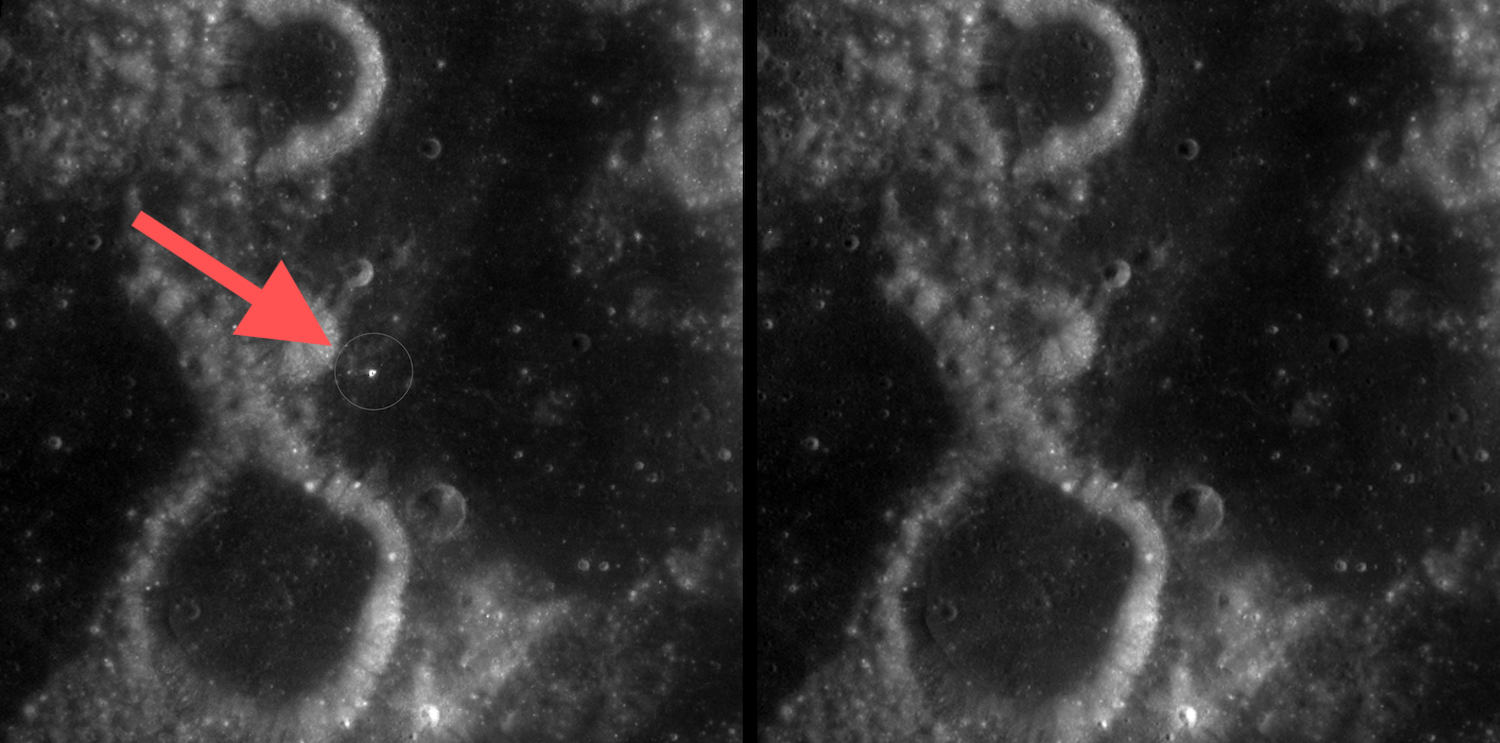
Despite combing through over a decade and a half of high-resolution telemetry, image-processing specialist Robert Wagner encountered something entirely unprecedented on October 24, 2025. While processing wide-angle camera data of the moon’s rugged eastern landscape, Wagner spotted a prominent, brilliant circle enclosed by a distinct dark halo. Recognizing that this formation deviated sharply from standard impact morphologies, Wagner halted his standard workflow to investigate the anomaly.
Confirming a fresh lunar impact is an exacting process that extends far beyond simple side-by-side photographic comparisons. Automated algorithms designed to highlight subtle shifts in lighting and shadows frequently produce hundreds of false positives. To verify the authenticity of the find, Wagner manually examined the region at an individual pixel level, searching for telltale signatures of fine regolith dispersal and secondary ejecta smatterings radiating outward from the central blast zone.
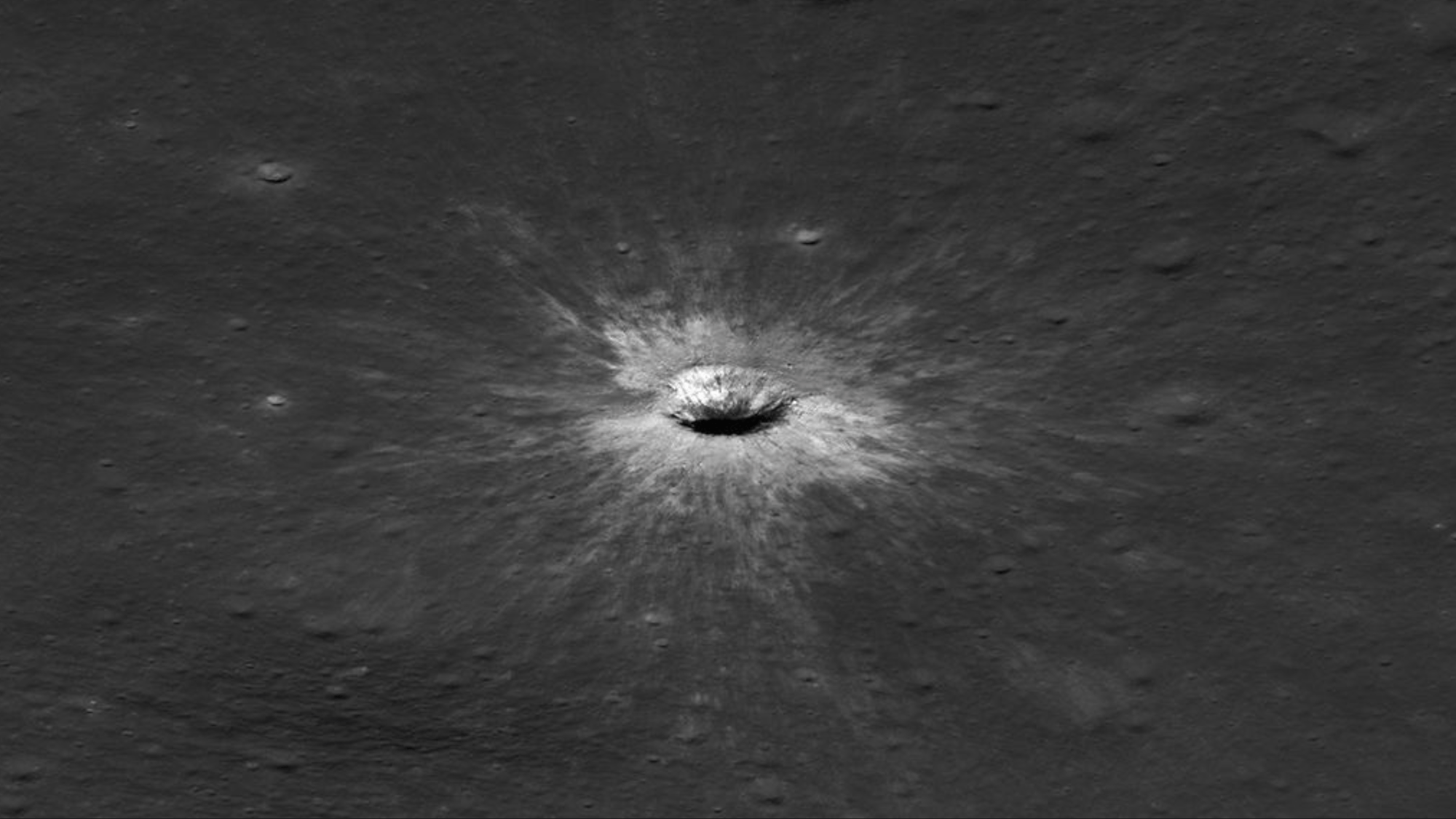
The painstaking analysis confirmed his initial suspicions. The moon had sustained a major strike, and the resulting debris pattern was the most prominent and pristine ever captured by the orbiter’s cameras. The newly identified feature was officially named the McGetchin Crater, in honor of the late, renowned lunar scientist Tom McGetchin.
Chronology of the Impact Event
Pinpointing the exact timeframe of the impact required cross-referencing archival data with the LRO’s extensive observation history. According to the research team’s findings, the cosmic projectile struck the moon’s eastern edge sometime between April 11 and May 22, 2024.
Because the region had been thoroughly photographed during prior orbital passes—most notably in a comprehensive survey conducted in the spring of 2011—scientists were able to establish a definitive "before-and-after" baseline. The stark contrast between the smooth, undisturbed terrain captured in 2011 and the chaotic, high-albedo blast zone recorded in mid-2024 allowed researchers to narrow the impact window to a precise six-week span.
Subsequent scans utilizing the LRO’s Diviner Lunar Radiometer Experiment—a thermal instrument designed to measure surface temperatures—revealed further physical alterations. Thermal data indicated that a four-mile-wide zone surrounding the McGetchin Crater was roughly 16 degrees Fahrenheit cooler during the lunar night than the ambient surrounding terrain. Scientists explain that high-energy impacts thoroughly disrupt and loosen the upper layers of surface regolith, creating a porous, fluffy mantle of pulverized rock and dust that holds significantly less thermal energy than compacted soil.
Dimensions and Scale of the Impact
The scale of the McGetchin Crater places it in an elite category of lunar events. Measurements derived from LRO data indicate that the crater spans an astonishing 728 feet (approximately 222 meters) in width and plunges to a depth of 141 feet (about 43 meters).
To put these dimensions into perspective, the impacting body possessed a mass and velocity capable of carving out a cavity large enough to swallow multiple commercial passenger aircraft. The resulting ejecta blanket—material violently excavated from the lunar crust during the hypervelocity collision—spread across an area tens of miles wide, leaving a stark white footprint against the darker mare basalts and highlands of the moon’s eastern hemisphere.
Researchers are currently utilizing the LRO’s ultra-high-resolution Narrow-Angle Camera, which can resolve surface features down to three feet per pixel, to analyze the internal structure of the crater, wall slumping, and the distribution of melt sheets. These detailed observations will enable dynamic modeling of the impact angle, velocity, and composition of the incoming projectile.
Scientific Implications and Future Research
The documentation of the McGetchin Crater provides astronomers with a vital calibration point for understanding the current impact flux of the inner solar system. For decades, scientists have relied on crater-counting techniques to estimate the relative ages of planetary surfaces on the Moon, Mars, Mercury, and various asteroids. However, calibrating these models depends heavily on accurate estimates of how frequently large objects strike these bodies today.
Observing a once-in-a-century event in real time allows researchers to test and refine models of impact mechanics, crater collapse, and the thermal evolution of ejecta blankets. Furthermore, as international space agencies and commercial entities look toward establishing sustainable, long-term human infrastructure on the lunar surface, understanding the frequency and severity of large impacts transitions from pure academic interest to critical mission safety.
While the probability of a human outpost or robotic asset being directly struck by a three-story asteroid remains statistically low, the expansive reach of high-speed ejecta blankets means that distant impacts can still pose localized hazards to unshielded hardware. The data harvested from the McGetchin Crater will feed directly into risk-assessment models for future Artemis program missions and commercial lunar landers, ensuring that planners can better account for the dynamic, hazardous nature of the lunar environment.
As researchers prepare to publish subsequent phases of their analysis, the McGetchin Crater stands as a dramatic reminder that even the most ancient and static-seeming worlds in our solar system remain vulnerable to the unpredictable violence of cosmic traffic.