Mid-air Cabin Structural Failure Prompts Emergency Landing of Sepehran Airlines Boeing 737 in Iran

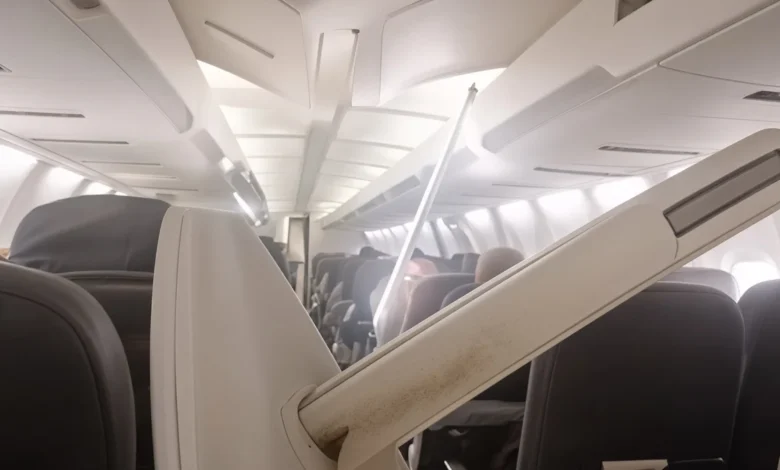
A harrowing incident occurred on Monday aboard a Sepehran Airlines Boeing 737-300 during a domestic flight from Mashhad to Kermanshah, as a significant section of the aircraft’s interior cabin ceiling detached, hanging over passengers mid-flight. The structural failure, which saw cabin panels drop onto seats, forced the flight crew to declare an emergency and execute an immediate return to Mashhad. While reports from local aviation authorities and airline representatives confirm that all passengers and crew disembarked safely with no reported injuries, the incident has reignited urgent concerns regarding the airworthiness of Iran’s aging commercial fleet and the impact of long-standing international sanctions.
Chronology of the Emergency
The flight, identified as a Boeing 737-300 with the registration EP-FSU, departed Mashhad International Airport under routine conditions. According to preliminary incident reports, the sequence of mechanical distress began during the takeoff roll. Observers and local media outlets have indicated that the aircraft suffered a burst tire shortly after leaving the runway. This initial failure appears to have triggered a cascade of secondary mechanical issues, including potential engine damage.
As the aircraft climbed, the intense vibrations and structural stress—likely exacerbated by the tire failure and subsequent engine anomalies—compromised the integrity of the cabin’s overhead interior fittings. Passengers reported seeing large sections of the ceiling panels buckle and collapse into the cabin, dangling above their heads while the cabin lights remained functional. The flight crew responded by declaring an emergency, prioritizing the safety of the occupants over reaching the intended destination of Kermanshah. The aircraft successfully landed back in Mashhad, where the runway used for the emergency landing was subsequently closed for inspection and debris removal.
Aircraft Profile and Maintenance History
The aircraft involved, EP-FSU, is a veteran of the skies, having first entered service in July 1996. Now approximately 30 years old, the Boeing 737-300 represents a generation of aircraft that requires rigorous, consistent maintenance to remain safe for commercial operations.
The incident on Monday is not an isolated event for Sepehran Airlines. Just weeks earlier, on August 25, another Boeing 737 operated by the same carrier experienced a runway excursion at Mashhad Airport. These consecutive incidents suggest systemic operational challenges. When structural interior components fail in the manner witnessed this week, it often points to a combination of high-cycle fatigue and the degradation of attachment points. Severe, sustained vibration—such as that caused by an out-of-balance rotating engine assembly or a violent landing gear failure—can overwhelm the emergency design thresholds of overhead passenger service units (PSUs). While modern 737s are equipped with secondary retention lanyards to prevent panels from falling entirely, such safety features are often absent or outdated on older, legacy models that have not undergone extensive cabin retrofits.
The Impact of International Sanctions
The timing of this emergency has brought renewed attention to the U.S. Treasury’s recent expansion of sanctions against the Iranian aviation sector. On September 8, 2026, the U.S. Treasury Department imposed further restrictive measures on Sepehran Airlines and several other Iranian carriers. The U.S. government maintains that these airlines have been utilized by the Iranian regime to facilitate the transport of illicit cargo, including weaponry and personnel, across the region.

This regulatory tightening has effectively closed the last remaining loopholes for the procurement of Western-manufactured aircraft parts. In 2018, following the U.S. withdrawal from the Joint Comprehensive Plan of Action (JCPOA), the licensing approach for aircraft sales was revoked. While the U.S. Office of Foreign Assets Control (OFAC) previously maintained a narrow pathway for the export of spare parts essential for "safety-of-flight," this route has been systematically dismantled. A policy update issued on September 10, 2026, now adopts a "presumption of denial" for all Iran-related license requests, barring cases of exceptional, life-critical necessity.
Broader Implications for Civil Aviation in Iran
The difficulty of sourcing genuine spare parts has forced Iranian airlines to rely on a complex, often clandestine network of front companies and intermediaries to keep their fleets airborne. Industry analysts have long warned that this approach to fleet maintenance is unsustainable. As early as 2021, officials within the Iranian aviation industry acknowledged that more than half of the country’s civilian fleet was grounded, cannibalized for parts, or otherwise rendered non-operational due to the lack of access to original equipment manufacturer (OEM) support.
The reliance on aging aircraft, combined with the difficulty of conducting comprehensive overhauls without authorized technical data or genuine components, creates an environment of increased risk for the traveling public. While the regime has faced global condemnation for its human rights record, the secondary impact of these geopolitical tensions is being felt by civilian passengers who rely on these flights for domestic travel.
Regulatory and Safety Analysis
The structural failure aboard the Sepehran flight mirrors concerns identified in previous aviation safety directives. In 2016, regulators proposed updates to airworthiness standards for Boeing 737 interior components, specifically focusing on the retention of PSUs. The intent was to ensure that in the event of an emergency, cabin equipment would not become a projectile or an obstruction during an evacuation. While the subject aircraft, a 737-300, is a "classic" model predating many of these later requirements, the incident serves as a stark reminder of the vulnerability of older cabin structures when subjected to abnormal airframe loads.
The incident also raises questions about the "presumption of denial" policy regarding aviation safety parts. Aviation experts suggest that while the geopolitical intent of the sanctions is to curb the regime’s military activities, the current policy creates a "gray zone" where the distinction between military and civilian safety components becomes increasingly difficult to navigate. There is a growing, albeit controversial, argument among some international aviation safety advocates that a tightly controlled, transparent mechanism for supplying strictly civilian safety-related components could be implemented to mitigate the risk of catastrophic hull losses, without undermining the broader strategic objectives of the sanctions regime.
Conclusion and Outlook
As of mid-September 2026, the investigation into the Sepehran Airlines incident remains ongoing. The aircraft is currently grounded in Mashhad pending a full structural and mechanical review. For the passengers who experienced the mid-air failure, the event serves as a harrowing reminder of the fragile state of Iranian civil aviation.
Moving forward, the aviation community will be watching to see if Iranian regulators move to ground similar aging airframes or if the carrier will attempt to return the aircraft to service after localized repairs. With the U.S. government maintaining its strict policy of non-engagement regarding aircraft components, the outlook for Iran’s commercial aviation sector appears increasingly precarious. The challenge for international observers remains balancing the urgent need to prevent the further proliferation of the regime’s military capabilities with the humanitarian concern of ensuring the safety of thousands of civilians who fly daily on a fleet that is rapidly approaching the end of its operational lifecycle. The combination of aging infrastructure, lack of technical support, and the escalating pressure of international sanctions suggests that incidents of this nature may become more frequent, necessitating a difficult re-evaluation of the current approach to global aviation safety and security policy.
Related posts: