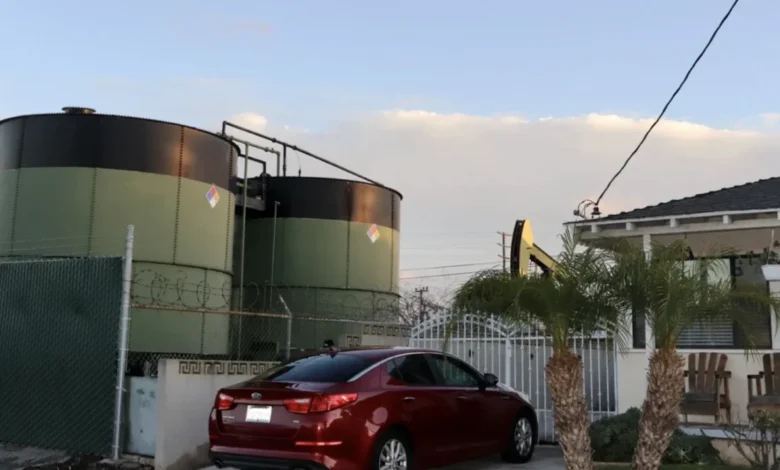
For generations, the residents of Inglewood, Baldwin Hills, and Ladera Heights have lived in the shadow of the Inglewood Oil Field, the largest urban oil drilling site in the United States. For many, the rhythmic thrum of pumpjacks and the pervasive, sulfurous scent of crude have been the defining features of their landscape. However, as medical research increasingly links proximity to these drilling operations with chronic respiratory issues, reproductive health complications, and cancer, the state of California is poised to enact a landmark piece of legislation that moves beyond mere environmental regulation. Assembly Bill 1661, currently awaiting the signature of Governor Gavin Newsom, represents a pioneering effort to provide direct financial restitution to those who have historically borne the externalized costs of fossil fuel extraction.
The legislation mandates that $5 million, collected as penalties from low-producing oil wells within the Inglewood field, be distributed to 1,000 households that have suffered documented health impacts. By characterizing these payments as environmental reparations, California lawmakers are elevating the conversation from simple pollution mitigation to a broader framework of restorative justice for Black and low-income communities that have faced systemic environmental racism.
A Legacy of Extraction and Inequality
The history of urban oil drilling in Los Angeles is deeply intertwined with the history of redlining and segregation. Throughout the 20th century, as residential patterns were solidified by discriminatory housing policies, industrial infrastructure—including refineries, pipelines, and drilling sites—was disproportionately sited in neighborhoods home to Black and Latino families.
Regina Martin’s experience is emblematic of this history. Growing up in the 1950s and 60s, she perceived the constant odor of the oil fields not as an anomaly, but as a standard condition of life. It was only in adulthood, as she grappled with her own health challenges and witnessed her sister’s struggle with asthma, that the correlation between her environment and her physical well-being became undeniable. This narrative is backed by mounting scientific evidence. Proximity to drilling sites is frequently associated with elevated levels of particulate matter (PM2.5), volatile organic compounds (VOCs) such as benzene, and hydrogen sulfide—a cocktail of pollutants known to exacerbate cardiovascular and respiratory diseases.
Chronology of the Legislative Push
The path to AB 1661 did not occur in a vacuum; it is the culmination of years of grassroots organizing and legislative maneuvering.
- 2020–2022: Community groups, including Black Women for Wellness and various environmental justice coalitions, intensified their advocacy, highlighting the intersection of health outcomes and oil infrastructure.
- 2024: Governor Newsom signed Assembly Bill 2716, introduced by Assemblymember Isaac G. Bryan. This foundational law mandated the closure of the Inglewood Oil Field by 2030 and established a punitive fee structure for low-producing wells, which are notorious for leaking methane and other harmful gases.
- September 2026: The California legislature passed AB 1661, directing the revenue generated from those penalties—set at $10,000 per well, per month—into a dedicated community repair and reinvestment fund.
- October 2026 (Expected): Governor Newsom is expected to sign the bill into law, effectively activating the disbursement mechanism for the $5 million aid package.
The Mechanism of Restitution
The $5 million fund is structured to provide payments of up to $5,000 for each of the 1,000 qualifying households. Crucially, the state has also moved to protect these payments from taxation, ensuring that the full amount of the intended relief reaches the families who need it most.
The logistical challenge now lies with Los Angeles County, which is tasked with designing the distribution process. Assemblymember Isaac G. Bryan, who represents the affected area and serves as the chair of the Assembly’s Natural Resources Committee, has emphasized the need for a streamlined approach. The goal is to avoid the administrative hurdles that often exclude the most vulnerable populations from accessing government support. Activists are strongly advocating for a "self-attestation" model, arguing that requiring complex, expensive medical documentation would perpetuate the very inequities the bill seeks to resolve.
Official Responses and Political Stakes
Assemblymember Bryan has been a vocal proponent of the bill, framing it as a necessary correction to decades of corporate negligence. "The company has essentially just been extracting from the community with no investments in the community, no care in the community, and what feels like no regard at times for the broader community," Bryan stated. He views this as a pilot program that could establish a template for other municipalities to hold industrial actors accountable for the long-term impacts of their operations.
The support for the bill is broad, with three dozen community organizations rallying behind the measure. There has been a notable absence of formal, public opposition from industry groups, perhaps reflecting the changing political landscape regarding the liability of fossil fuel companies in the face of climate change and public health demands.
Broader Implications: Beyond the Inglewood Field
The implications of AB 1661 extend far beyond the borders of Inglewood. As the state moves toward a greener energy transition, the question of what to do with the "leftovers" of the oil era—the abandoned wells, the contaminated soil, and the long-term health burdens of the residents—has become a central pillar of environmental policy.
Critics and advocates alike point out that $5 million and 1,000 households, while significant, are only a fraction of the total need. Tens of thousands of residents live in the vicinity of the Inglewood field, many of whom have endured similar health impacts. Furthermore, there is a persistent concern regarding the economic transition of these neighborhoods. As oil wells are plugged and land is remediated, the threat of green-gentrification—where rising property values and rents displace the very residents who suffered from the pollution—remains a major point of contention.
Tianna Shaw-Wakeman, the environmental justice program director with Black Women for Wellness, has been a leading voice in ensuring that this legislation remains focused on the people rather than just the land. "We can’t replace toxic oil extraction with gentrification," she warned, emphasizing that while the $5 million is a vital start, the state must remain committed to long-term community health and economic security.
A Model for National Policy?
As other states watch California’s experiment, the debate is shifting from "whether" to compensate for industrial harm to "how" to do it effectively. The California model suggests that the solution may lie in redirecting industry-paid penalties directly to the impacted population, rather than absorbing them into the state’s general fund.
By labeling these payments as "environmental reparations," California is acknowledging that the damage caused by industrial pollution is not just physical or environmental, but also economic. For families who have spent decades paying for medical treatments, losing property value, and dealing with the intergenerational trauma of chronic illness, this law is a tacit admission that the state failed to protect them—and is now taking the first step toward making amends.
As the program moves toward implementation, its success will be measured by its reach. If the county can successfully implement an equitable, non-burdensome application process, AB 1661 could serve as the bedrock for a new era of environmental law in the United States, proving that policy can indeed bridge the gap between historic harm and restorative justice.
Related posts: