Los Angeles Chargers Hit Rock Bottom at 0-8 Following Blowout Loss to Texans Amid Mounting Trade Deadline Pressure

The Los Angeles Chargers’ disastrous 2026 NFL campaign reached a dismal new milestone on Sunday afternoon, plunging the franchise into an unrecoverable 0-8 hole following a decisive 44-22 defeat at the hands of the Houston Texans at SoFi Stadium. As the calendar turns toward the mid-point of November, the once-promising franchise finds itself searching not only for its first victory of the season but also for an identity amidst mounting fan outrage, questionable coaching decisions, and an unyielding front-office strategy regarding the upcoming trade deadline.
Sunday’s contest in Inglewood, California, served as a microcosm of everything that has gone wrong for the Chargers this year. Despite flashes of individual talent and desperate schematic adjustments, the team was thoroughly outmatched by a surging Texans squad. Franchise quarterback Justin Herbert was under constant duress from Houston’s ferocious pass rush, led by defensive end Will Anderson Jr., before ultimately being pulled in garbage time after mounting just 15 points through the first three quarters.
A Chronology of Collapse: How the Chargers Reached 0-8
The roots of the Chargers’ current 2026 freefall can be traced back to a tumultuous offseason, but the regular-season unraveling has been swift and unforgiving. Hopes were high in Southern California entering September, with many analysts projecting the team to contend for an AFC playoff spot under head coach Jim Harbaugh. Instead, the team has stumbled at every conceivable turn.

Through the first month of the season, offensive inconsistencies plagued the unit, leading to stagnant possessions and a glaring lack of explosive plays. By Week 5, during a tightly contested matchup against the Denver Broncos, the offense began a historic and humiliating drought. Entering Sunday’s game against Houston, the Chargers had gone an astounding 37 consecutive offensive drives without scoring a single touchdown—a drought that stretched across more than a month of professional football and exposed deep-seated flaws in play-calling and execution.
That agonizing streak finally came to an end in the second half against the Texans when Justin Herbert connected with wide receiver Quentin Johnston on a deep 58-yard catch-and-run touchdown. While the play momentarily electrified the home crowd and trimmed Houston’s commanding lead, it proved to be a mere drop in the bucket. The defensive secondary, missing key contributors and completely overwhelmed by the Texans’ multi-dimensional attack, surrendered 44 points—the highest total allowed by the Chargers defense this season.
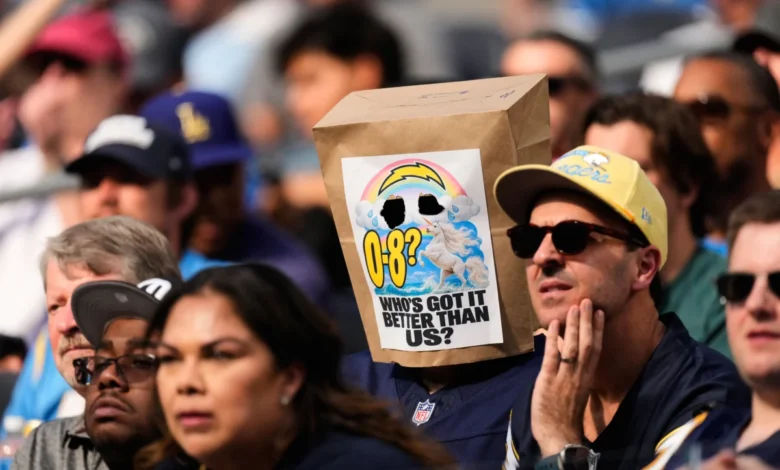
Frustration inside SoFi Stadium reached a boiling point during the first half. One disgruntled fan captured the zeitgeist of the fanbase by sitting in the stands wearing a brown paper bag over their head with eyeholes cut out. Attached to the bag was a hand-drawn sign reading, "0-8? Who’s got it better than us?" positioned above a satirical sketch of a unicorn and a rainbow. The striking image quickly circulated across national sports broadcasts and social media platforms, symbolizing the utter despair permeating the Chargers’ faithful fanbase.
Coaching Turmoil and Stubborn Front-Office Stance
In a desperate bid to jumpstart the stagnant offense prior to Sunday’s kickoff, the coaching staff implemented a drastic measure, moving offensive coordinator Mike McDaniel up to the coaches’ booth. The tactical shift, designed to give the play-caller a clearer panoramic view of opposing defensive coverages, yielded virtually zero tangible benefits. The offense remained disjoined, predictable, and heavily reliant on Herbert’s scrambling ability to avoid total disaster. Head coach Jim Harbaugh stood stone-faced on the sideline throughout much of the second half, watching helplessly as the game slipped out of reach.

Despite the on-field catastrophe, the Chargers’ front office has maintained a fiercely rigid stance regarding the roster composition as the NFL trade deadline looms on Tuesday, Nov. 10, at 4 p.m. ET. Across the league, rival general managers have reportedly inquired about the availability of several high-profile players, including franchise quarterback Justin Herbert, perennial Pro Bowl edge rusher Khalil Mack, and dynamic young wide receiver Ladd McConkey.
Thus far, the Chargers’ leadership has rebuffed all incoming inquiries. Rather than pivoting toward a traditional fire-sale and accumulating valuable future draft capital for a complete roster rebuild, the front office has doubled down on its current personnel. This stubborn refusal to recalibrate has drawn heavy criticism from analysts and pundits alike, who view the strategy as short-sighted given the team’s insurmountable deficit in the AFC West standings.
Financial, Strategic, and Roster Implications
As the clock ticks down to the trade deadline, the organization faces critical decisions that will shape the trajectory of the franchise for years to come. Holding onto high-salary veterans like Khalil Mack while sitting at 0-8 ties up significant salary cap flexibility that could otherwise be deployed toward acquiring youthful assets or clearing financial space for future free agency windows.
Conversely, trading a cornerstone player of Justin Herbert’s caliber remains a highly polarizing proposition. While the return package in terms of draft picks would be historic—likely featuring multiple first-round selections—moving away from a franchise quarterback under a long-term contract signals a total surrender that few modern NFL front offices are willing to execute mid-season. Nevertheless, the relentless losing environment raises legitimate questions regarding player morale, locker room culture, and whether the current leadership group can retain the trust of its cornerstone athletes moving forward.

For Harbaugh and his staff, the immediate future offers little margin for error, even if the postseason is mathematically out of reach. The pressure to secure at least one victory to salvage professional pride has become paramount. With games remaining against increasingly difficult conference opponents, avoiding a winless 0-17 campaign is now the primary objective for a franchise that entered the autumn with championship aspirations.
As the team prepares for a short week of practice ahead of their next matchup, the overarching narrative in Los Angeles remains bleak. The combination of an ineffective offense, a porous defense, and an inflexible front-office philosophy has created a pressure cooker environment in Hollywood. Unless management dramatically shifts its strategy before Tuesday’s trade deadline or the coaching staff pulls off a miraculous turnaround on the gridiron, the 2026 season will be remembered as one of the most turbulent and disappointing chapters in modern Chargers history.