Life, Larry and the Pursuit of Unhappiness: A Star-Studded Journey Through American History

Larry David, the acclaimed creator and star of the beloved sitcom Curb Your Enthusiasm, has returned to HBO Max with a new sketch comedy series, Life, Larry and the Pursuit of Unhappiness. This ambitious project delves into pivotal moments of American history, reimagined through David’s signature observational humor and populated by an astonishing ensemble of Hollywood’s brightest stars. The show, executive produced by former President Barack Obama and Michelle Obama’s Higher Ground Productions, marks a significant departure from David’s previous work, offering a comedic yet insightful exploration of the nation’s past.
The series premiered following the conclusion of Curb Your Enthusiasm, a show that defined comedic awkwardness for over two decades. Life, Larry and the Pursuit of Unhappiness takes a more expansive approach, weaving David’s comedic persona into meticulously recreated historical settings. The concept of the show is to place David, often embodying a character tangential to the main historical event, into the thick of significant American narratives, allowing his inherent discomfort and unique perspective to drive the humor. This approach, combined with an unprecedented roster of guest stars, positions the series as a unique cultural commentary.
A Pantheon of Stars Embark on a Historical Comedy Tour
The guest list for Life, Larry and the Pursuit of Unhappiness reads like a who’s who of contemporary entertainment. Beyond the executive producers, a staggering number of acclaimed actors, comedians, and cultural figures have donned historical attire to inhabit figures from America’s past. This star power is not merely for fleeting cameos; each episode features over a dozen celebrity guests, contributing significantly to the narrative fabric of each sketch.
Notable among the cast are several of David’s Curb Your Enthusiasm co-stars, bringing a familiar comedic chemistry to the new format. The series also marks the final screen performance of the late Rob Reiner, a poignant addition to an already impressive lineup. Major Hollywood figures such as Samuel L. Jackson, Lin-Manuel Miranda, Jerry Seinfeld, Jon Hamm, and Kathryn Hahn are among those who have lent their talents to the project. The sheer volume of recognizable faces underscores the ambitious scope of the series and its ability to attract top-tier talent.
Episode-by-Episode Breakdown: A Closer Look at Historical Satire
Life, Larry and the Pursuit of Unhappiness airs new episodes on Friday nights at 9 p.m. on HBO and is available for streaming on HBO Max. The series is structured to explore different historical periods and events, with each episode offering a distinct thematic focus.
Episode 1: “Livingston” – The Founding Fathers and Civil Rights Icons
The inaugural episode sets a high bar, opening with a charming appearance by former President Barack Obama, an executive producer through his Higher Ground Productions. Obama, addressing the nation as it approaches its semiquincentennial, offers a humorous critique of David’s comedic style, playfully positioning himself as a foil to the notoriously curmudgeonly comedian. The episode then transitions to narration by Samuel L. Jackson, whose distinctive voice provides a gravitas that contrasts with the comedic scenarios that follow.
The first sketch features Henry Winkler as John Hancock, Chris Parnell as Benjamin Franklin, and Alan Tudyk as Thomas Jefferson. They are depicted as the architects of the Declaration of Independence, humorously rejecting Robert Livingston’s (portrayed by David) attempts to insert his own grievances into the document. This segment effectively establishes the show’s premise: taking revered historical figures and placing them in relatable, often petty, conflicts.
David then appears as Alexander Graham Bell, struggling to introduce the telephone to a crowd that is already demanding features like text messaging and a variety of color options, highlighting a timeless human desire for instant gratification and technological advancement. This sketch features supporting roles from sitcom veterans Alison Becker, Mary Sohn, and Rodney J. Hobbs, adding layers of contemporary comedic sensibility to a historical setting.
The WWI trench warfare sketch sees David as a cowardly soldier under the command of Michael Chiklis’s sergeant. His fellow soldiers are played by Mike Castle and Jake Reiner, the son of the late Rob Reiner, whose own appearance in the series is a significant draw. The episode concludes with David as an irritating bus passenger encountering Jurnee Smollett as Rosa Parks, a casting choice that brings a powerful resonance to the historical figure and a stark contrast to David’s character.
Episode 2: “Farewell” – Explorers, Elections, and the Great Depression
The second episode reunites Larry David with Jerry Seinfeld, the co-creator of their iconic 90s sitcom. As explorers Lewis and Clark, the duo’s dynamic instantly recalls their legendary on-screen chemistry. The sketch humorously portrays their expedition as a convenient, years-long "drinking buddy" adventure, with Rita Wilson appearing as Meriwether Lewis’s long-suffering wife, Mavis, offering a grounded perspective on their ambitious undertaking.
David then satirizes the Electoral College by portraying Samuel Tilden, the candidate who won the popular vote in the 1876 presidential election but lost due to electoral college results. His aides, played by Curb alum Matthew Jones and Rich Fulcher, are depicted as exasperated by his rants.
A segment set during the Great Depression introduces Larry Wilmore and Colton Dunn. The standout moment of this sketch is Kaley Cuoco as a grieving widow, whose emotional state David attempts to exploit to gain preferential treatment for his soup. This scenario exemplifies David’s talent for finding humor in deeply uncomfortable social interactions.
The episode culminates in the much-anticipated final screen performance of Rob Reiner, who portrays George Washington discussing presidential term limits. This segment subtly critiques contemporary political discourse, with David’s character delivering veiled jabs at then-President Trump, further amplified by Jimmy Kimmel’s meta-commentary on his own public feuds.
Episode 3: “McCarthy” – Revolution, Innovation, and Red Scare Politics
Episode three opens with David involved in the Boston Tea Party, satirizing his typical role as an outsider caught in historical events. Lin-Manuel Miranda, leveraging his Hamilton pedigree, delivers a standout performance as a ringleader of the protest, while comedian Lou DiMaggio adds to the comedic interplay.
J.B. Smoove brings his distinctive comedic energy to a segment involving the Underground Railroad, where his character’s demands and the arrival of his entourage create humorous friction. The episode then shifts to the early days of aviation, with Jon Hamm and Sean Hayes portraying the Wright brothers, Orville and Wilbur, respectively. David, meanwhile, plays a less accomplished Wright sibling, squabbling with his wife over his butter-churning skills, a domestic squabble juxtaposed against groundbreaking technological achievement.
The most talked-about segment of the episode features David as Senator Joseph McCarthy, tackling the era of the Red Scare. Michael McKean, known for his roles in Better Call Saul and Saturday Night Live, delivers a powerful rendition of attorney Joseph Welch’s iconic “Have you no decency, sir?” rebuttal. Rob Huebel also appears as a senator moderating one of McCarthy’s infamous hearings, adding to the tense, yet darkly humorous, atmosphere.
Episode 4: “Deepthroat” – Watergate, Industry, and Vaccines
The fourth episode tackles the Watergate scandal through David’s lens. He portrays "Deep Throat," the anonymous informant, but instead of providing crucial information, his character offers trivial nonsense to Washington Post reporters, played by Beck Bennett. This sketch lampoons the gravity often associated with such historical moments, replacing it with mundane absurdity.
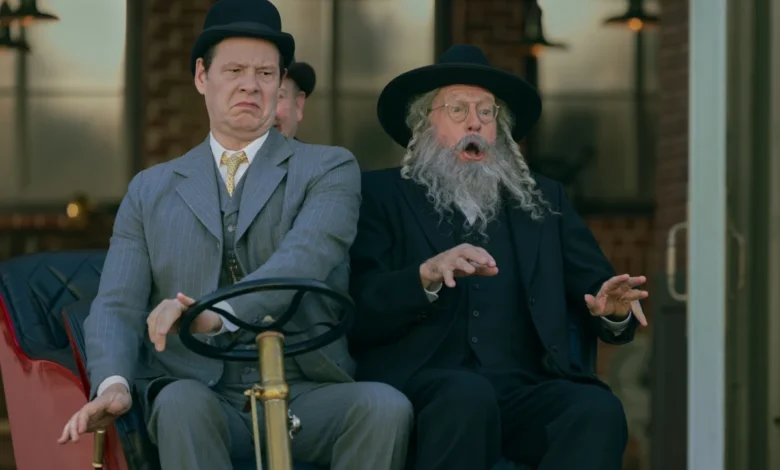
Next, Ike Barinholtz plays Henry Ford, a figure notorious for his antisemitic views. David’s character, a rabbi, engages in an awkward exchange with Ford, highlighting the societal prejudices of the era through a comedic lens. The episode then features David as President James Buchanan, navigating a party where he is introduced to the concept of passed appetizers, a scenario that allows for uncomfortable social interactions with characters played by Jordana Brewster and Katie Aselton. Diallo Riddle appears as Buchanan’s assistant.
The episode’s climax is a parody of the Jonas Salk polio vaccine controversy. David plays Dora Salk, an overly proud mother boasting about her son’s discovery. The sketch takes a sharp turn by mocking criticisms of vaccines, drawing a parallel to contemporary debates, and humorously referencing HHS Secretary Robert F. Kennedy Jr., the husband of David’s former Curb co-star Cheryl Hines. The segment culminates with a young man named Bobby predicting dire consequences from the vaccine, a clear nod to the politicization of public health.
Episode 5: “Lincoln” – The Wild West and Presidential Theater
The fifth installment of Life, Larry and the Pursuit of Unhappiness focuses on two significant historical moments. The first segment transports viewers to the O.K. Corral, featuring Timothy Olyphant as Wyatt Earp and Don Johnson as Doc Holliday. David’s character injects his signature brand of logistical complaining into the planning of the legendary shootout, with Marc Menchaca, Johnno Wilson, and Maximo Salas rounding out the cowboy cast.
The episode then delves into the strained relationship between Abraham Lincoln and his wife, Mary Todd Lincoln, a theme recently explored on Broadway. Bill Hader portrays a beleaguered Lincoln, who, in the sketch, conspires with his chief of staff, Lawrence Butterfield, to have Mary removed from Ford’s Theatre during a performance of Our American Cousin. Kathryn Hahn plays Mary Todd Lincoln, and Lennon Parham portrays Laura Keene, the actress in the play. The sketch descends into a comedic "telephone game" of miscommunication and domestic disputes, with a stolen sweater incident reminiscent of Curb Your Enthusiasm‘s plotlines. Seth Morris appears as Andrew Johnson, Lincoln’s successor.
Broader Impact and Implications
Life, Larry and the Pursuit of Unhappiness arrives at a time when historical narratives are frequently debated and re-examined. By infusing these pivotal moments with Larry David’s unique brand of humor, the series offers a fresh perspective on American history, encouraging viewers to engage with the past in a new and entertaining way. The show’s ability to attract such a high caliber of talent, including former President Obama as an executive producer, speaks to the cultural significance of both Larry David’s comedic voice and the historical subjects being explored.
The series’ implications extend beyond mere entertainment. By satirizing historical figures and events, Life, Larry and the Pursuit of Unhappiness can prompt conversations about the complexities of the past, the evolution of societal norms, and the enduring human traits that transcend time. The show’s success hinges on its ability to balance historical accuracy with comedic absurdity, offering a reflective, albeit humorous, look at the nation’s journey. As new episodes continue to roll out, the series is poised to become a significant cultural touchstone, blending comedy, history, and a star-studded cast into an unforgettable viewing experience. The ongoing updates to this story, as new episodes release, ensure that audiences remain informed about the full scope of this ambitious comedic endeavor.
Related posts: