Wildfires Force Shutdown of NASA’s Deep Space Network Madrid Complex, Severely Curtailing Global Space Communication Capabilities

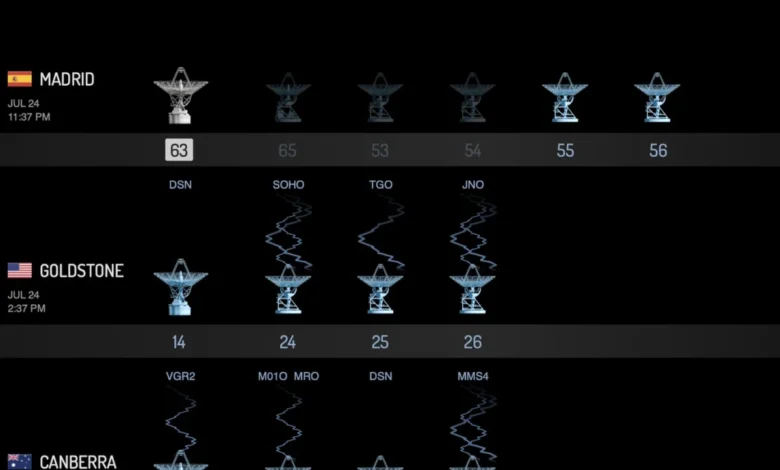
The crucial Madrid Deep Space Communications Complex (MDSCC), a vital component of NASA’s global Deep Space Network (DSN), ceased operations on Friday, July 24, 2026, due to encroaching wildfires in the central Spanish region. This unexpected shutdown leaves the DSN with only one fully operational 70-meter radio antenna worldwide, significantly impacting the agency’s ability to maintain constant contact with its fleet of deep space missions exploring the solar system and beyond. The closure was mandated to ensure the safety of personnel amidst a rapidly escalating environmental crisis that has triggered widespread evacuations and emergency responses across the region.
The Deep Space Network: NASA’s Ears and Voice in the Cosmos
The Deep Space Network is a global array of massive radio antennas managed by NASA’s Jet Propulsion Laboratory (JPL). It serves as the primary communication link for all of NASA’s interplanetary spacecraft, as well as several international missions. Established in the early days of space exploration, the DSN is critical for sending commands to spacecraft, receiving telemetry data about their health and status, and, most importantly, downlinking the invaluable scientific data that fuels humanity’s understanding of the universe. Without the DSN, missions like the Voyager probes, the Mars rovers, the Juno orbiter at Jupiter, and countless others would be effectively blind and deaf, unable to relay their discoveries or receive crucial instructions from Earth.
The network is strategically designed with three primary complexes, each positioned approximately 120 degrees apart in longitude around the globe: Goldstone, California (USA); Madrid, Spain; and Canberra, Australia. This geographical separation ensures that as the Earth rotates, at least one DSN complex always has a line of sight to deep space missions, providing continuous communication coverage. Each complex houses multiple antennas of varying sizes, including the iconic 70-meter (230-foot) diameter dishes, which are the most powerful and sensitive, essential for communicating with distant spacecraft that transmit faint signals over billions of miles. Smaller 34-meter antennas support missions closer to Earth or those with less demanding data rates.
Madrid Complex Silenced by Advancing Blazes
On Friday afternoon, status updates on a NASA website dedicated to DSN operations indicated a complete lack of activity at the Madrid complex, located near Robledo de Chavela, approximately 60 kilometers (37 miles) west of the Spanish capital. In stark contrast, antennas at the Goldstone complex in California and the Canberra complex in Australia were actively engaged, communicating with a diverse range of spacecraft. These included the venerable Voyager 2, traversing interstellar space, and the Juno mission, diligently studying Jupiter’s enigmatic atmosphere and magnetic field. The sudden silence from Madrid underscored the severity of the situation on the ground.
A statement from NASA confirmed the rationale behind the shutdown: "The safety and well-being of our personnel is our highest priority, and our thoughts are with the families and neighbors who are also experiencing the impact of the wildfires in the surrounding communities. We will provide updates as conditions evolve." This statement highlights the immediate human impact of the crisis, emphasizing that the decision was a direct response to a threat to life and property, rather than a technical malfunction. The MDSCC, operational since the 1960s, has been instrumental in numerous historic missions, including the Apollo moon landings and tracking probes to the outer solar system, making its operational pause a rare and significant event.
Regional Wildfire Crisis Escalates
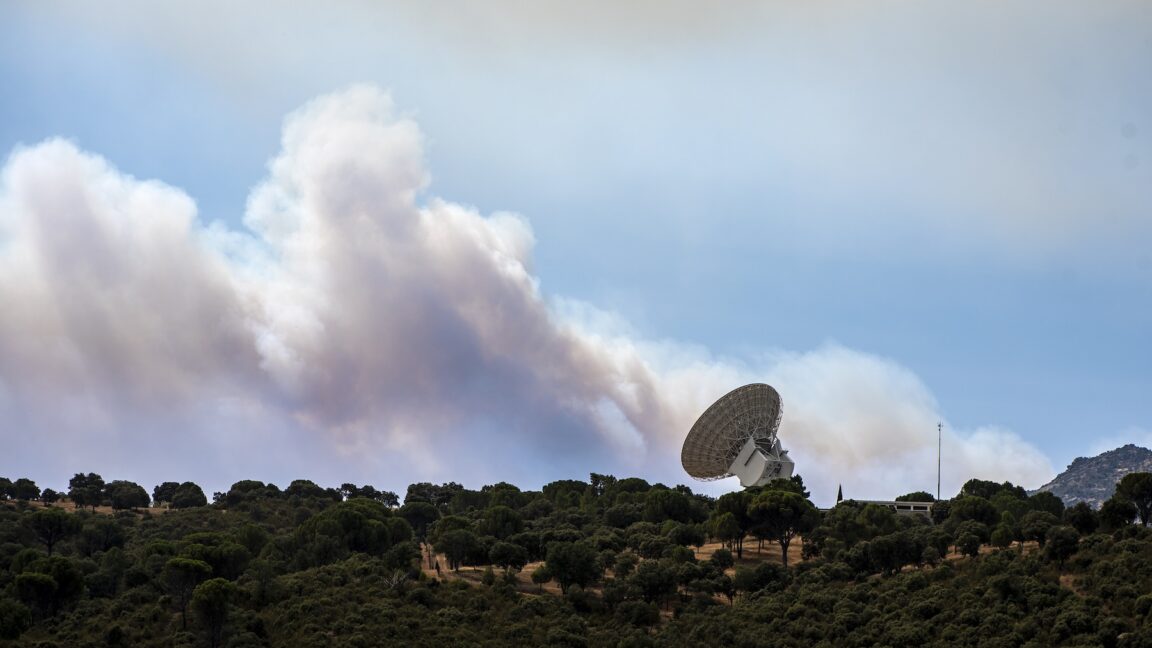
The wildfires forcing the closure of the Madrid DSN complex are part of a broader, devastating conflagration sweeping across central Spain. According to reports from Reuters and Spanish news outlets, authorities declared a state of emergency as the fires intensified throughout Friday, July 24, 2026. The blazes, fueled by a punishing summer heatwave and chronic drought conditions, have prompted the evacuation of more than 19,000 people from towns nestled in the mountains west of Madrid. The affected area encompasses a significant rural landscape, with several communities facing immediate threats.
The response to the crisis has been monumental, with Spanish authorities deploying over 2,000 firefighting personnel, supported by a fleet of 10 aircraft, including water-bombing planes and helicopters. The scale of the deployment underscores the ferocity and rapid spread of the fires, which have been exacerbated by high temperatures consistently exceeding 40 degrees Celsius (104 degrees Fahrenheit) and strong, erratic winds. These conditions have created a highly volatile environment, making containment exceedingly difficult and putting infrastructure, including critical scientific facilities, at risk.
The impact extends beyond NASA’s facility. A separate deep space tracking station, the Cebreros tracking station, owned and operated jointly by the Spanish government and the European Space Agency (ESA), was also evacuated due to its proximity to the fires. Located just a few miles from NASA’s DSN facility, Cebreros is a key component of ESA’s Estrack network, providing crucial communication links for European space missions such as Mars Express and BepiColombo. The simultaneous shutdown of two major deep space communication hubs in the same region amplifies the concern within the global space community regarding the resilience of vital ground infrastructure in the face of escalating climate-related disasters.
A Critical Reduction in DSN Capacity: The Goldstone Incident
The shutdown of the Madrid complex comes at an already precarious time for the Deep Space Network. Prior to this event, the DSN had already been operating under reduced capacity due to a severe incident at its Goldstone complex in California. The 70-meter antenna at Goldstone, known as Deep Space Station 14 (DSS-14) or "Mars," has been offline since last year following an accident. During routine operations, the massive antenna experienced an "over-rotation" incident. This refers to a mechanical failure where the antenna rotated beyond its designed limits, causing significant structural and operational damage.
The over-rotation led to the severing and entanglement of critical cables and water lines essential for the antenna’s operation. This damage resulted in a substantial leak, flooding the base of the antenna with approximately 200,000 gallons of water mixed with glycol. Glycol, a chemical compound often used as an antifreeze or coolant, presented not only an operational challenge but also an environmental hazard, necessitating a complex and costly cleanup operation. The repair work for DSS-14 is projected to cost between $4.1 million and $4.6 million. NASA officials have opted to combine these essential repairs with previously planned upgrades to the antenna’s systems, aiming to enhance its longevity and performance. However, this integrated approach means the Goldstone 70-meter antenna is not expected to return to full operational status until sometime in 2028.
With both the Madrid 70-meter antenna now offline due to wildfires and the Goldstone 70-meter antenna out of commission for repairs, the Deep Space Network is currently reliant on a single operational 70-meter antenna: DSS-43 at the Canberra Deep Space Communication Complex in Australia. This situation represents an unprecedented vulnerability for NASA’s deep space communications. While the DSN has multiple smaller 34-meter antennas at each complex, these have limitations in terms of signal strength and data rate, especially for the most distant missions like the Voyagers or for high-volume data downlinks. The loss of redundancy in the primary 70-meter capability significantly increases the risk of communication disruptions for critical missions.
Implications for Current Missions and Future Endeavors
The immediate consequence of the reduced DSN capacity is the need for rigorous prioritization and meticulous scheduling of communication windows. Missions currently supported by the DSN, such as the Mars Perseverance rover, the Parker Solar Probe, and numerous others, will have to share access to the remaining operational antennas, particularly the sole 70-meter dish in Canberra. This could lead to reduced data downlink opportunities, potential delays in receiving critical scientific information, or even limitations on sending command sequences. Mission controllers will be working tirelessly to optimize the available resources, potentially extending communication times or re-scheduling mission activities to align with Canberra’s visibility windows.
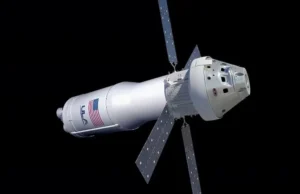
While the situation is undoubtedly challenging, there is a silver lining, particularly concerning NASA’s ambitious Artemis program. The Artemis missions, designed to return humans to the Moon and establish a sustained lunar presence, place exceptionally high demands on the DSN. These missions require continuous, high-bandwidth communication for telemetry, command uplinks, and massive imagery downlinks to support human spaceflight operations, where even momentary communication blackouts can have severe consequences.
Fortunately, the next crewed Artemis missions are still several years away. Artemis III, which was originally planned as a lunar landing, has been re-scoped to fly in low-Earth orbit (LEO) to test the Orion capsule with commercial Moon landers from SpaceX and Blue Origin. This mission is now focused on in-space validation of critical hardware and procedures. The first planned lunar landing with astronauts, Artemis IV, is currently targeted for no earlier than 2028. This timeline provides a crucial window for the Goldstone 70-meter antenna to complete its repairs and, hopefully, for the Madrid complex to resume operations once the wildfire threat subsides and any potential damage is assessed and mitigated.
However, any further delays in the Goldstone repairs, or prolonged outages at Madrid, could pose significant challenges to the Artemis schedule. The DSN’s robust and redundant infrastructure is a cornerstone of NASA’s long-term space exploration strategy, and ensuring its full operational capability is paramount for future lunar and Martian endeavors.
Addressing Resilience in a Changing Climate
The dual blows to the DSN — a major mechanical failure compounded by an environmental disaster — highlight the increasing vulnerability of critical ground infrastructure to both technical complexities and the impacts of a changing climate. The intense heatwaves and persistent drought conditions plaguing Spain and other parts of Southern Europe are increasingly linked to global climate change, making wildfires more frequent, widespread, and severe. This incident serves as a stark reminder for space agencies worldwide to assess and enhance the resilience of their ground networks against such natural phenomena.
In the long term, NASA and its international partners will likely continue to invest in upgrades and modernization efforts for the DSN, not only to improve its technical capabilities but also to bolster its resilience. This could include exploring alternative communication technologies, enhancing fire suppression systems at ground stations in high-risk areas, or developing more robust contingency plans for prolonged outages. The intricate dance between humanity’s reach into the cosmos and the terrestrial challenges posed by a dynamic planet underscores the interconnectedness of our endeavors, reminding us that even the most advanced space exploration relies fundamentally on the stability and security of our home world. As the fires in Spain continue to rage, the global space community watches closely, hoping for the swift and safe return of the Madrid Deep Space Communications Complex to its vital role in humanity’s cosmic dialogue.