The Promise and Peril of Prior Authorization Reform: A Year of Stalled Progress for Patients


One year after the Trump administration heralded a six-part pledge by major health insurers to streamline prior authorization, a critical but often frustrating process for accessing medical care, a growing chorus of patients, physicians, and advocates claims little has fundamentally improved. While the insurance industry points to reductions in prior authorization requests, critics argue these figures obscure a reality where patients continue to face significant barriers and delays in receiving recommended treatments. The voluntary nature of the pledge, coupled with a lack of robust enforcement mechanisms, has led many to question its efficacy and express deep-seated skepticism about the industry’s commitment to meaningful change.
The initiative, announced in June 2023, aimed to address widespread dissatisfaction with prior authorization, a requirement where insurers must approve a patient’s medical service or prescription before it is rendered. This process, intended to control costs and prevent unnecessary care, has increasingly been criticized for causing undue delays, forcing patients to abandon recommended treatments, and adding administrative burdens to already strained healthcare providers.
A Year of Stalled Progress: Insurer Promises Under Scrutiny
The original pledge, spearheaded by the Trump administration and supported by organizations like AHIP (the national association of health insurance providers), was designed to tackle six key areas: improving electronic submission of prior authorization requests, enhancing transparency in coverage decisions, implementing a 90-day grace period for continuity of care when patients switch plans, expediting urgent requests, developing standardized formats for prior authorization, and offering clearer explanations for denials.
According to AHIP, since the pledge’s inception, health plans have eliminated an estimated 6.5 million prior authorizations, representing an 11% reduction. "We have seen tangible progress in streamlining the prior authorization process, reducing administrative burden for providers and ensuring patients get the care they need," stated a spokesperson for AHIP. The industry group emphasized that these reductions are a testament to their proactive efforts to improve patient access.
However, these figures have been met with considerable skepticism from those on the front lines of healthcare. U.S. Representative Greg Murphy (R-N.C.), a physician and co-chair of the GOP Doctors Caucus, who was present at the pledge’s announcement, expressed his disappointment. "It has never been this bad for patients," Murphy stated, emphasizing that the voluntary pledge "has no teeth." His sentiment is echoed by patient advocates who describe the initiative as "performative" and lacking genuine impact.
Sabrina Corlette, a research professor at the Center on Health Insurance Reforms at Georgetown University, has long studied the complexities of health insurance regulation. She posits that without clear rules, standards, and mandates from governing bodies, insurance companies will invariably prioritize their financial interests. "In the absence of clear rules, policies, standards, and mandates, insurance companies are going to do what makes sense for them to do financially," Corlette explained.
The Department of Health and Human Services, under the Biden administration, has not provided a detailed response regarding its oversight of the Trump-era pledge or how accountability is being measured. This lack of transparency fuels concerns about the federal government’s commitment to enforcing the spirit, if not the letter, of the insurers’ commitments.
The Enduring Challenge of Prior Authorization
Prior authorization, sometimes referred to as preauthorization or precertification, has been a staple of health insurance for decades. Insurers contend that it is a vital tool for controlling escalating healthcare costs, curbing waste and fraud, and safeguarding patients from potentially harmful or unnecessary treatments. The process is applied across a wide spectrum of medical services, from relatively low-cost urgent care visits for tick bites to complex and expensive cancer treatments.
"Prior authorization is a vital patient safeguard," argued Chris Bond, a spokesperson for AHIP, underscoring the industry’s perspective that the practice serves a legitimate purpose in managing healthcare resources.
The national conversation around prior authorization intensified significantly in late 2023 and early 2024, following the tragic killing of UnitedHealthcare CEO Brian Thompson. This event sparked a wave of public anger and frustration, amplifying the voices of patients and clinicians who reported experiencing detrimental impacts from insurance denials and restrictive prior authorization policies, which they believe are designed to boost insurer profits at the expense of patient well-being.
The issue of prior authorization reform has emerged as a rare point of bipartisan agreement in the often-contentious healthcare landscape. On July 15, the House Ways and Means Committee unanimously advanced a bill that would impose new requirements on Medicare Advantage plans. The proposed legislation mandates that these plans provide the federal government with a list of all items and services subject to prior authorization and report data on denials and grievances, among other provisions.
When the industry pledge was announced, Centers for Medicare & Medicaid Services (CMS) Administrator Mehmet Oz acknowledged the public outcry, noting that "there’s violence in the streets over these issues" and that "Americans are upset about it." He expressed anticipation for seeing the results of the pledge.
However, Mike Gartner, founder of Health Access Innovation, an organization dedicated to assisting patients in overturning insurance denials, remains unconvinced. He believes that the 11% reduction in prior authorizations cited by AHIP "hides a lot of nuance" and does not reflect a fundamental shift in insurer behavior. Gartner specifically highlighted concerns that patients requiring the most expensive treatments, such as those for cancer, continue to face disproportionate denials of doctor-recommended care.
AHIP clarified that their reported reductions primarily pertain to medical services and do not include prescription medications. The trade group has not provided granular data detailing which specific services have been removed from prior authorization requirements or how these reductions vary among individual insurers.
In the wake of the pledge, CMS Administrator Oz stated that the federal government would be "evaluating progress" and "driving accountability," even foreshadowing the creation of "public dashboards" to track insurer performance. However, such dashboards have not materialized, and federal officials have been unresponsive to inquiries regarding specific accountability measures.
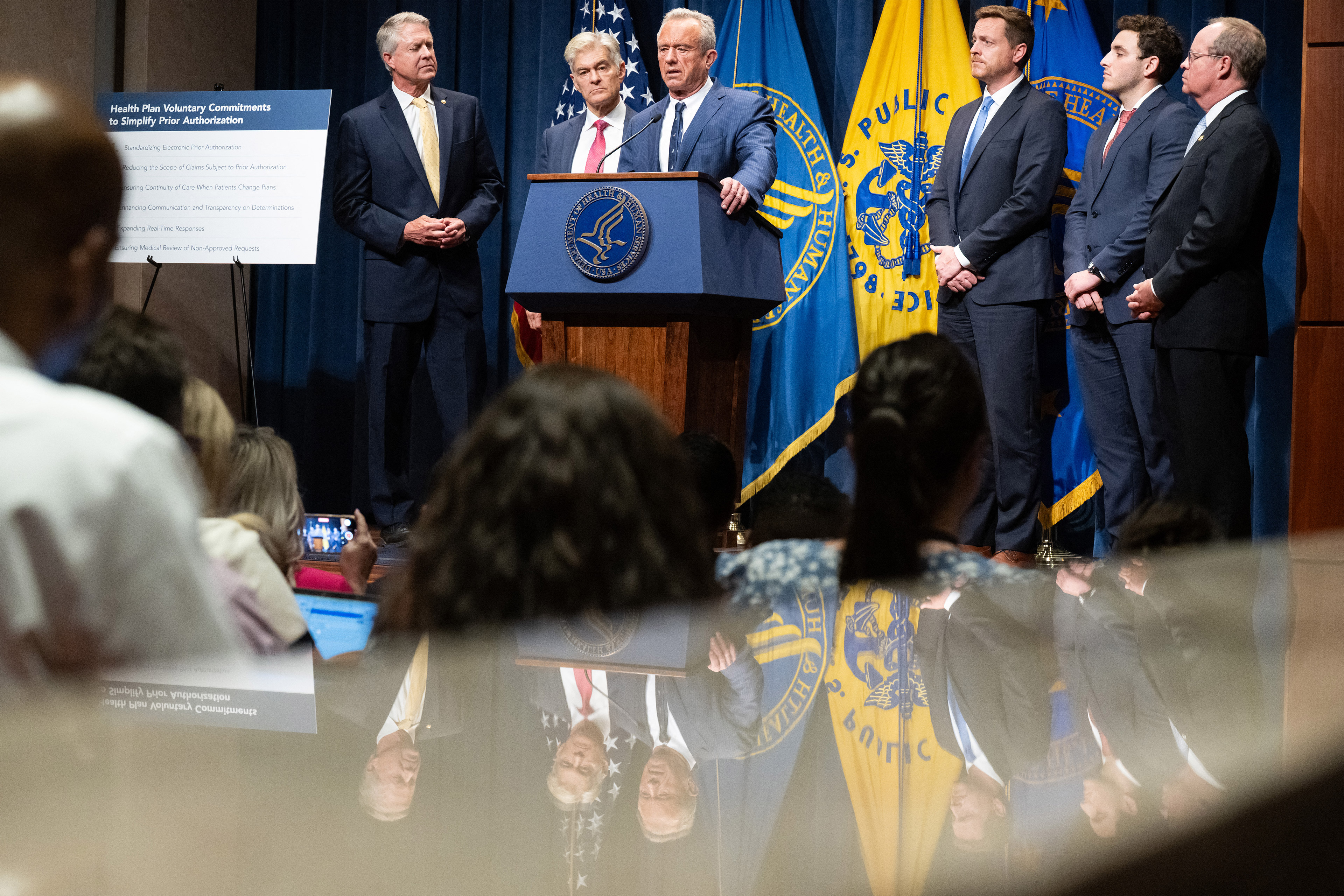
Congressman Murphy articulated a sentiment shared by many critics: "I have zero faith in the industry policing itself." He added, "I didn’t believe insurance companies then, and I don’t believe them now."
Individual Stories of Frustration: The Patient Experience
The abstract statistics and policy debates often fail to capture the profound personal impact of prior authorization challenges. The story of Betsy Adler and Justin Young of Stillwater, Minnesota, illustrates the labyrinthine difficulties families can face. Shortly after the birth of their daughter, Coco, who has a serious heart defect, the family found themselves accumulating substantial out-of-network costs, despite having meticulously verified their coverage.
The family had switched to Medica, a prominent health insurer, during Adler’s pregnancy, believing their chosen maternal-fetal specialists and hospital were in-network. However, shortly after their new plan commenced, some claims began being processed as out-of-network. By mid-March, they had incurred over $4,000 in out-of-network charges, in addition to existing in-network bills.
Adler’s attempts to rectify the situation were met with bureaucratic hurdles. She was informed that a referral from her primary care provider had not been submitted. Despite multiple attempts to obtain the necessary documentation, including being required to visit an unfamiliar clinic for a referral that was allegedly never received due to a malfunctioning fax machine, the problem persisted.
"I have a critically ill child," Adler recalled, grappling with the emotional toll. "I can either spend my emotional energy at war with Medica, or I can let it go and just enjoy my time with my daughter." Medica spokesperson Greg Bury declined to comment on the specific case, citing patient privacy, but issued a statement affirming the company’s commitment to working with Adler to clarify her benefits.
One of the six promises in the insurer pledge was to honor a 90-day "continuity of care" grace period for patients switching plans, effective January 1, 2024. This provision aims to allow patients to continue receiving services and medications authorized under their previous insurer. However, as Georgetown’s Corlette noted, the pledge’s wording is not a strict mandate. Insurers are not necessarily obligated to cover out-of-network providers as if they were in-network, even if they were under the prior plan. Consequently, Adler and Young were forced to switch insurance companies again when Coco was a month old to avoid further out-of-network charges.
Retroactive Denials and Unclear Explanations: The Loopholes
Patient advocates like Sally Nix, who lives with a chronic disease, argue that the reported reductions in prior authorizations do not account for the creative ways insurers can still deny care. "Insurers are not including the data for the loopholes they create," Nix stated. She points to the issue of retroactive denials, where a pre-approved service can later be denied payment. "Patients are going to see a lot more retroactive denials," Nix predicted, having personally experienced a claim for nerve pain injections that was initially processed and then subsequently denied.
Jocelyn Austin, a 49-year-old from Amherst, New York, experienced a similar predicament. After years of prescribed sleeping and anxiety medications, she underwent a weeks-long inpatient substance abuse treatment program that her insurer, Independent Health, had initially approved. Upon discharge, she received a bill for over $12,000, as her insurer had not paid for the treatment, despite prior authorization letters that explicitly stated, "authorization is not a guarantee of claim payment." This was in addition to a $10,000 deductible she had already paid.
Frank Sava, a spokesperson for Independent Health, stated that the denial was upheld because the services provided were deemed inconsistent with the authorized care and the medical record did not sufficiently support the billing. These findings were reportedly confirmed by an external consultant. An explanation of benefits indicated that the provider, not the patient, was responsible for the cost, yet the treatment facility continued to pursue payment from Austin. She remains resolute, stating, "Insurance companies should be held accountable."
Technological Hurdles and Transparency Gaps
Another key commitment in the pledge was the adoption of new technology to standardize the electronic submission of prior authorization requests. Last summer, CMS officials highlighted that over 50% of these requests were still processed manually via phone, fax, or mail.
In April, AHIP announced an update to this initiative, indicating that participating insurers would adopt new standards on a rolling basis, with full implementation scheduled for January 1, 2027. However, eight insurers that initially signed the pledge—Alignment Health Plan, EmblemHealth, HealthFirst, Independent Health, Medica, MVP Health Care, Point32Health, and SummaCare—did not endorse this technology update. These insurers represent beneficiaries across the country. While most provided emailed statements affirming their commitment to reform, they declined interviews.
Spokespersons for Alignment Health and Medica cited technical and operational challenges with the proposed data-sharing processes as reasons for not signing the April update. EmblemHealth, however, indicated it would sign on after being questioned by KFF Health News. AHIP acknowledged that "there is still significant work ahead" but expressed optimism that more plans would join the initiative.
The pledge also included a commitment to enhance transparency and provide "clear, easy-to-understand explanations" to patients, a requirement already mandated by the Affordable Care Act. Yet, critics like Gartner and Congressman Murphy assert that insurers frequently fail to adequately explain denials, often providing "inconsistent and contradictory information." They also voice concerns that insurers may be increasingly leveraging artificial intelligence to generate denials, creating pathways to discourage patients from pursuing necessary care.
"They craft the pathways to basically deny things immediately with the hope that people will give up," Murphy observed. He expressed a desire for former President Trump to issue executive orders addressing these issues, lamenting that "the problem is the insurance industry is the strongest lobby in this town."
As the year anniversary of the prior authorization pledge passes, the gap between industry promises and patient realities remains a significant concern. While some progress has been made in reducing the sheer volume of prior authorizations, the fundamental challenges of access, transparency, and timely care persist, leaving many patients feeling like they are engaged in a constant battle with their insurers. The path to truly simplifying prior authorization and ensuring patient-centered care appears to be a long and arduous one, demanding more than voluntary commitments and sustained federal oversight.