Former FBI Director James Comey Indicted for Allegedly Threatening President Trump, Marking Second Prosecution Attempt by Administration

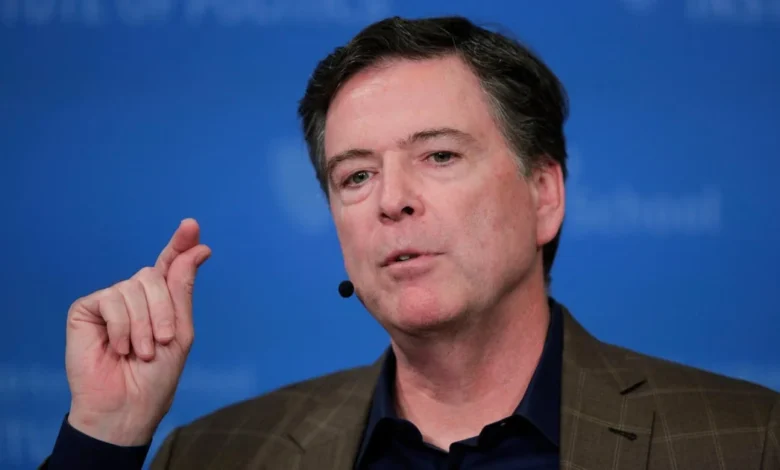
Washington – A federal grand jury on Tuesday formally indicted James Comey, the former Director of the Federal Bureau of Investigation, on charges of allegedly making threats against the President of the United States. This marks the second instance in which Comey has faced prosecution by President Trump’s Justice Department, reigniting intense scrutiny over the independence of federal law enforcement and the parameters of free speech. The indictment charges Comey with two distinct counts: knowingly and willfully making a threat to take the life of, and to inflict bodily harm on, the president, and a second charge of knowingly and willfully transmitting in interstate commerce a threat to kill the president. CBS News had previously reported that Comey was facing renewed charges hours before the official indictment was unsealed, indicating a swift progression of the legal process.
The genesis of these grave charges lies in an image Comey briefly posted to his Instagram account last year. The photo, which circulated widely before its deletion, depicted seashells arranged in the sand to form the numbers "86 47," sources familiar with the investigation previously informed CBS News. According to the indictment, federal prosecutors contend that "a reasonable recipient who is familiar with the circumstances" would interpret the depiction of the shells in the photograph "as a serious expression of an intent to do harm to President Trump." This interpretation hinges on the widely understood slang "86" as meaning to "eject," "remove," or even "kill," especially when paired with "47," which many of President Trump’s supporters identify as a reference to his potential status as the 47th President of the United States.
Legal Proceedings and Official Statements
The indictment was filed in the Eastern District of North Carolina, an area that has become a focal point for politically charged legal actions during the current administration. Assistant U.S. Attorney Matthew Petracca signed the indictment, and the case has been assigned to Judge Louise Wood Flanagan. Concurrently with the indictment, a warrant for Comey’s arrest was also issued, signaling the immediate legal ramifications of the grand jury’s decision.
In a press conference held shortly after the indictment’s release, Acting Attorney General Todd Blanche addressed the public, emphasizing the gravity of the charges. "Threatening the life of anybody is dangerous and potentially a crime," Blanche stated, adding, "Threatening the life of the president of the United States will never be tolerated by the Department of Justice." Blanche, who was recently installed as acting attorney general following the ouster of Pam Bondi earlier this month, stressed that while the defendant’s identity makes the case notable, the "alleged conduct is the same kind of conduct that we will never tolerate and that we will always investigate and regularly prosecute." He confirmed that the investigation leading to this indictment had been underway for approximately a year and remains ongoing. "You are not allowed to threaten the president of the United States," Blanche reiterated, asserting, "That’s not my decision. That’s Congress’ decision in a statute that they passed, that we charge multiple times a year."
U.S. Attorney W. Ellis Boyle further underscored the commitment to due process, stating that Comey would be afforded "every form of due process" that all citizens are entitled to receive. "In the Eastern District of North Carolina, it doesn’t matter who you are," Boyle affirmed. "We take all threats cases seriously and prosecute anyone who violates federal law, regardless of title or status."
Comey’s Vehement Denial and Defense
Immediately following the public announcement of the indictment, James Comey released a video statement on his Substack platform, vigorously pushing back against the charges. Comey, a frequent and outspoken critic of President Trump, with whom the president has famously clashed for years, expressed profound disappointment and defiance. "This is not who we are as a country," Comey declared, asserting, "this is not what the Department of Justice is supposed to be." He maintained his innocence and resolve, stating, "I’m still innocent, I’m still not afraid and I still believe in the independent federal judiciary. So, let’s go."
Comey’s attorney, Patrick Fitzgerald, echoed his client’s sentiments in a formal statement, reiterating that Comey "vigorously denies the charges" outlined in the indictment. Fitzgerald vowed to challenge the allegations in court, stating, "We will contest these charges in the courtroom and look forward to vindicating Mr. Comey and the First Amendment." This invocation of the First Amendment immediately sets the stage for a significant legal battle over the boundaries of protected speech, particularly concerning public figures and political commentary.
A History of Conflict: The Trump-Comey Saga
The latest indictment is the newest chapter in a long-standing and acrimonious relationship between President Trump and James Comey, a feud that has profoundly shaped American political discourse and raised serious questions about the politicization of justice. Their conflict began in earnest after Trump fired Comey from his position as FBI Director in May 2017, a decision that plunged the nascent Trump administration into turmoil and ultimately led to the appointment of Special Counsel Robert Mueller to investigate Russian interference in the 2016 election and potential obstruction of justice by the president. Comey’s subsequent public testimony and memoir, which were highly critical of Trump, further fueled the president’s ire.
President Trump has consistently voiced his anger at Comey, frequently using his social media platforms to call for his prosecution. In a September post to Truth Social, the president explicitly urged then-Attorney General Pam Bondi, "we can’t delay any longer," demanding action against Comey, alongside New York Attorney General Letitia James and Senator Adam Schiff, a California Democrat. This public pressure from the sitting president to prosecute political adversaries has been a recurring theme throughout his administration, drawing criticism from legal ethics experts and civil liberties advocates who warn against the weaponization of the justice system for political ends.
The Precedent of Previous Legal Actions
This is not Comey’s first encounter with President Trump’s Justice Department. He was initially indicted by a federal grand jury in late September of the previous year (2025) on charges of lying to Congress during testimony in September 2020 and obstructing a congressional proceeding. Comey pleaded not guilty to those charges.
However, that case, along with criminal charges against New York Attorney General Letitia James, was ultimately dismissed in November (2025) by a federal judge. The judge found that Lindsey Halligan, the top prosecutor in eastern Virginia who had secured both indictments, had been unlawfully appointed to her position. This procedural error provided a temporary reprieve for Comey, though the Justice Department swiftly appealed the dismissal. Halligan subsequently left her post at the Justice Department in January (2026).
In court filings related to the first indictment, Comey’s legal team sought its dismissal on multiple grounds, including arguments that his prosecution was vindictive and selective. They alleged that President Trump had personally ordered prosecutors to charge Comey out of "personal spite," citing Comey’s persistent criticism of the president. The judge overseeing Comey’s first criminal case never rendered a ruling on that specific motion, leaving the question of prosecutorial motive largely unaddressed in that instance. The timing of the current indictment, following the ouster of Attorney General Bondi and the installation of Todd Blanche as acting AG – a figure whose elevation coincided with Trump’s public demands for action against his critics – will undoubtedly reignite these concerns about political interference in federal prosecutions.
The "86 47" Controversy and Interpretations
The Instagram image that forms the basis of the current charges sparked considerable outrage among President Trump’s supporters when it first appeared. They widely interpreted "47" as a clear reference to Trump’s projected return as the 47th President and "86" as a call to "eject" or "remove" him, potentially even through violent means.
Comey, in an Instagram post accompanying the deletion of the controversial photo, stated that he initially believed the shell formation was communicating a "political message" and claimed ignorance of its violent connotations. "I didn’t realize some folks associate those numbers with violence," Comey wrote. "It never occurred to me but I oppose violence of any kind so I took the post down."
FBI Director Kash Patel acknowledged that the grand jury was informed of Comey’s swift deletion of the post and his subsequent statement clarifying his intent and disavowing violence. "Mr. Comey will have his day in court," Patel concluded, emphasizing the judicial process. Despite Comey’s explanation, the government’s indictment indicates that prosecutors believe a "reasonable recipient" would interpret the message as a serious threat, irrespective of Comey’s stated intent. This legal standard, established in cases concerning threats against the president, focuses on whether an objective observer would perceive the statement as a genuine threat, rather than solely on the speaker’s subjective intent.
The Secret Service, which is responsible for protecting the president, had interviewed Comey last May (2025) regarding the post. At that time, then-Homeland Security Secretary Kristi Noem publicly stated that Comey had "just called for the assassination" of the president and indicated that the Secret Service would investigate and "respond appropriately." This early official response underscores the serious view taken by federal agencies regarding such communications.
Broader Implications and First Amendment Concerns
The indictment of a former high-ranking federal official on charges of threatening the president carries significant legal, political, and societal implications. Legally, the case will undoubtedly become a test of the "true threat" doctrine under the First Amendment. The Supreme Court has long held that certain categories of speech, including "true threats," are not protected by the First Amendment and can be prosecuted. However, defining what constitutes a "true threat" – one that objectively communicates a serious intent to commit an unlawful act of violence – has been a subject of ongoing legal debate, especially concerning ambiguous or symbolic expressions. Comey’s defense team’s invocation of the First Amendment signals a direct challenge to the government’s interpretation of his Instagram post.
Politically, this second indictment further exacerbates the perception among some that the Justice Department is being used as a tool for political retribution against critics of the president. The circumstances surrounding the dismissal of the first indictment due to an unlawful appointment, coupled with President Trump’s public demands for Comey’s prosecution, will fuel arguments that the current administration is weaponizing the justice system. Conversely, the Justice Department will likely emphasize the principle that no one, regardless of their past position or political prominence, is above the law, and that threats against the president must be taken with utmost seriousness.
This case also reignites broader discussions about online speech, particularly in an era of heightened political polarization and the rapid dissemination of messages across social media platforms. The ambiguity of online communications, the potential for misinterpretation, and the subjective nature of what constitutes a "threat" versus political commentary or satire will be central to this legal contest. The outcome of United States v. Comey will not only determine the fate of a prominent former FBI Director but could also establish important precedents regarding free speech, the interpretation of online expressions, and the delicate balance between national security and individual liberties in a politically charged environment. Pat Milton contributed to this report.