FAA Lifts Nationwide Ground Stop After Major Air Traffic Control Communications Failure Causes Historic Flight Disruptions

The Federal Aviation Administration officially lifted a sweeping nationwide ground stop on Friday night, bringing an end to more than four hours of unprecedented paralysis across the United States airspace. The sweeping operational halt was triggered by a catastrophic communication breakdown that crippled multiple Air Route Traffic Control Centers, the critical high-altitude facilities responsible for managing aircraft cruising between commercial airports. Although the ground stop was rescinded at approximately 8:15 p.m. Eastern Time, aviation authorities and airline executives have warned that massive scheduling ripple effects will severely disrupt domestic and international travel throughout the weekend.
The incident, which stands as one of the most widespread technological failures in the modern history of American aviation, instantly threw the national transportation network into chaos. Flight tracking platforms and airline operational centers reported staggering numbers of canceled and delayed journeys, leaving hundreds of thousands of passengers stranded in terminals from coast to coast. As the industry scrambles to reposition aircraft and crews, aviation experts emphasize that restoring normalcy will require days of concerted recovery efforts.
Chronology of the Crisis
The breakdown began quietly on Friday afternoon before rapidly cascading into a national emergency. According to official briefings, the initial symptoms of system instability manifested shortly before mid-afternoon, catching air traffic management personnel and federal regulators off guard.
At 3:36 p.m. ET, Transportation Secretary Sean Duffy took to public briefings to announce that the Federal Aviation Administration had begun experiencing acute technical instability regarding radar systems and voice communication networks. These failures simultaneously impacted high-altitude Air Route Traffic Control Centers and Terminal Radar Approach Controls, commonly known as TRACONs, which manage arrivals and departures within congested airspace zones. At the exact moment the instability was detected, approximately 3,500 commercial and cargo aircraft were actively airborne, relying on intermittent or failing data streams to navigate their routes safely.
Transportation officials later revealed that the root cause of the initial failure stemmed from severe data overloads within core network architecture. "Our switchers and routers got overwhelmed," Secretary Duffy explained during early updates, detailing how the sudden surge in data traffic created a massive bottleneck that effectively severed the communication pipelines between ground controllers and airborne pilots.
Recognizing the immense safety risks posed by compromised radar and voice links, the FAA instituted an unprecedented nationwide ground stop, ordering all departing flights to remain parked at their gates until the integrity of the air traffic management system could be verified.
For more than four hours, the nation’s skies remained largely devoid of new departures while controllers grappled with the monumental task of safely guiding planes already in flight to their intended destinations. Technical teams worked frantically to isolate the corrupted routing protocols, reboot core servers, and establish redundant communication channels. By 8:15 p.m. ET, the FAA declared that critical systems had achieved stability, clearing the way for the gradual resumption of flight departures.
Staggering Scale of Flight Cancellations and Delays
The immediate fallout of the nationwide ground stop manifested in staggering operational statistics across the global aviation sector. Because modern commercial aviation operates on an intensely tight schedule—where aircraft, flight crews, and gate assignments are meticulously choreographed across multiple cities each day—a four-hour halt to all U.S. departures created an immediate and devastating backlog.
Data compiled by flight tracking service FlightAware illustrated the historic magnitude of the disruption. On Friday alone, commercial carriers canceled upwards of 9,000 flights, wiping out nearly an entire day’s operational capacity for several major airlines. The disruption did not evaporate with the lifting of the ground stop; as the new day dawned on Saturday morning, an additional 4,000 flight cancellations were already locked into airline schedules as carriers struggled to reset their networks.
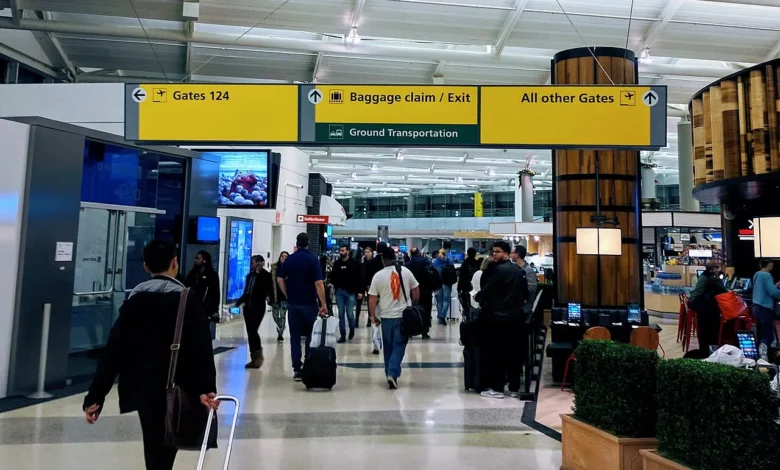
Major aviation hubs—including Hartsfield-Jackson Atlanta International Airport, Chicago O’Hare International Airport, Dallas/Fort Worth International Airport, and the major metropolitan airports serving New York, Washington, and Los Angeles—became epicenters of human congestion. Terminal seating areas quickly filled to capacity, baggage reclaim carousels overflowed with unclaimed luggage, and long lines formed at customer service desks as frustrated passengers sought alternative routings, hotel vouchers, or refunds.
International carriers flying into the United States were similarly forced to ground aircraft or divert long-haul flights to Canadian and Caribbean airports to prevent severe airspace congestion over the North American continent. The economic toll on airlines, corporate travelers, and the tourism industry is projected to reach hundreds of millions of dollars, encompassing everything from passenger compensation claims to emergency crew overtime and fuel expenses.
Official Responses and Security Reassurances
As the crisis unfolded on Friday evening, federal authorities moved quickly to address rampant public speculation regarding the underlying cause of the communication failure. Given the current geopolitical climate and increasing concerns regarding critical infrastructure cyberattacks, federal agencies prioritized transparency to quell rumors of malicious interference.
During a televised press briefing late Friday night, Homeland Security Secretary Markwayne Mullin delivered a definitive update regarding the nature of the technical failure. Secretary Mullin stated unequivocally that federal intelligence and cybersecurity agencies had found no evidence whatsoever indicating a cyberattack, state-sponsored sabotage, or external network intrusion.
"At this time, there is zero indication, intelligence, or data suggesting that this incident is the result of a cyberattack or malicious actor," Secretary Mullin stated. "Our preliminary technical assessments point entirely toward internal hardware and software data routing failures within the FAA’s legacy infrastructure."
Transportation Secretary Sean Duffy echoed these sentiments, emphasizing that the primary objective throughout the crisis was the absolute safety of the traveling public. Duffy praised the resilience and professionalism of air traffic controllers who managed to maintain safe separation standards for thousands of airborne aircraft despite experiencing sudden and severe technological degradation.
Airlines including Delta Air Lines, United Airlines, American Airlines, and Southwest Airlines issued comprehensive travel waivers, allowing affected passengers to rebook their flights without incurring standard change fees or fare differences. However, due to the sheer volume of canceled journeys, airline customer service telephone lines and digital chat applications experienced historic wait times, leaving many travelers stranded without immediate assistance.
Broader Implications and Infrastructure Vulnerabilities
The catastrophic failure of Friday evening has reignited an urgent, long-standing debate concerning the state of the United States’ critical aviation infrastructure. For years, aviation safety experts, labor unions representing air traffic controllers, and congressional oversight committees have raised alarms regarding the heavy reliance on aging technology systems within the Federal Aviation Administration.
Many of the core computer networks, radar processors, and communication routers utilized by the FAA date back decades, requiring continuous patches and complex maintenance to interface with modern digital tracking systems. While the agency has initiated multi-billion-dollar modernization programs—such as the Next Generation Air Transportation System (NextGen) initiative—progress has frequently been hampered by bureaucratic delays, funding debates, and the inherent difficulties of upgrading active infrastructure without interrupting daily flight operations.
Industry analysts note that Friday’s incident serves as a stark reminder of the fragile interconnectedness of the global transportation network. A single localized bottleneck in data switching equipment, when magnified across a nationwide network managing tens of thousands of daily flights, can cascade into a systemic failure of historic proportions.
In the wake of this event, lawmakers from both political parties have signaled an intent to launch rigorous congressional investigations into the FAA’s technical redundancies, emergency preparedness protocols, and funding allocation for hardware modernization. Aviation committees are expected to demand comprehensive technical post-mortems from the FAA and private technology vendors to determine exactly how switchers and routers could fail on such a monumental scale.
For the traveling public, the immediate focus remains on navigating the grueling recovery process over the weekend. As airlines work around the clock to reposition stranded crews and clear the massive backlog of delayed passengers, federal regulators face mounting pressure to prove that the nation’s skies are supported by robust, fail-safe infrastructure capable of preventing a recurrence of Friday’s unprecedented crisis.