Building the Future Among the Stars: University of Arkansas Researchers Turn Moon Dust into Interlocking Lego-Like Bricks Without Binders

As humanity stands on the precipice of a new era of space exploration, the ambition to establish a permanent human presence on the Moon transitions rapidly from science fiction to practical engineering. Establishing a sustainable lunar base requires habitats capable of withstanding the punishing environment of the lunar surface. Future astronauts will face extreme temperature fluctuations ranging from boiling heat to freezing cold, relentless cosmic radiation, hyper-velocity micrometeorites, and frequent seismic activity known as moonquakes. While architects and materials scientists on Earth have access to an infinite variety of durable building supplies, bringing these materials to the lunar surface presents a prohibitive logistical and financial challenge.
The economics of spaceflight dictate that every single pound of cargo launched into Earth orbit and beyond incurs staggering costs. Transporting traditional concrete, steel, or bricks from Earth to the Moon is simply unfeasible for scaling up a permanent colony. Consequently, space agencies and private aerospace contractors have spent decades researching In-Situ Resource Utilization (ISRU), a strategy focused on leveraging local materials found directly on the Moon. The primary target of these investigations has been lunar regolith—the fine, pulverized rock and dust that blankets the lunar crust.
However, transforming raw moon dust into a dependable construction material has long baffled engineers. Traditional methods of sintering or solidifying regolith almost universally rely on chemical binders, geopolymers, or extraneous additives. These binding agents must still be manufactured on Earth and transported across space at great expense, undermining the core objective of ISRU. Furthermore, the unique physical properties of lunar dust present formidable manufacturing hurdles that have stymied researchers for generations.
A breakthrough achieved at the University of Arkansas offers a compelling alternative. Cole McCallum, an undergraduate researcher working alongside mechanical engineering professor Wan Shou, has successfully developed a specialized 3D printing method capable of manufacturing interlocking, LEGO-like construction blocks entirely out of simulated lunar dust. Crucially, this technique requires zero binding agents, relying instead on the physics of laser-induced thermal fusion to bind the particles to themselves. Their findings, published in the journal NPJ Advanced Manufacturing, provide a promising blueprint for how future lunar pioneers might construct habitats using nothing more than the ground beneath their boots.
Understanding the unique hostility of lunar regolith is essential to grasping the magnitude of this engineering feat. Unlike terrestrial soil, which is rich in organic matter, decayed vegetation, and microbial life, lunar regolith contains absolutely zero organic material. Billions of years of unyielding bombardment by asteroids, meteorites, and solar wind have shattered the lunar bedrock into jagged, microscopic shards of glass and mineral fragments. Because these particles lack organic compounds or moisture, they possess no natural cohesive properties. Left untouched, they remain as loose, abrasive dust that clings persistently to spacesuits and machinery while refusing to bind together naturally.
Recognizing these limitations, McCallum investigated whether advanced additive manufacturing techniques could bypass the need for external adhesives. His focus turned toward laser powder bed fusion (LPBF), an advanced industrial 3D printing technology. In a traditional LPBF system, a thin, uniform layer of fine powder is distributed across a build platform. A high-powered laser beam then traces a digital cross-section, intensely heating the microscopic particles to their melting point so they fuse together in a process known as sintering. Once a layer is complete, the build tray lowers incrementally, a fresh coat of powder is swept across the surface, and the laser repeats the cycle until a fully three-dimensional solid object emerges from the powder bed.
Applying this mechanism to lunar dust appeared theoretically sound, but it had never been effectively optimized for binder-free construction blocks designed for modular assembly. McCallum and Professor Shou set out to test the hypothesis using commercially available Lunar Highlands Regolith Simulant (LHS-1). Because actual lunar material brought back by the Apollo missions is strictly controlled and available only in minute quantities for specialized analyses, researchers rely on high-fidelity simulants like LHS-1. These earthly materials are chemically and physically formulated to mimic the Highlands regolith samples collected during NASA’s historic lunar landings in the late 1960s and 1970s.
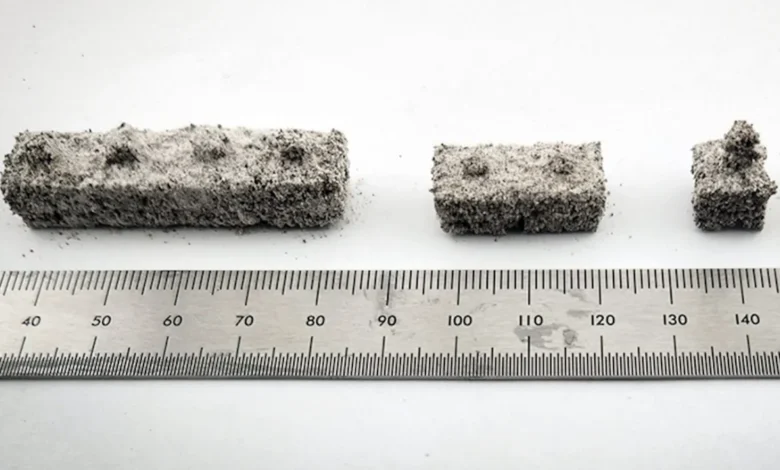
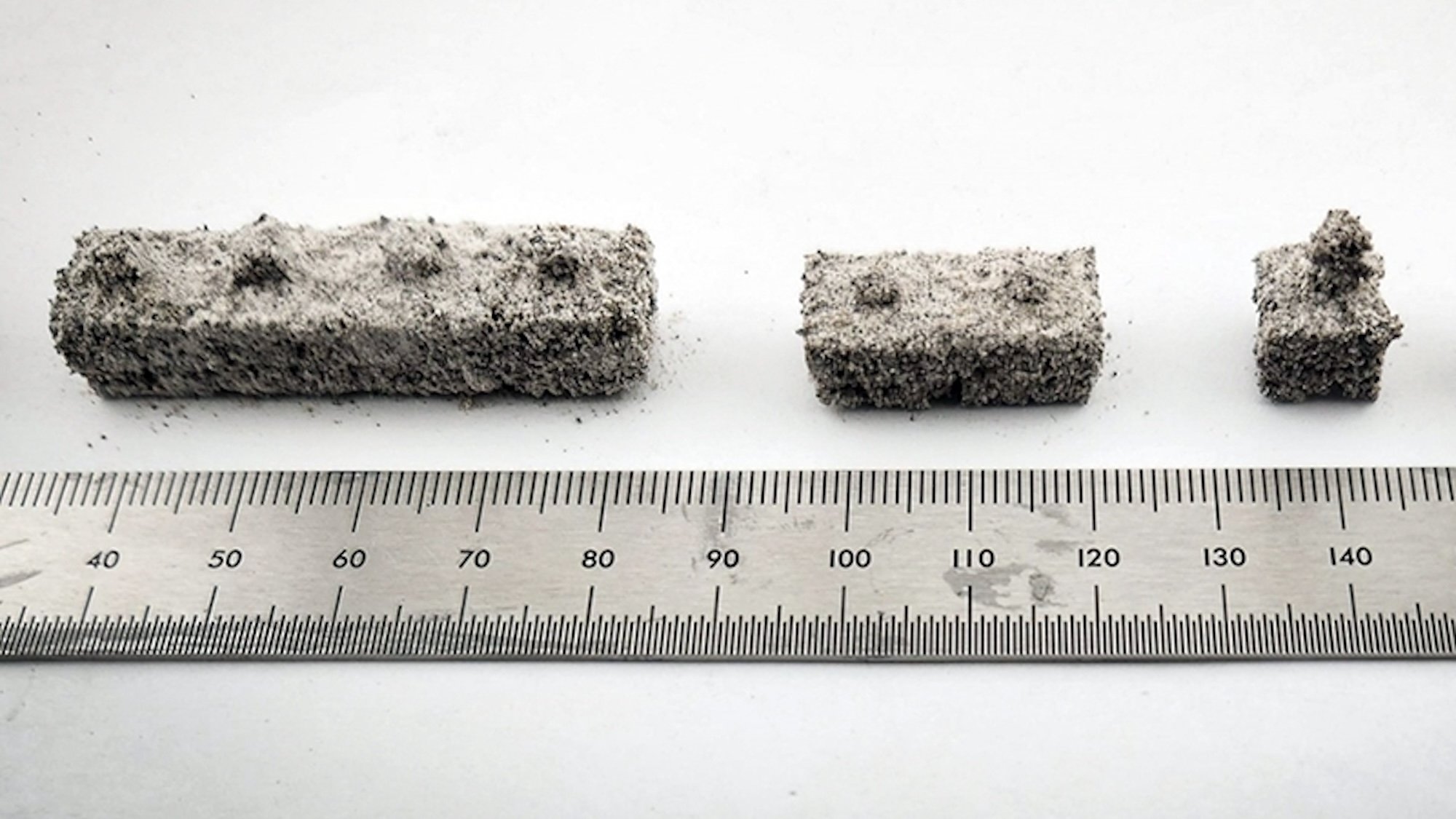
Within the laboratory setting, the research team experimented with various geometric profiles to determine which shapes would offer structural integrity while remaining easy to manipulate. They ultimately selected two distinct configurations for their prototype blocks: one resembling a simple cross and another shaped like the letter "H." These configurations allowed the tiny, centimeters-wide blocks to interlock seamlessly, mimicking the functional mechanics of commercial toy bricks.
The successful fabrication of these interlocking modules marked a significant milestone, yet the researchers remain appropriately cautious about the current limitations of their material. Through mechanical testing, McCallum and Shou discovered that their laser-sintered regolith bricks are significantly more porous and possess a lower compressive strength than traditional building materials or regolith composites enhanced with industrial binders. The intense, localized heating of the laser creates microscopic voids within the sintered matrix, reducing the overall structural density of the blocks.
Moreover, transitioning this technology from a terrestrial laboratory to the unforgiving environment of the lunar surface introduces a multitude of unverified variables. Earth-based experiments are conducted under normal atmospheric pressure and standard gravity. The Moon, by contrast, possesses a near-vacuum environment and exerts only about one-sixth of Earth’s gravity. These environmental differences drastically alter thermal dynamics, heat dissipation, and powder behavior during the laser-sintering process. Without an atmosphere to help regulate thermal transfer, the interaction between high-powered lasers and loose regolith in a lunar vacuum could produce entirely unexpected structural defects.
Addressing these technical hurdles represents the logical next phase for the research team. Future studies will need to test laser powder bed fusion parameters within thermal vacuum chambers that simulate the punishing atmospheric and gravitational conditions of the lunar environment. Additionally, engineers must evaluate how these porous, self-supporting blocks behave under sustained compressive loads, seismic tremors, and the abrasive wear of the lunar environment over extended periods.
Despite these caveats, the implications of this research extend far beyond the walls of the University of Arkansas mechanical engineering labs. As global space agencies—including NASA through its Artemis program, the European Space Agency, and international counterparts—accelerate plans to establish continuous human outposts on the Moon, the demand for sustainable in-situ construction methods grows increasingly urgent. The prospect of utilizing autonomous 3D-printing rovers equipped with high-powered lasers to harvest local regolith and autonomously assemble interlocking protective habitats could fundamentally alter the logistics of space colonization.
While McCallum is quick to note that these specific sintered blocks are not yet ready to bear the weight of heavy structural roofs or pressurized habitation modules, the underlying proof of concept offers a clear path forward. By demonstrating that lunar dust can be fused into modular, interlocking components without importing heavy chemical binders from Earth, this research solves a foundational puzzle in space architecture. As scientists continue to refine laser parameters, material densities, and brick geometries, humanity creeps one step closer to building the very foundations of an off-world civilization out of the lunar dust itself.