ESA’s Hera Spacecraft Captures First Close-Up View of the Didymos Asteroid System Following Historic DART Impact

In September 2022, humanity achieved a historic milestone in planetary defense when NASA’s Double Asteroid Redirection Test (DART) spacecraft intentionally collided with the asteroid Dimorphos at a staggering speed of roughly 14,000 miles per hour. While the car-sized spacecraft was completely obliterated upon impact, mission engineers and scientists worldwide celebrated the kinetic strike as a resounding success. Designed as a full-scale testbed for asteroid deflection technologies, the multimillion-dollar DART mission provided researchers with an unprecedented opportunity to study how a high-velocity kinetic impact could alter the trajectory of a celestial body.
In the years since the collision, astronomers have meticulously pored over telemetry, light curves, and imagery gathered by DART right up to the final moments before impact. The overarching goal of these extensive analyses has been to refine predictive models of asteroid behavior, ensuring that if Earth ever finds itself directly in the path of a hazardous near-Earth object (NEO), space agencies will possess the empirical data necessary to successfully deflect it.
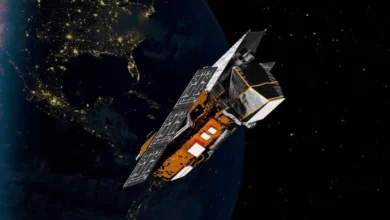
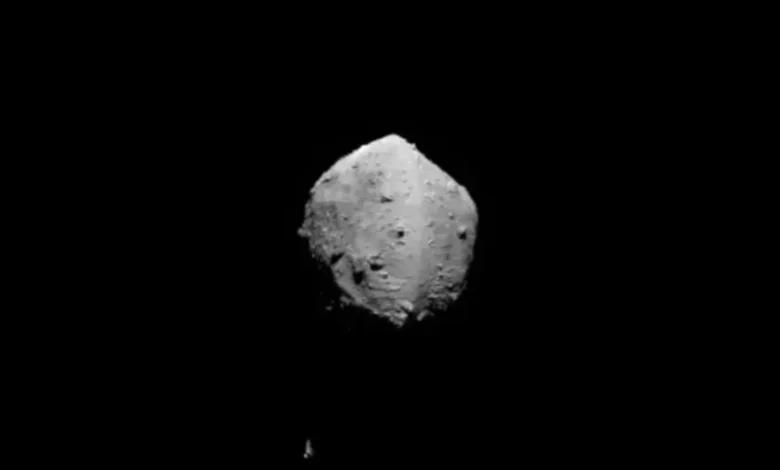
Now, the scientific investigation of the DART impact has entered its next major phase. The European Space Agency (ESA) has dispatched its own dedicated observer spacecraft, Hera, to conduct a comprehensive post-impact forensic investigation of the binary asteroid system. On November 5, the ESA released the very first close-up image captured by Hera, offering a breathtaking glimpse of Didymos—the larger, primary asteroid around which Dimorphos orbits. Taken from a distance of approximately 37 miles, the photograph marks the beginning of a multi-week imaging campaign designed to decode the lasting physical consequences of humanity’s first planetary defense test.
The Anatomy of a Binary System and the DART Aftermath
The Didymos system is a binary asteroid comprising a larger primary body, Didymos, and a smaller orbiting moonlet, Dimorphos, which measures roughly 530 feet in diameter. When DART struck Dimorphos in 2022, it successfully altered the moonlet’s orbital period around Didymos by more than 30 minutes, proving that kinetic impactors are a viable method for planetary deflection under the right conditions. However, the precise physical mechanics of the cratering process, the redistribution of ejecta, and the internal composition of both bodies have remained subjects of intense debate among planetary scientists.
In the newly released image from the Hera spacecraft, DART’s actual crash site on Dimorphos is shrouded in the deep shadows cast by the roughly 2,559-foot-wide primary body. Despite this, the unique viewing angle has allowed astronomers to examine Didymos in exquisite detail, providing crucial insights into how debris from a direct strike on a secondary body interacts with and affects the primary object in a binary system.
"The first thing we said was, ‘Wow!’" noted Hera principal investigator Patrick Michel in an official ESA statement regarding the milestone photograph. "This is the other side of Didymos from the one that DART’s camera showed us shortly before impact, so this feels like looking at a whole new world."
A Tale of Two Worlds: Surface Morphology and Debris Dynamics
A preliminary examination of the newly imaged hemisphere reveals that while Didymos retains the distinct central equatorial ridge previously observed by DART during its final descent, its overall surface morphology appears strikingly different from that of its smaller companion, Dimorphos. Because the two asteroids are separated by barely half a mile, the gravitational interactions and the exchange of loose material—known as regolith—between them present a complex puzzle for dynamicists.
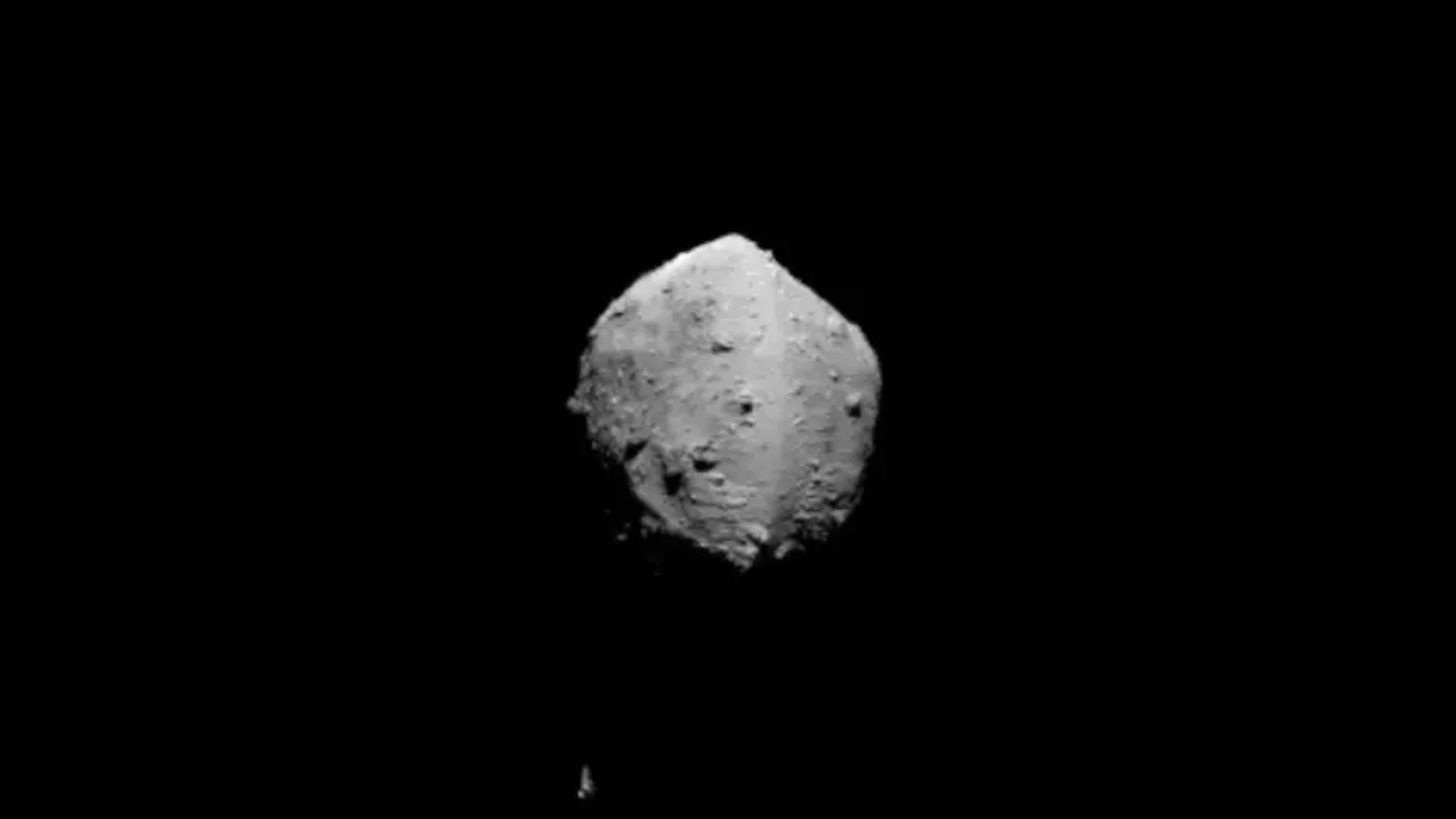
Scientists are eager to determine how much of Didymos’s current surface texture and topographical features have been shaped by the fallback of debris hurled into space by the DART impact. The transfer of momentum and material within a binary asteroid system following an explosive event is a poorly understood phenomenon, primarily because prior to DART and Hera, humanity had never directly experimented on a binary system.
"We have exciting work ahead of us to sort it out," added mission scientist Michael Kueppers. "We look forward to seeing much more of both bodies and systematically mapping all the changes we identify."
The Chronology of the DART-Hera Campaign
To fully appreciate the significance of Hera’s current observations, it is helpful to review the timeline of humanity’s interactions with the Didymos system:
- November 2000: The Didymos binary system is discovered by astronomer Joe Montani of the Spacewatch Project at the University of Arizona. Originally designated 1996 FG3, it was later officially named 65803 Didymos.
- September 26, 2022: NASA’s DART spacecraft successfully executes its kinetic impact maneuver, slamming into Dimorphos at 14,000 mph while Earth-based and space-based telescopes watch in real-time.
- October-November 2022: Telescopes confirm that the impact significantly shortened Dimorphos’s orbit around Didymos and hurled a massive plume of dust and boulders thousands of miles into space.
- October 2024: The ESA successfully launches the Hera spacecraft aboard a SpaceX Falcon 9 rocket from Cape Canaveral Space Force Station in Florida, beginning its two-year cruise phase toward the Didymos system.
- November 5, 2026: Hera captures its first high-resolution close-up image of Didymos from a distance of 37 miles, initiating the intensive scientific observation phase of the mission.
- November 25, 2026: The ESA scheduled to release an expanded catalog of high-detail images and preliminary compositional data covering both Didymos and Dimorphos.
Broader Implications for Planetary Defense and Space Exploration
The arrival of the Hera spacecraft at the Didymos system represents a crucial transition from observation-at-a-distance to in-situ characterization. While telescopes on Earth and passing space probes provided valuable immediate data regarding the orbital shift of Dimorphos, answering fundamental questions about asteroid interior structures requires close-range radar, thermal imaging, and high-resolution optical mapping.
Understanding the internal porosity and material strength of asteroids is essential for future planetary defense planning. Not all near-Earth objects are solid monolithic rocks; many are "rubble piles"—loosely bound collections of boulders and dust held together by weak mutual gravity. A kinetic impactor that works effectively against a solid rock might behave entirely differently when striking a rubble pile, potentially fracturing it into multiple hazardous fragments rather than smoothly deflecting it.
By comparing the pre-impact models with the post-impact reality revealed by Hera, planetary scientists will be able to calibrate computer simulations of asteroid collisions with unprecedented accuracy. This data will directly inform future missions, ensuring that space agencies can tailor their deflection strategies—whether through kinetic impactors, gravity tractors, or other theoretical methods—to the specific physical characteristics of any threatening asteroid.
As the ESA prepares to release a broader suite of detailed images and scientific data on November 25, the international scientific community stands poised to unlock the next chapter in our understanding of the solar system and our ability to protect the Earth from cosmic hazards.