The Political Paradox of Deb Haaland: Navigating Indigenous Legacy and Industrial Realities in New Mexico’s Gubernatorial Race

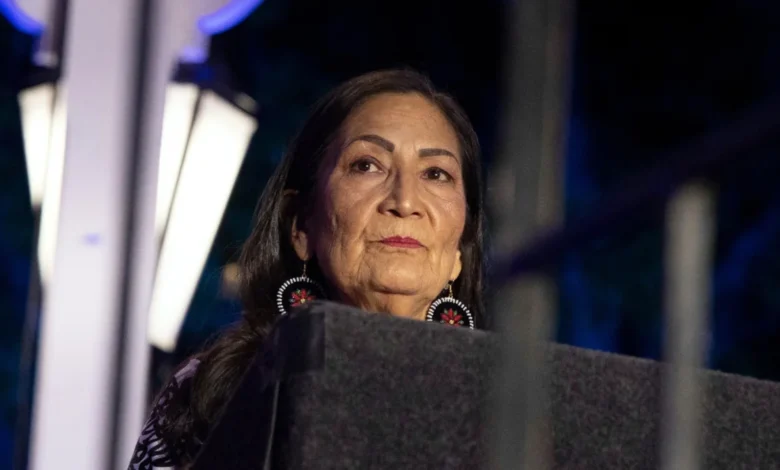
Deb Haaland’s journey from a struggling single mother relying on federal assistance to the nation’s first Native American cabinet secretary has long been framed as a narrative of relentless perseverance. Descending from a lineage of Pueblo runners who delivered critical messages during the 1680 Pueblo Revolt, Haaland has often characterized her political career as an endurance test. Now, as she reaches the final days of a grueling 20-month campaign for the governorship of New Mexico, she stands on the precipice of another historic milestone: becoming the first Native American woman to lead a U.S. state. Yet, as she traverses the high desert of her ancestral home, her candidacy has become a flashpoint for a complex debate regarding the intersection of climate advocacy, corporate influence, and the economic lifeblood of the American West.
The political trajectory that brought Haaland to this moment began in earnest in 2018, when she leveraged the national visibility gained through her support of the #NoDAPL movement at Standing Rock to secure a seat in Congress. As a progressive firebrand, she built a reputation on environmental stewardship, championing the Green New Deal and pledging to reject contributions from the fossil fuel industry. However, the transition from federal representative to state executive has necessitated a shift in political strategy, one that has drawn intense scrutiny from the very base that once propelled her to power.
A Chronology of a Changing Platform
Haaland’s political evolution reflects the broader shift within the Democratic Party as it balances ambitious climate goals with the economic realities of energy-dependent states.
- 2016–2017: Haaland gains prominence as a grassroots organizer during the Standing Rock protests against the Dakota Access Pipeline, cementing her status as an environmental activist.
- 2018: Elected to Congress as one of the first two Native American women, campaigning on a platform that explicitly rejected corporate fossil fuel donations.
- 2021: Confirmed as the Secretary of the Interior under the Biden-Harris administration, where she oversaw federal land management and tribal affairs.
- 2025–2026: Launches a 20-month gubernatorial campaign in New Mexico, shifting her rhetoric from "keep it in the ground" to a more nuanced focus on economic stability and energy transition.
- August 2026: New Mexico Supreme Court issues a temporary stay on water permits for Project Jupiter, an AI data center project, amid mounting environmental concerns.
- October 2026: Haaland faces public confrontation at a community forum regarding campaign contributions from firms linked to the fossil fuel industry and the Project Jupiter data center.
The Economic Tightrope: Fossil Fuels and Public Funding
The central challenge for any governor of New Mexico is the state’s profound reliance on the oil and gas industry. According to the state’s recent fiscal data, oil and gas production accounted for nearly 50 percent of the state’s $10.2 billion operating budget in the last fiscal year. This revenue stream has funded the expansion of universal child care, tuition-free college, and comprehensive school meal programs—initiatives that have become the hallmarks of the current Democratic administration.
This fiscal reality creates an inherent tension for a candidate like Haaland, who rose to prominence by opposing the very industry that currently keeps the state’s social safety net solvent. Critics point to the irony of her campaign accepting tens of thousands of dollars from entities such as Energy Transfer LP, the company behind the Dakota Access Pipeline, and other fossil fuel interests. When confronted with these donations, Haaland has maintained a pragmatic stance. "I believe I can walk and chew gum at the same time," she remarked during a recent press engagement, emphasizing the necessity of navigating a transition rather than an overnight cessation of industry operations.
Project Jupiter and the Tech-Energy Nexus
The controversy surrounding "Project Jupiter," a massive $165 billion AI data center initiative in southern New Mexico, has further complicated Haaland’s standing. As the digital economy demands unprecedented amounts of power and water, data centers have become a focal point of environmental activism. Project Jupiter is projected to consume vast quantities of groundwater in the water-stressed Chihuahuan Desert while generating carbon emissions estimated at 10.1 million tons annually.
Campaign finance disclosures revealed that Haaland accepted over $100,000 from Oracle, its executives, and other stakeholders connected to the project. For activists like Isaac Lira, a resident of Sunland Park, these contributions signify a betrayal of the values Haaland once championed. "Coming from a working-class background, knowing the struggle, yet saying, ‘Hey, you know, I can’t do anything about it,’ is disheartening," Lira stated.
While Haaland has pledged a "Day One" moratorium on new data centers if elected, she has declined to return the contributions already received, arguing that the costs of mounting a modern, competitive gubernatorial campaign necessitate substantial financial resources. Political analysts, such as Joe Monahan, note that while some on the progressive left feel disillusioned, there is a lack of widespread voter abandonment, largely because the alternative—a Republican administration—is perceived as fundamentally opposed to the social and environmental priorities of the Democratic base.
Broader Implications for State Policy
The implications of Haaland’s potential governorship extend well beyond the borders of New Mexico. As the state moves toward its 2030 greenhouse gas reduction targets, officials have acknowledged that the state is currently off-track. The failure of a net-zero emissions bill in the last legislative session underscores the political headwinds facing climate-conscious leadership.
Jon Clark, the state’s chief investment officer, has emphasized that the transition away from fossil fuel dependence is an economic imperative that will require decades of planning. The state’s sovereign wealth funds, currently valued at approximately $75 billion and projected to reach $100 billion by 2030, are being positioned as a buffer against declining oil revenues. However, the successful management of these funds requires a delicate balance between market growth and environmental risk mitigation.
For Haaland, the path forward is fraught with systemic challenges. Her supporters argue that her environmental commitment remains firm, pointing to her efforts to protect Chaco Canyon and federal lands from further industrial degradation. They argue that her pragmatic approach to campaign finance is a necessary evil in an era of astronomical political spending, and that her ultimate loyalty lies with the long-term preservation of New Mexico’s cultural and natural heritage.
The Road Ahead
As Election Day approaches, the discourse surrounding Haaland’s campaign has become a microcosm of the national conversation regarding the Democratic Party’s direction. Can a party that identifies as the champion of environmental justice effectively govern in an era where the tax base is still inextricably linked to carbon-intensive industries?
Haaland’s campaign represents a test case for this question. Her supporters believe that her background as a Pueblo woman provides her with a unique perspective—one that balances ancestral duty with the realities of modern statecraft. Her detractors, meanwhile, warn that the "climate hushing" observed in the campaign’s final weeks may signal a future of compromised policy.
Whether she succeeds in reconciling these competing interests will determine not only the legacy of her governorship but also the future of New Mexico’s environmental and economic landscape. As she faces the final stretch of the race, Haaland’s narrative remains one of resilience, though it is now marked by the complexities of power and the challenging trade-offs required to lead a state at the crossroads of history.