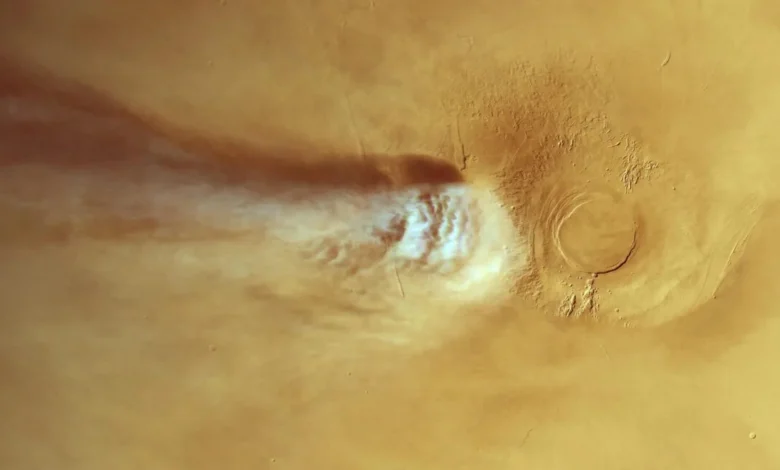
The red planet has long been a subject of intense meteorological study, but recent findings published in Nature Geoscience have fundamentally altered our understanding of atmospheric dynamics beyond Earth. Researchers analyzing the Arsia Mons Elongated Cloud (AMEC)—a recurring, gargantuan cloud formation that stretches up to 1,800 kilometers across the Martian sky—have identified a physical process previously unseen in nature. While terrestrial clouds rely on dust, salt, or soot to act as "seeds" for condensation, the AMEC appears to materialize through a rare and exotic process known as homogeneous nucleation. This discovery suggests that the thin, cold atmosphere of Mars is capable of hosting extreme weather phenomena that operate under laws of physics once thought to be theoretical or unattainable in natural planetary settings.
The Mechanics of Atmospheric Formation
On Earth, the creation of clouds is a foundational process governed by heterogeneous nucleation. Water vapor requires a surface—a microscopic particle like a speck of dust, a grain of pollen, or a salt crystal—to transition from a gas into a liquid droplet or an ice crystal. Without these "cloud condensation nuclei," the vapor would remain in a supersaturated state even at temperatures well below freezing.
However, the new research led by planetary scientist Jorge Hernández-Bernal indicates that the Martian atmosphere is performing a different feat. Under the specific shadow of the 65,000-foot-tall Arsia Mons volcano, the AMEC undergoes homogeneous nucleation. In this process, water vapor molecules collide and aggregate to form ice crystals spontaneously, without the intervention of foreign debris. Hernández-Bernal describes the sensation of this discovery with a compelling analogy: "It’s akin to droplets of condensation appearing in the middle of a room, rather than on a window. It’s wholly unexpected."
The Arsia Mons Catalyst: A Geographic Engine
To trigger this rare physical state, the Martian atmosphere must be pushed to its absolute limits. The Arsia Mons volcano, a shield volcano of staggering proportions, acts as the primary engine for this meteorological phenomenon. As global wind currents collide with the volcano’s massive bulk, the air is forced upward in a violent, rapid ascent. This orographic lifting, combined with the specific topography of the region, creates a powerful gravity wave that launches pockets of moist air into the upper atmosphere in less than ten minutes.
This sudden vertical transport is accompanied by a dramatic thermal collapse. The temperature in these air masses plummets by 30 degrees Celsius within that same ten-minute window. This rapid cooling, coupled with high relative humidity, creates an environment where the vapor has no choice but to condense instantly. The result is a sprawling, ephemeral cloud that dominates the Martian horizon for several hours before dissipating as the sun warms the surface.
Challenging Earth-Centric Meteorological Models
For decades, atmospheric models for Mars were heavily influenced by terrestrial meteorology. Scientists assumed that if clouds were forming on other planets, they were doing so via the same particle-based mechanisms seen on Earth. This assumption was largely a result of the lack of comprehensive, high-resolution data regarding the Martian upper atmosphere.
The study serves as a milestone in planetary science, as it successfully reproduces the AMEC in a model for the first time. The data confirms that the humidity levels required for this phenomenon to occur are staggering—more than 100,000 times greater than any humidity levels ever measured in Earth’s atmosphere. This realization has forced researchers to recalibrate their expectations for what constitutes a "normal" atmospheric process in the solar system.
"We don’t have nearly as much information about Mars’ atmosphere as we do about Earth’s, so reproducing the AMEC to this degree is a big success," Hernández-Bernal noted. The fact that the model aligns with observations provides a robust foundation for future studies of other planets, such as Venus, where similar high-altitude clouds have been spotted but never fully explained.
Timeline of Observation and Analysis
The scientific journey to understand the AMEC has spanned years of observation from orbiters and ground-based telescopes. The cloud typically emerges during the Martian southern solstice, a period when the planet’s tilt and orbit create the ideal conditions for the volcano’s interference with the atmospheric circulation.
- Initial Detection: Recurring plumes were noted by early Mars missions, but they were often misidentified as volcanic eruptions due to their proximity to Arsia Mons.
- Systematic Mapping: Over the last decade, high-resolution cameras on platforms like the Mars Express orbiter allowed researchers to map the cloud’s daily growth and decay cycles.
- Modeling Phase: Using advanced numerical weather prediction tools, researchers attempted to simulate the thermodynamics of the region. Initial models failed to account for the speed of cloud formation until they integrated the physics of homogeneous nucleation.
- Current Findings (2026): The publication of the findings in Nature Geoscience marks the first time that the internal physics of the AMEC have been verified through a combination of observational data and theoretical modeling.
Implications for Planetary Science and Astrobiology
The discovery of homogeneous nucleation on Mars has profound implications for the study of other planets. It demonstrates that the lack of atmospheric "seeds" (dust or aerosols) does not prevent the formation of clouds in extraterrestrial environments. If this process is common on Mars, it is highly probable that it occurs on other bodies with thin, cold atmospheres, such as the icy moons of Jupiter or the upper layers of Neptune and Uranus.
Furthermore, this study changes the way scientists look for water vapor in the deep space environment. If water can spontaneously transition into ice under specific high-humidity, high-volatility conditions, it means that water cycle tracking must account for these "invisible" cloud formation events that leave little trace in the aerosol record.
For astrobiologists, the study of Martian clouds is not merely about weather; it is about understanding the distribution of water on the planet. Water is the primary prerequisite for life as we know it, and understanding how it cycles from the surface into the upper atmosphere—and potentially out into space—is critical for determining whether Mars could have ever supported life, or if there are current pockets of habitable environments.
Future Research and Global Collaboration
The research team emphasizes that this is only the beginning of a broader investigation into the exotic physics of the Martian climate. Future missions to the red planet, including planned sample return missions and next-generation orbiters, will aim to collect in-situ data from within these cloud layers. By sampling the air during a peak AMEC event, scientists hope to confirm the exact chemical composition of the ice crystals and measure the humidity levels with a level of precision that remote sensing cannot currently achieve.
The international cooperation involved in this study—highlighting the importance of shared data between the European Space Agency, NASA, and independent research institutions—underscores the global nature of modern planetary science. As we push the boundaries of what we know about the solar system, the AMEC stands as a reminder that the universe is governed by physical laws that often operate far outside the narrow parameters of Earth-bound experience.
The mystery of the 1,800-kilometer-long cloud over Arsia Mons is, in many ways, a microcosm of the Martian experience: a blend of familiar geological features and entirely foreign, extreme physical processes. As researchers continue to dissect the data, the AMEC remains a beacon of the unknown, inviting further exploration into the complex, volatile, and remarkably dynamic atmosphere of our neighbor in space. The success of the current study provides a blueprint for future atmospheric analysis, ensuring that as we refine our models, we remain open to the possibility that the most exotic phenomena are not just theoretical, but are waiting to be observed in the cold, thin skies of the red planet.