When the Voice from the Grave Sells Christmas: How Royal Mail’s Unlabeled AI Commercial Stirred Ethical Outrage and Forensic Debate

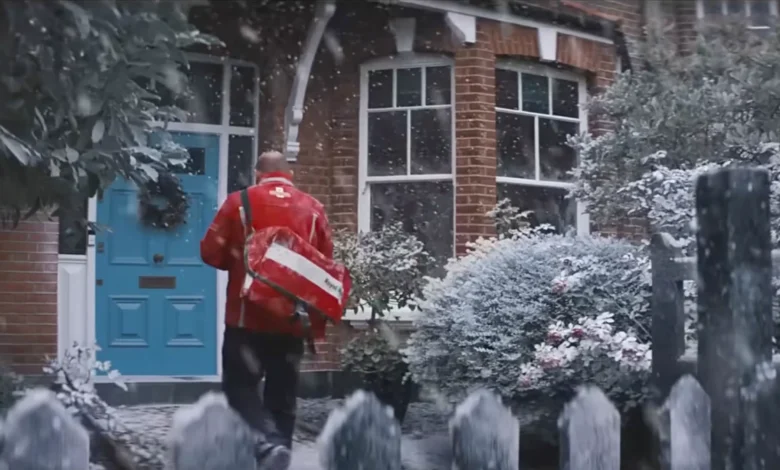
The intersection of generative artificial intelligence and commercial broadcasting has crossed a deeply sensitive ethical boundary, exposing systemic vulnerabilities in how major corporations utilize synthetic media. In November 2025, an unremarkable evening in Buckinghamshire transformed into an unsettling encounter with the past for Lucy Wynne. While watching a festive advertisement broadcast on ITV for the historic 500-year-old British postal service, Royal Mail, Wynne froze as a familiar, authoritative British male voice resonated across her living room. The voice delivered the campaign’s concluding tagline: "Royal Mail, it’s so much more than just a card."
To millions across the United Kingdom, the timbre was simply a warm, comforting narration. To Wynne, however, it was a visceral jolt. The voice belonged to her late father, Paul Vaughan, a legendary British broadcaster and voiceover artist who had passed away eleven years prior in November 2014. Vaughan was a foundational fixture of British media culture. He served as the definitive voice of the BBC’s heavyweight science documentary series Horizon, narrated Radio 4’s esteemed arts program Kaleidoscope, voiced beloved Paddington audiobooks, and left an indelible psychological imprint on a generation of Britons as the narrator of Threads, the harrowing 1984 atomic bomb drama.
What followed was not a moment of nostalgic comfort, but a wave of profound dread. Wynne immediately suspected that her father’s voice—hallowed in British broadcasting and deeply embedded in the public domain—had been synthetically resurrected without authorization, utilizing advanced artificial intelligence models. Subsequent investigative reporting and forensic audio analysis have since confirmed that Royal Mail’s festive campaign utilized an AI-generated voiceover, igniting a fierce national debate over intellectual property, corporate transparency, the ethical limits of generative AI, and the haunting reality of synthetic voices echoing from the digital afterlife.
The Anatomy of a Production: From Creative Agencies to Czech AI Specialists
The controversy surrounding the 2025 Royal Mail Christmas campaign—designed to celebrate tangible human connection through physical greeting cards—uncovered a complex, multi-tiered corporate and production pipeline. The advertising campaign was originally conceived and overseen by the creative agency Darwin & the Machines. To capture the authentic human narratives at the heart of the festive spots, the agency partnered with independent production company Untold Studios to film real actors across the United Kingdom.
However, rather than commissioning a human voiceover artist or professional actor to record the campaign’s closing slogan, Darwin & the Machines subcontracted the audio production to Fameplay. Fameplay is a specialized artificial intelligence audio firm based in Czechia. The corporate connections running behind the scenes quickly drew scrutiny: Fameplay is backed by Czech Media Invest, chaired by billionaire Daniel Křetínský, whose investment vehicle, EP Group, holds a controlling stake in Royal Mail itself.

According to industry sources who worked closely on the commercial’s production, representatives from Fameplay—specifically close Křetínský associate Juraj Felix—were present during filming and pushed aggressively for the integration of synthetic audio technology. Witnesses reported that Felix was visibly evangelical about AI voice generation, brushing aside warnings from local production teams who cautioned that deploying untested synthetic narration for a venerable, historic British institution could backfire spectacularly. Despite these internal warnings, the commercial moved forward. While Royal Mail leadership was fully aware of the production methods, the postal service chose not to disclose the use of artificial intelligence to the viewing public, omitting any transparency regarding its editorial shortcut.
Tracing the Tech: ElevenLabs and the Question of Training Data
As inquiries mounted regarding the exact genesis of the Royal Mail voiceover, Fameplay maintained that no direct references to Paul Vaughan were utilized in its generative text prompts. However, investigations revealed that Fameplay licensed its underlying synthetic audio technology from ElevenLabs, a dominant $22 billion AI audio giant. ElevenLabs has rapidly scaled its market presence, securing high-profile partnerships with entertainment icons like Michael Caine and investment backing from Hollywood figures such as Matthew McConaughey.
When pressed by investigators, ElevenLabs officials confirmed that the Royal Mail narration was not a direct, isolated voice clone of Paul Vaughan. Yet, when questioned directly on whether its expansive AI models had ingested historical archival material, BBC broadcasts, and audiobook recordings voiced by Vaughan—thereby allowing generic prompts to output a statistically probable facsimile of his distinct speech patterns—ElevenLabs declined to comment.
This gray area sits at the very heart of the modern copyright and generative AI crisis. Because Vaughan’s voice was so omnipresent across decades of British broadcasting, education, and entertainment, his vocal data existed in immense quantities within the public domain. For voice psychology experts and audio engineers, this abundance of professional material made Vaughan an ideal candidate for AI model training, whether intentional or the result of algorithmic convergence.
Forensic Audio Analysis and Psychological Recognition
Royal Mail initially defended its production choices by stating that the advert’s producers had carried out standard checks and advised that the synthetic output did not raise any "residence concerns" or direct impersonation flags. This claim quickly unraveled under rigorous academic and forensic scrutiny.

Lucy Wynne’s immediate psychological reaction—her absolute certainty that she was hearing her deceased father—was evaluated by Dr. Nadine Lavan, a voice psychology expert at Queen Mary University of London. Dr. Lavan noted that human psychological architecture is remarkably adept at recognizing the familiar vocal characteristics of loved ones. "With Wynne recognizing the voice from the advert as being Paul, we can conclude the voice is very similar," Dr. Lavan stated, highlighting the deep emotional resonance tied to phonetic idiosyncrasies.
To test this hypothesis further, the case was brought to Vincent Hughes, a professor of forensic speech science at the University of York. While Professor Hughes noted that formal forensic comparison was constrained by the brevity of the commercial’s audio clip, his analysis identified "considerable phonetic similarity" between the Royal Mail narration and authenticated recordings of Paul Vaughan. Specifically, Hughes pointed to a material overlap in segmental patterns—the precise phonetic pronunciation of vowels and consonants—as well as a striking alignment in overall voice quality and vocal timbre.
Independent comparisons utilizing three distinct open-source AI audio analysis tools yielded identical conclusions, with all systems indicating a high probability that the synthetic voice shared the same acoustic speaker profile as Vaughan. As Wynne poignantly observed, her father possessed a distinct inflection and cadence entirely unique to him—a vocal fingerprint that automated compliance checks completely failed to detect.
Industry Backlash and the Wider Implications for Performers
The fallout from the Royal Mail advertisement has galvanized UK performers, actors’ unions, and digital rights advocates who view unlabelled synthetic media as an existential threat to the creative economy. Peter Caulfield, an actor and founder of the Nicola Coughlan-backed "Save Our Voices Now" campaign, sharply criticized the commercial’s production oversight. Caulfield argued that Vaughan’s lifelong expertise and peerless vocal delivery naturally attracted automated systems seeking high-status authority, warning that casual corporate deployment of AI risks "stealing a voice from the grave and causing great upset to the family involved."
For Lucy Wynne, the experience underscores a terrifying frontier in media consumption: the frictionless infiltration of synthetic voices into everyday life without informed consent. She noted the sheer indignity of the situation, observing that corporations deploy AI out of administrative convenience without performing basic background due diligence to trace the historical lineage of the voices their algorithms synthesize. Had Vaughan passed away recently, or spent his final years in a care facility losing his ability to speak, the sudden posthumous resurrection on national television would have inflicted even greater trauma.
Furthermore, Wynne emphasized that her father—a staunch professional who spent decades perfecting his craft—would have fiercely opposed the substitution of human artists for corporate profit. "Pay the money and get somebody in to do the job," she asserted.

Corporate Response and Policy Shifts
In the wake of mounting public criticism and media inquiries, Royal Mail issued a brief, generalized statement: "We understand the concerns raised and have taken them seriously." However, the corporation has not issued a direct, formal apology to the Vaughan family.
On the technological front, the controversy has prompted immediate platform-level restrictions. Following the investigation, ElevenLabs added Paul Vaughan’s vocal profile to its internal "No Go Voices" registry, ensuring that his specific auditory signature cannot be directly cloned on its platform moving forward.
Timeline of Events
- November 2014: Paul Vaughan, renowned British broadcaster and narrator, passes away at the age of 80.
- November 2025: On the 11th anniversary of her father’s passing, Lucy Wynne hears the Royal Mail Christmas commercial on ITV and identifies the synthetic voice as her late father.
- Late 2025: Investigative inquiries reveal that Darwin & the Machines subcontracted the voiceover to Czech AI firm Fameplay, backed by Daniel Křetínský’s EP Group.
- Early 2026: Forensic speech scientists and voice psychology experts analyze the commercial, confirming striking phonetic and timbral similarities to Paul Vaughan’s archived BBC and audiobook work.
- Mid-2026: Following public outcry and industry pressure led by advocacy groups like Save Our Voices Now, ElevenLabs adds Paul Vaughan to its restricted "No Go Voices" database.
A Cautionary Tale for the Digital Age
The Royal Mail AI voiceover controversy transcends a single corporate misstep, serving as a watershed moment for the advertising and broadcasting industries. It exposes the murky regulatory landscape governing AI training datasets, the ethical vacuum of unlabelled synthetic media, and the profound emotional toll placed on grieving families when corporate efficiency supersedes human dignity. As brands increasingly market idealistic visions of authentic human connection while quietly substituting humans with algorithms, the case of Paul Vaughan stands as a stark warning: without strict transparency, rigorous vetting, and robust intellectual property protections, the voices of the past risk being mined, monetized, and manipulated without consent.
Related posts: