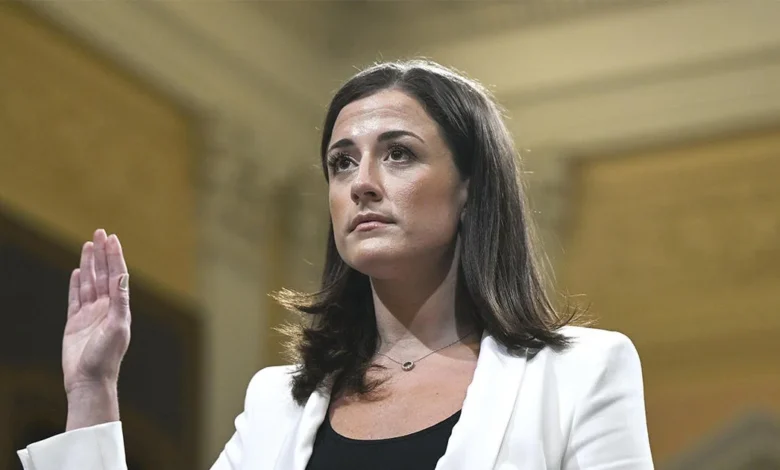
Federal prosecutors have failed to secure an indictment against Cassidy Hutchinson, the former top aide to White House chief of staff Mark Meadows, following a grand jury investigation into her testimony concerning the January 6, 2021, assault on the U.S. Capitol. According to four sources familiar with the secret proceedings, the grand jury declined to move forward with charges, marking a significant development in the long-running legal fallout stemming from the House Select Committee’s investigation into the events of that day.
The determination by the grand jury effectively halts, at least for the time being, the Justice Department’s pursuit of potential perjury or false statement charges against Hutchinson. The investigation had been spearheaded by the Justice Department’s Civil Rights Division. During a procedural hearing on an unrelated matter this past Tuesday, trial attorney Neville Hedley informed U.S. Magistrate Judge Zia Faruqui that the grand jury had declined to concur on a proposed indictment. While Hedley did not publicly name the target during the hearing, multiple sources have confirmed that the proceedings centered on Hutchinson’s high-profile congressional testimony.
A Timeline of Contention
The genesis of this legal scrutiny lies in the summer of 2022, when Cassidy Hutchinson provided bombshell testimony before the House Select Committee investigating the January 6 attack. Her appearances, both in recorded depositions and live televised hearings, were central to the committee’s narrative regarding the internal dynamics of the Trump White House during the final days of his presidency.
Hutchinson’s testimony painted a picture of a chaotic and defiant executive branch. She alleged that both Donald Trump and his chief of staff, Mark Meadows, were made aware of intelligence reports indicating that rally-goers intended to bring weapons to the Capitol. Despite these warnings, she testified that the president insisted on removing magnetometers at the Ellipse rally, reportedly stating that his supporters were not there to hurt him.
The most explosive portion of her testimony involved a second-hand account relayed to her by Anthony Ornato, then-White House deputy chief of staff. Hutchinson testified that Ornato told her that upon returning to his armored SUV after his speech, the president became enraged when the lead Secret Service agent refused to drive him to the Capitol. She alleged that Ornato described the president as having lunged toward the steering wheel and attempted to grab the agent by the clavicle. This account was later challenged by various allies of the former president and, specifically, through subsequent testimony from the driver of the vehicle, who denied that such a physical altercation occurred.
Contextualizing the Grand Jury Scrutiny
The referral to the Justice Department was not initiated by the department itself, but rather by House Republican allies of the former president who sought to challenge the integrity of the committee’s findings. These critics argued that inconsistencies in Hutchinson’s testimony, particularly the disputed account of the vehicle incident, amounted to criminal misrepresentations.
For the Justice Department, the threshold for bringing charges regarding congressional testimony is high. Prosecutors must prove not only that a witness provided information that was objectively incorrect, but also that the witness willfully intended to deceive under oath. In high-stakes political investigations, the "willfulness" component becomes a primary point of contention, as defense teams often argue that witnesses are merely relaying information as they recall it—or as it was told to them—even if that information is later proven inaccurate.
The decision of the grand jury not to indict suggests that federal prosecutors were unable to convince the panel that there was sufficient evidence of a criminal intent to lie. The outcome highlights the difficulty of prosecuting political figures or their aides for testimony that, while controversial and highly contested, may not meet the strict evidentiary standards of a perjury charge.
The Role of the Justice Department’s Civil Rights Division
The involvement of the Civil Rights Division in this investigation was somewhat unique, as these matters are often handled by the Department’s Public Integrity Section or local U.S. Attorney’s offices. However, the scope of the January 6 investigations necessitated a massive inter-agency effort.
Throughout the process, the Department of Justice has maintained a policy of silence regarding the specifics of ongoing grand jury investigations. Requests for comment from the DOJ regarding the outcome of this specific proceeding have gone unanswered. This standard protocol is designed to protect the integrity of the legal process, even when that process attracts intense media and political scrutiny.
Broader Implications for Jan. 6 Accountability
The failure to indict Hutchinson is likely to be viewed through two very different lenses in the American political landscape. To her supporters, the grand jury’s decision is a vindication of her role as a whistle-blower who provided critical, albeit contested, details about the inner workings of the White House. To her critics, the lack of an indictment does not necessarily prove the accuracy of her statements, but rather reflects the high evidentiary bar required to pursue criminal charges against witnesses in sensitive congressional inquiries.
This development also underscores the broader challenges of the post-January 6 legal landscape. Since 2021, the Justice Department has processed over 1,500 criminal cases related to the Capitol breach. While the vast majority of these cases have involved direct participants in the rioting, the secondary layer of investigations—those targeting the political architects and witnesses involved in the administration’s response—has proven far more legally complex and politically polarizing.
Analysis of Legislative and Legal Tensions
The case against Hutchinson serves as a case study in the tension between congressional oversight and criminal prosecution. Congressional committees rely on witnesses to uncover the truth, but they operate under rules that differ significantly from the courtroom. Statements made in a hearing room, while under oath, are subjected to different cross-examination standards than those in a federal trial.
When these testimonies become the basis for criminal referrals, the Justice Department is often placed in the position of refereeing political disputes. By declining to indict, the grand jury has effectively prevented the case from entering a courtroom, where it would have undoubtedly become a spectacle. This outcome provides a measure of closure for a specific, contentious chapter of the post-January 6 investigation, yet it remains unlikely to end the debate over the historical accuracy of the events that transpired that day.
As the political cycle moves forward, the legacy of the House Select Committee’s work will continue to be a subject of intense public interest. For now, however, the legal cloud that had hung over one of its most prominent witnesses has been lifted by the decision of a federal grand jury. The silence from the Justice Department following the proceedings underscores the finality of this particular legal step; without an indictment, there is no public record of charges to defend against, and the investigation into Hutchinson’s testimony concludes without a trial.
Moving forward, this event is likely to be cited by both sides of the aisle. For those concerned with the integrity of the justice system, the grand jury’s decision serves as a reminder of the importance of independent legal review in politically charged cases. For those focused on the events of January 6, it marks the end of a specific effort to discredit the testimony of one of the few White House insiders who chose to speak out publicly against the former administration’s conduct. Regardless of the political outcome, the legal matter appears to have reached its definitive conclusion.
Related posts: