Forensic Reexamination of 5,000-Year-Old Skulls Solves Ancient Egyptian Royal Retainer Sacrifice Mystery

The ancient tombs of Egypt have long captured the global imagination, serving as symbols of monumental architecture, intricate religious rituals, and the absolute power of the pharaohs. For generations, popular culture and sensationalist accounts have perpetuated the trope that deceased rulers were routinely accompanied into the afterlife by hundreds of living servants who were buried alive or executed en masse. While modern Egyptology has successfully debunked the vast majority of these cinematic myths, a rare and historically brief exception did indeed occur during the dawn of Egypt’s dynastic period. Now, nearly a century after their initial discovery, a groundbreaking forensic reexamination of 5,000-year-old skulls has provided definitive physical evidence that at least a dozen ancient Egyptian royal attendants met violent, calculated ends to honor their deceased masters.
The findings, published in the journal Frontiers in Environmental Archaeology, shed new light on a series of archaeological cold cases from the First Dynasty (roughly 3100 to 2900 BCE). Utilizing advanced forensic methodologies unavailable to early 20th-century pioneers, a team of researchers has successfully reinterpreted skeletal trauma that was misdiagnosed decades ago. This breakthrough not only closes several historical chapters regarding early Egyptian funerary practices but also offers a sobering glimpse into the brutal enforcement of social hierarchy and religious ideology at the very inception of the pharaonic state.
The Discovery at Abydos and a Century-Old Mystery
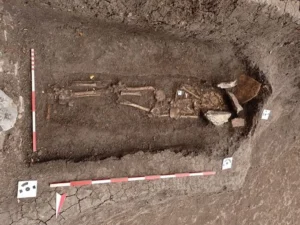
The story of these silenced attendants begins in the 1920s, when renowned British archaeologist Flinders Petrie undertook extensive excavations at Abydos, an ancient and sacred burial site located in upper Egypt. During his investigations of early dynastic funerary complexes, Petrie uncovered the monumental tombs of several First Dynasty pharaohs. Surrounding these primary royal structures were hundreds of smaller, secondary graves, arranged in orderly rows and containing the remains of individuals who appeared to have been buried at the same time as the sovereign.
Given the sheer concentration of these burials and their proximity to the royal tombs, Petrie and his contemporaries hypothesized that these subsidiary graves housed retainers who had been sacrificed to serve their king in the afterlife. However, the hypothesis remained largely speculative. The human remains recovered from the site lacked obvious, catastrophic signs of lethal trauma that could conclusively prove homicide. Lacking modern forensic tools, the excavation teams could not determine whether these individuals had been executed, poisoned, or had simply died of natural causes before being interred alongside their ruler.
Dozens of the skulls exhumed by Petrie’s team were eventually crated and shipped to Cambridge University in the United Kingdom, where they languished in academic archives for nearly a century. While the general consensus among historians leaned toward the theory of retainer sacrifice—largely due to historical parallels in other ancient cultures, such as early Mesopotamia—hard scientific proof remained frustratingly out of reach.
Modern Forensics and the Reanalysis of First Dynasty Remains
The tide turned when Roselyn Campbell, an archaeologist and researcher at Purdue University, gained access to the Abydos skeletal collections housed at Cambridge. Armed with contemporary forensic anthropology techniques, Campbell set out to reexamine 46 crania from the collection to determine if earlier generations of researchers had missed subtle markers of violence.
The results of her rigorous analysis were striking. Out of the 46 skulls reviewed, 18 displayed clear, undeniable indications of peri-mortem trauma—injuries sustained at or around the time of death—which Petrie’s team had either overlooked or misidentified as natural degradation or post-mortem damage.
"The injuries on the preserved crania are generally linear fractures, which would likely cause rapid unconsciousness, internal bleeding, and death," Campbell explained in a statement detailing the research.
Further inspection revealed that some of the skulls bore evidence of sharp-force trauma, including one remarkable and gruesome specimen that featured a distinct chopping wound directly to the eye socket. The linear fractures observed across multiple crania are typically consistent with heavy impact from a wide, flat implement. However, Campbell and her colleagues have exercised scientific caution, refraining from definitively naming the exact weapons used to inflict the fatal blows.
This caution is necessitated by archaeological and iconographical complexities. Ancient Egyptian artwork frequently depicts kings slaying their foreign enemies with a mace. Yet, biomechanical and forensic analyses indicate that a traditional stone or wooden mace would not typically produce the clean linear fractures observed on these particular skulls, suggesting that a different class of weapon or execution tool was employed within the private confines of the royal mortuary complex.
Chronology and Context: Why Retainer Sacrifice Was Brief
To understand why these attendants were executed, historians must look to the unique political and religious landscape of the Early Dynastic Period. Egypt was in the process of centralizing under a single ruler, uniting Upper and Lower Egypt into a cohesive state. During this volatile and formative era, the pharaoh was not merely viewed as a political leader; they were considered living gods upon whose cosmic stability the entire agricultural and social order depended.
Retainer sacrifice—also known as retainer immolation—was practiced by several early civilizations as a physical manifestation of this absolute power and deeply held religious beliefs. By ensuring that a pharaoh was accompanied into the afterlife by administrators, guards, and domestic servants, the royal court sought to maintain the earthly household in the celestial realm. Simultaneously, the practice served as a stark, terrifying reminder of the king’s supreme authority over life and death.
Despite its profound ideological utility, the practice was remarkably short-lived in ancient Egypt. Archaeological evidence indicates that retainer sacrifice was largely confined to the First Dynasty, spanning a period of roughly two centuries between 3100 and 2900 BCE. By the time of the Second Dynasty, the practice had been entirely abandoned. Egyptologists attribute this abrupt cessation to a shift in religious philosophy, wherein magical substitutes—such as shabti figurines, small servant statues placed in later tombs—were believed to be sufficient for afterlife labor, rendering actual human sacrifice obsolete and culturally taboo.
Unanswered Questions and the Limitations of the Archive
While Campbell’s forensic reexamination successfully closes several cold cases from the dawn of Egyptian history, many mysteries surrounding the Abydos burials remain unresolved. The fate of the majority of the attendants is still unknown. Many of the skulls analyzed showed no outward signs of trauma, leaving open the possibility that these individuals died of natural causes, disease, or perhaps via methods of execution—such as lethal ingestion or asphyxiation—that leave no lasting trace on skeletal remains.
Compounding these challenges is the archival reality of early 20th-century archaeology. Following his initial excavations, Flinders Petrie reburied the vast majority of the post-cranial skeletal remains at the Abydos site itself, retaining only select crania for institutional study. Consequently, researchers today have access to only a fraction of the original osteological record, severely limiting opportunities for comprehensive demographic analysis regarding the age, biological sex, or overall health of the sacrificed retainers.
"If I had unlimited resources, I would love to figure out where the bodies of these individuals might be and analyze them," Campbell remarked, highlighting the ongoing hurdles faced by modern bioarchaeologists working with historic museum collections.
Broader Implications for Egyptology and Forensic Science
The successful reanalysis of the Abydos skulls underscores the immense value of applying modern forensic science to legacy museum collections. As analytical techniques continue to evolve—incorporating advancements in micro-CT scanning, isotope analysis, and trauma biomechanics—researchers are increasingly able to extract novel data from artifacts and remains that have sat in storage for generations.
Furthermore, the study provides a sobering human counterweight to the monumental achievements of ancient Egypt. Behind the towering stone monuments and golden treasures of the pharaohs lay a rigorous, and at times brutal, social hierarchy. By combining meticulous archaeological excavation with advanced forensic pathology, modern science continues to give voice to the forgotten individuals who built the foundations of one of history’s greatest civilizations, transforming anonymous bones into historical subjects whose final moments are finally coming to light.
Related posts: