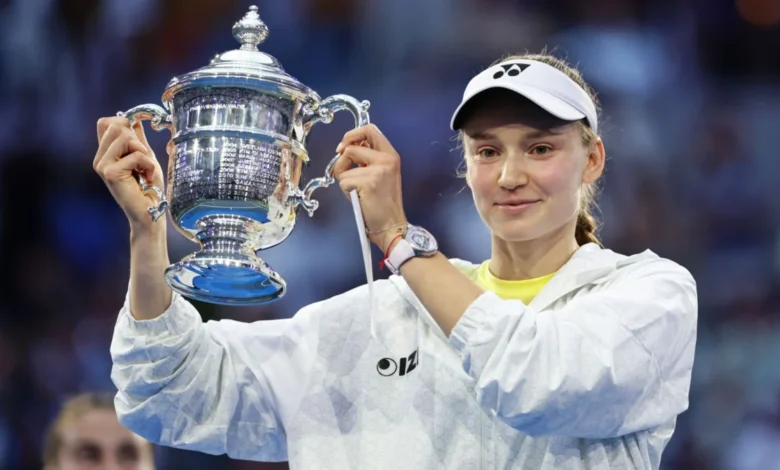
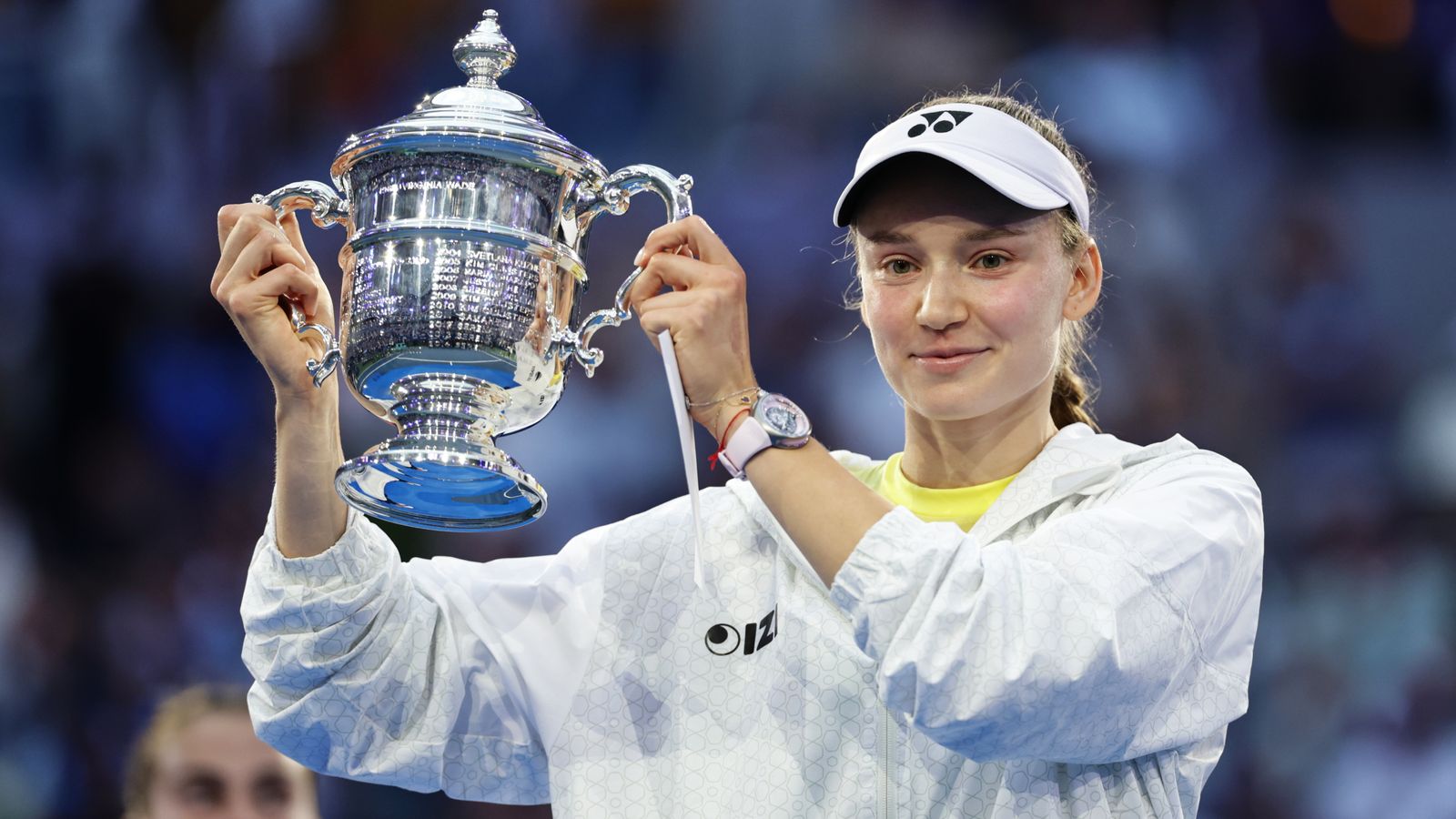
Elena Rybakina has officially ascended to the pinnacle of women’s tennis, capturing her maiden US Open title at Arthur Ashe Stadium with a commanding 6-4, 5-7, 6-2 victory over two-time defending champion Aryna Sabalenka. The triumph in New York not only secures Rybakina her third career Grand Slam title but also serves as the final validation of her rise to world number one, a ranking she was already guaranteed to occupy when the official WTA list is updated on Monday.
For Rybakina, the journey to the 2026 US Open trophy was fraught with physical uncertainty. Having entered the tournament under the shadow of a nagging ankle injury that threatened to curtail her campaign before it even began, the Kazakh star displayed a level of resilience that defied her initial pre-tournament expectations. By adding the New York crown to her 2023 Australian Open title and her 2022 Wimbledon championship, Rybakina has moved one step closer to completing the coveted career Grand Slam, with only the French Open remaining to finalize her collection of major hardware.
A Clash of Titans in New York
The final was billed as a marquee showdown between the two most dominant forces in the modern game. Sabalenka, the top seed and two-time defending champion, entered the match with the weight of history on her shoulders. She was attempting to become only the third woman in the Open era—joining the legendary ranks of Chris Evert and Serena Williams—to achieve a "three-peat" at the US Open.
From the opening game, it was evident that both players were operating at the absolute limit of their physical capabilities. Rybakina, sporting a distinctive yellow-and-black aesthetic, set an aggressive tone early, utilizing her wingspan to produce stinging, low-trajectory groundstrokes that pushed Sabalenka deep behind the baseline.
The turning point of the first set arrived in the fifth game. A rare lapse in concentration from the Belarusian, highlighted by a costly double fault, allowed Rybakina to secure a crucial service break. The frustration was palpable; Sabalenka immediately drew a code violation after launching a ball high into the rafters of the arena. Rybakina remained unmoved by the drama, maintaining a trademark composure that allowed her to consolidate the break and close out the set, 6-4.
The Momentum Shift and Final Surge
The narrative shifted during the second set. Whether through a slight dip in concentration or a tactical adjustment by the defending champion, Rybakina’s intensity wavered, allowing Sabalenka to claw her way back into contention. The Belarusian seized the opportunity with a spectacular display of athleticism, punctuating her resurgence with a perfectly executed drop shot and a series of blistering crosscourt backhands. By taking the second set 7-5, Sabalenka appeared to have wrestled the momentum away, sending a roar of defiance toward the crowd as the match headed into a deciding third set.
However, the third set revealed the true depth of Rybakina’s resolve. Rather than retreating, the new world number one elevated her game, demonstrating the tactical maturity that has defined her 2026 season. She attacked Sabalenka’s serve with relentless precision, dictating the pace of rallies and forcing the Belarusian into defensive positions from which she could not recover. Racing to a 5-2 lead, Rybakina remained clinical, closing out the match with a display of poise that underscored her status as the sport’s new standard-bearer.
Official Reactions and Emotional Aftermath
In the immediate aftermath of the match, the contrast between the two competitors was stark. A visibly emotional Sabalenka, struggling to process the end of her reign in New York, addressed the crowd with grace despite the evident sting of defeat.
"The last thing I want to do right now is give a speech, but I’ll try my very best," Sabalenka told the audience. "I want to congratulate Elena on an incredible year and an incredible result. It is well deserved. I wish I could have performed a little bit better, but I guess there is always next year."
During her post-match press conference, Sabalenka expanded on the pressure of the moment. "It is really tough to control your emotions when you lose in the final of a Grand Slam, especially when you are trying to go for a three-peat. I just needed to let the aggression and disappointment out. If I had held it inside, I wouldn’t have been able to function."
For her part, Rybakina reflected on the improbable nature of her victory given her physical setbacks earlier in the fortnight. "Some magic is happening," she admitted. "I was so unlucky with the injury before the start of the tournament. My team was positive, but even in the beginning, we didn’t know how it was going to be. I am super happy and very proud. I still can’t believe it."
Expert Analysis: The Tactical Divide
Tennis analysts were quick to praise the tactical clarity shown by the new champion. Martina Navratilova, observing for Sky Sports Tennis, noted that the dynamic of the match was uncharacteristic for a Sabalenka final.
"We do not usually see this," Navratilova remarked. "Typically, it is Sabalenka doing the bullying. She is used to dictating play, putting opponents on their heels, and forcing rushed errors. Instead, it was Rybakina who did that to her. It was not that Sabalenka lost the match; it was that Rybakina won it. She earned every point."
Marion Bartoli echoed these sentiments, highlighting the "extraordinary" nature of Rybakina’s accomplishment. "Can you imagine that her previous best result here was the fourth round? To come here with the weight of the world on her shoulders, knowing she had the number one ranking on her racket, and to win? The ball-striking is just something else. She is only missing Roland Garros now from completing a career Grand Slam."
Former British number one Laura Robson identified the backhand as the fundamental difference-maker. "We were excited about this final for good reason. For Rybakina, even without the crowd’s support, she did not flinch. The difference today was the backhand, which was lights out from start to finish."
Implications for the Tour
The statistics from 2026 underscore the sheer dominance Rybakina has exerted throughout the season. With this victory, she has recorded her 49th win of the year and her 10th win over a top-10 opponent in 2026 alone. Her ability to dismantle Sabalenka in two Grand Slam finals this year suggests a shifting hierarchy in women’s tennis.
The immediate implication for the tour is a solidified leader at the top of the rankings. Rybakina’s transition to world number one is not merely a mathematical certainty but a reflection of her performance on the sport’s biggest stages. As the tour moves toward the final events of the calendar year, the focus will now shift to whether the rest of the field can find a tactical response to Rybakina’s blend of power and composure.
For Sabalenka, the loss marks the end of a historic era at Flushing Meadows. However, at 28, she remains firmly in the prime of her career. The "drawing board" approach mentioned by analysts will likely involve recalibrating her strategy for high-stakes encounters against defensive specialists who can withstand her pace.
As the US Open concludes, the tennis world is left with a clear picture of the sport’s current trajectory. Elena Rybakina has not only captured the trophy; she has claimed the mantle of the world’s best player with a performance that will be studied and analyzed for years to come. With three of the four Grand Slams now in her trophy cabinet, the quest for the elusive French Open title will undoubtedly be the primary narrative of the 2027 season.
Related posts: