Cornwall Prepares for History as Cosmic Girl Leads the United Kingdom into the New Orbital Space Age


At the far southwestern tip of England, dangling into the Atlantic, the remote region of Cornwall rarely feels like the center of the world, yet the sleepy landscape surrounding Newquay Airport is rapidly transforming into the unlikely launchpad for a new era of British aerospace exploration. For weeks, local residents have observed a distinctive aircraft performing low-altitude maneuvers above the coastline, a spectacle that signals a monumental shift in the United Kingdom’s capabilities within the global space sector. This aircraft, a modified Boeing 747-400 affectionately dubbed Cosmic Girl, is the centerpiece of Virgin Orbit’s ambitious "Start Me Up" mission, which aims to execute the first-ever orbital launch from British soil next month.
The sight of the "Queen of the Skies"—once a staple of Virgin Atlantic’s long-haul passenger fleet—banking over the Cornish cliffs has provided a tangible preview of a mission that has been years in the making. While Newquay Airport typically serves as a regional hub, currently ranking as the 29th largest airport in the United Kingdom, it has been meticulously retrofitted to support the complex requirements of a horizontal launch facility known as Spaceport Cornwall. The integration of this aerospace infrastructure into a commercial airfield represents a strategic pivot for the UK, moving away from traditional reliance on international space partners toward a self-sustaining domestic launch ecosystem.
A Technological Marvel: How Horizontal Launch Works
The brilliance of the Cosmic Girl mission lies in its departure from the traditional image of a vertical rocket launch. Unlike the massive gantry systems and flame-deflecting trenches associated with Kennedy Space Center or Baikonur, Virgin Orbit’s methodology utilizes a "horizontal" approach. Cosmic Girl functions as a flying launchpad. Beneath its left wing, the aircraft carries a 70-foot-long, 57,000-pound rocket known as LauncherOne.
The flight profile is as precise as it is daring. Once the 747 reaches an altitude of approximately 34,000 feet, the pilots will execute a maneuver to release the rocket. Seconds later, the rocket’s engine ignites, propelling its payload into low Earth orbit at speeds exceeding 17,000 miles per hour. This method offers significant logistical advantages, most notably the ability to launch from virtually anywhere with a runway long enough to support a Boeing 747, and the flexibility to adjust the launch trajectory to achieve a wider variety of orbits than ground-based systems allow.
Chronology of a Historic Mission
The journey to this moment has been characterized by rigorous testing and international coordination. The project gained significant momentum in early October 2022, when LauncherOne completed its final, successful full-scale launch rehearsal in Long Beach, California. This milestone cleared the way for the rocket to be transported to the United Kingdom, arriving on October 7.
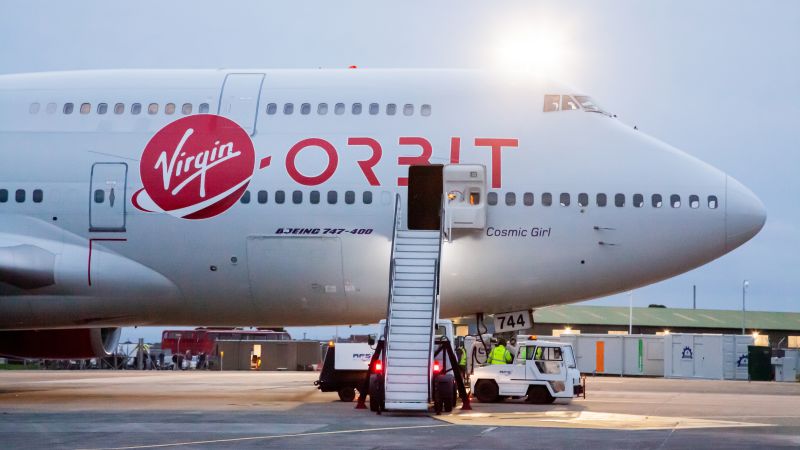
Cosmic Girl herself arrived in Cornwall on October 11, marking the official reunion of the carrier aircraft and its payload. By October 14, the flight crew had completed a crucial three-hour test flight over the Southwest of England, allowing engineers to gather flight-performance data while the plane carried the full weight and aerodynamic drag of the rocket. For the local community in Newquay, the sight of the aircraft flying at low altitudes over their homes and gardens served as a poignant reminder that the "Space Age" was no longer a distant abstraction, but an imminent local reality.
Official Perspectives and Local Sentiment
The local response has been a mix of professional curiosity and civic pride. Marc Andrew, a long-term resident of Newquay, traveled to the periphery of the spaceport to witness the aircraft’s landing, an event that drew spectators from across the region. "It was amazing to watch, and it will be a nice bit of history to tell my little boy when he’s older," he remarked. This sentiment is echoed by the personnel involved in the mission, who view the project as a catalyst for future generations.
Matthew Stannard, Virgin Orbit’s chief pilot, expressed the gravity of the moment following the test flights. "It feels amazing to bring Cosmic Girl home to the UK. We are weeks away now from the first UK launch at Spaceport Cornwall, so it’s all very real," Stannard noted. The project has also been a massive logistical undertaking for the local government and infrastructure teams. Melissa Thorpe, the head of Spaceport Cornwall, highlighted the culmination of years of preparation: "Seeing the infrastructure in place makes our launch ambitions a reality."
Strategic Implications for the UK Space Agency
The mission is more than a technical demonstration; it is a key component of the UK National Space Strategy. Ian Annett, deputy CEO of the UK Space Agency, has characterized the event as a landmark for Europe, noting that this will be the continent’s first successful satellite launch from domestic territory. Historically, the UK has been a leading manufacturer of satellites, but it has lacked the domestic capacity to launch them into orbit, forcing companies to rely on providers in the United States, Russia, or French Guiana.
By establishing Spaceport Cornwall, the UK is attempting to capture a larger share of the burgeoning "NewSpace" economy. The global market for small-satellite launches is projected to grow exponentially over the next decade, driven by the need for telecommunications, earth observation, and climate monitoring data. By providing a domestic "one-stop shop"—where satellites can be designed, built, and launched within the same nation—the UK hopes to streamline the process for its domestic aerospace industry and attract international clients.
Beyond Cornwall: The Future of Global Horizontal Launch
While the focus is currently on the Cornwall mission, the implications of this flight extend well beyond the British Isles. Virgin Orbit’s strategy is built on the concept of global scalability. The company has already expressed intentions to replicate the Cornwall model in various regions, with potential future launch sites identified in Australia, Brazil, Japan, Poland, and the Republic of Korea.

This decentralized approach to space access could fundamentally alter the geopolitics of the orbital landscape. If successful, the horizontal launch platform proves that space access is not the exclusive domain of major superpowers with vast, remote desert facilities. Instead, it demonstrates that existing commercial aviation infrastructure can be leveraged to support space-based objectives, potentially democratizing access to orbit for mid-sized nations and private corporations.
Technical Challenges and Risk Management
Despite the excitement, the mission is not without significant risk. Orbital launches are notoriously difficult, with high failure rates even for established players. Virgin Orbit’s previous trial in 2021—where the rocket was successfully released and achieved orbit—provided critical data, but each launch involves unique variables, from atmospheric conditions over the Atlantic to the integrity of the rocket’s guidance systems.
Engineers at Spaceport Cornwall have been working around the clock to ensure that the ground support equipment is synchronized with the onboard systems of the 747. The "Start Me Up" mission will carry seven payloads, including satellites for commercial and research purposes. The success of this launch will be measured by the precision of the deployment into their respective orbital planes. If the mission succeeds, it will solidify the United Kingdom’s reputation as a reliable and innovative hub for aerospace technology, potentially triggering a surge in foreign investment and job creation in the high-tech sector.
A New Chapter for British Aerospace
As the final weeks before the launch countdown tick away, the atmosphere in Cornwall is one of anticipation. The project represents a rare alignment of government policy, private sector innovation, and local economic development. The collaboration between the UK Space Agency, the Cornwall Council, and Virgin Orbit serves as a blueprint for how regions can transform their industrial identity.
What was once a quiet runway in the southwest of England is now effectively a gateway to the stars. The "Queen of the Skies" waiting in the hangar is a symbol of a nation looking upward, reclaiming its role as a leader in global exploration. For the residents of Newquay and the thousands of aerospace professionals involved in the mission, the upcoming launch is more than just a flight; it is a bold statement that the United Kingdom is ready to compete in the final frontier. Whether the mission meets all its technical milestones remains to be seen, but the precedent has already been set: the era of the horizontal space launch has officially arrived in the United Kingdom.