The Gas Tax Holiday Debate Amidst Global Supply Crises and Infrastructure Insolvency

As the United States approaches the unofficial commencement of the summer travel season, the domestic energy landscape remains fraught with volatility, prompting a renewed and contentious debate over the federal gasoline tax. With average pump prices hovering at levels not seen in years, President Donald Trump has signaled support for a temporary suspension of the federal fuel tax, a move that has garnered a mix of populist support and stern warnings from economic and infrastructure experts. The proposal comes at a time when the global oil market is reeling from significant geopolitical disruptions, specifically the ongoing closure of the Strait of Hormuz, which has effectively throttled a substantial portion of the world’s energy supply.
While the prospect of an 18.4-cent reduction per gallon offers a politically attractive talking point, analysts suggest the actual relief for American consumers may be negligible. The complexities of the global supply chain, combined with the dire state of the nation’s infrastructure funding, suggest that a "gas tax holiday" could be a short-term palliative with long-term systemic consequences.
The Geopolitical Catalyst: The Strait of Hormuz Crisis
The primary driver behind the current price surge is the sustained instability in the Middle East. Since early March 2026, the Strait of Hormuz—a narrow waterway through which approximately 20 to 30 percent of the world’s total oil consumption passes—has remained effectively closed to commercial traffic. This closure followed a series of military strikes launched by the United States and Israel against Iranian targets, leading to a retaliatory environment that has made shipping through the Persian Gulf a high-risk endeavor.
The impact on global benchmarks was immediate and severe. Brent crude, the international standard for oil pricing, spiked to an all-time high of $144 per barrel on the night of April 7, coinciding with a brief, two-week ceasefire negotiation between the Trump administration and the Iranian government. Although prices have since retreated to approximately $105 per barrel, they remain significantly elevated compared to the 2025 average of $69 per barrel.
Energy analysts, including Clark Williams-Derry of the Institute for Energy Economics and Financial Analysis, warn that even if the Strait were to reopen immediately, the "lag time" in the global logistics network would prevent an instant drop in prices. "An oil tanker moves as fast as a bicycle," Williams-Derry noted, emphasizing that it takes weeks for newly shipped crude to reach refineries and eventually filter down to local gas stations.
Domestic Economic Impact and Inflationary Pressure
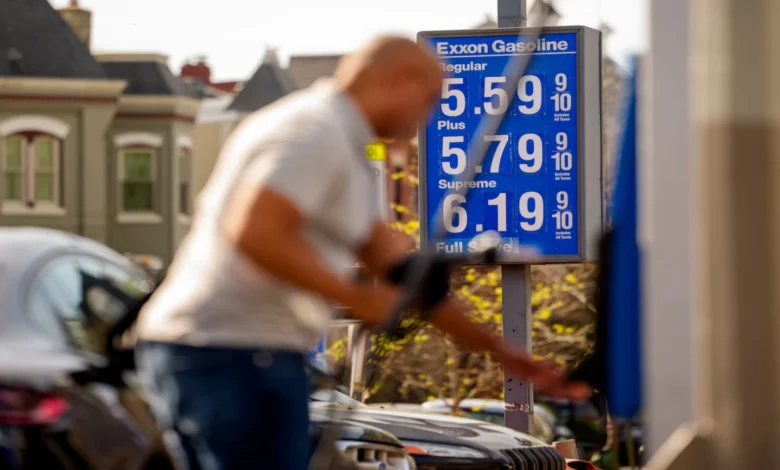
As of late May 2026, the national average for a gallon of gasoline stands at $4.53, according to AAA data. This represents a nearly 10 percent increase from the previous month and a staggering 42 percent increase from the same period in 2025, when prices averaged $3.18. In high-cost urban centers like Washington, D.C., prices have already breached the $5.00 mark, placing significant strain on household budgets.
The energy crisis is not occurring in a vacuum. High fuel costs are a primary driver of broader inflationary pressures across the U.S. economy. In April, the Consumer Price Index (CPI) rose by 3.8 percent year-over-year. The "pass-through" effect of high diesel and gasoline prices is visible in almost every sector:
- Agriculture: Oil is a critical feedstock for the production of synthetic fertilizers. The spike in energy prices has caused fertilizer costs to skyrocket, leading to higher food prices at grocery stores.
- Logistics: Increased shipping surcharges are being applied to consumer goods, airfare, and home delivery services.
- Mass Transit: Municipal transit authorities, already struggling with post-pandemic ridership shifts, are facing higher operational costs for bus fleets.
In this context, critics argue that a savings of 18.4 cents per gallon—the current federal tax rate for gasoline—is a drop in the bucket. For a consumer filling a 15-gallon tank, the total savings would amount to less than $3.00 per trip to the pump, a figure that many argue is insufficient to offset the rising costs of rent, groceries, and utilities.
The Legislative Push for a Tax Holiday
Despite the skepticism of economists, the political momentum for a gas tax holiday is growing. Members of both the Republican and Democratic parties have introduced various versions of the "Gas Price Relief Act," seeking to suspend the federal tax through the end of the 2026 calendar year.
President Trump, speaking to reporters last week, characterized the tax as an unnecessary burden on "hard-working Americans" during a period of international crisis. White House spokesperson Taylor Rogers echoed this sentiment, describing the suspension as a "temporary measure" designed to provide immediate psychological and financial breathing room for families planning summer vacations.
However, the President does not have the unilateral authority to suspend the tax. The federal gasoline tax was established by Congress in 1932 and requires a legislative act to be altered or removed. Historically, the tax has never been suspended, largely because of its role as the foundational revenue source for the nation’s transportation infrastructure.
Infrastructure at Risk: The Highway Trust Fund
The most significant argument against the tax holiday is the potential devastation of the Highway Trust Fund (HTF). The HTF is the primary source of federal funding for highway maintenance, bridge repairs, and mass transit projects across all 50 states.
Even before the current energy crisis, the fund was in a state of "severe insolvency." According to a 2025 infrastructure report card, nearly 40 percent of the nation’s roadways are in poor or mediocre condition, requiring hundreds of billions of dollars in immediate investment. The federal gas tax has not been increased since 1993, meaning its purchasing power has already been significantly eroded by decades of inflation.
Tyson Slocum, director of the energy program at Public Citizen, warns that cutting off this revenue stream, even temporarily, is a "bad deal" for the public. "What would be dramatic is the loss in federal revenues," Slocum said. "The loss of federal revenues available to ensure that our transportation infrastructure remains sound… it’s just not a good deal for consumers."
Analysts also point to the "political trap" of temporary tax cuts. Once a tax is suspended, reinstating it becomes a political liability, particularly as the 2026 midterm elections approach. There is a high probability that a "temporary" holiday could be extended indefinitely, leading to a permanent deficit in infrastructure funding that would eventually require a massive taxpayer bailout or lead to the further decay of the national transport network.
A Chronology of the 2026 Energy Crisis
To understand the current predicament, it is necessary to trace the timeline of events that led to the $5.00 gallon:
- January 2026: Global oil markets remain stable with Brent crude at $65/barrel. U.S. inflation shows signs of cooling.
- March 4, 2026: Following a breakdown in diplomatic talks regarding regional maritime security, the U.S. and Israel conduct joint airstrikes on strategic facilities in Iran.
- March 10, 2026: Iran deploys "mosquito boats" and naval mines to the Strait of Hormuz, effectively halting the passage of oil tankers. Global oil prices jump 15 percent in 24 hours.
- March 31, 2026: Gas prices in the U.S. Northeast and West Coast hit $5.00 per gallon. The White House begins internal discussions on fuel subsidies.
- April 7, 2026: A 14-day ceasefire is brokered. During the height of the uncertainty, Brent crude hits a record $144 per barrel.
- April 21, 2026: The ceasefire expires without a long-term resolution. The Strait remains closed.
- May 15, 2026: President Trump publicly calls for a federal gas tax holiday.
- May 22, 2026: Congressional committees begin debating multiple bills to suspend the tax, amid warnings from the Department of Transportation regarding the Highway Trust Fund’s balance.
Analysis: Will the Savings Reach the Consumer?
A final point of contention among economists is whether the 18.4-cent reduction would actually be passed on to the consumer. Gasoline prices are determined by a complex interplay of crude oil costs (55%), refining costs (14%), distribution and marketing (16%), and taxes (15%).
When a tax is removed at the retail level, there is no guarantee that gas station owners—many of whom operate on thin margins—will lower their prices by the full amount of the tax. In previous state-level experiments with gas tax holidays, research has shown that retailers often capture a portion of the tax cut to offset their own rising operational costs, such as electricity for pumps and increased credit card processing fees.
Furthermore, if the demand for gasoline remains high during the summer months despite the high prices, the basic laws of supply and demand suggest that any reduction in tax might simply be absorbed by a corresponding increase in the base price of the fuel.
Conclusion: A Precarious Path Forward
As the debate intensifies, the United States finds itself at a crossroads between short-term political expediency and long-term economic stability. While the "gas tax holiday" offers a simple narrative of relief, it fails to address the root causes of the 2026 energy crisis: a volatile geopolitical situation in the Middle East and a domestic infrastructure system that is "literally crumbling."
Without a resolution to the conflict in the Strait of Hormuz, the upward pressure on energy prices is likely to persist through the autumn. For now, American motorists are left caught between the high costs of the pump and the long-term costs of a deteriorating national highway system, with no easy solutions on the horizon.
Related posts: