Astronomers Witness the First Known Disappearing Exoplanet as Gravitational Tug-of-War Tilts Its Orbit Out of Sight

The cosmos is frequently romanticized as a celestial clockwork, an environment governed by clock-like precision where planets trace absolute, unvarying ellipses around their host stars for billions of years. However, recent astronomical observations are shattering this tranquil illusion. For the first time in the history of observational astronomy, scientists have witnessed a massive alien world effectively vanish from view as it was violently thrown out of alignment by an unseen, neighboring celestial body.
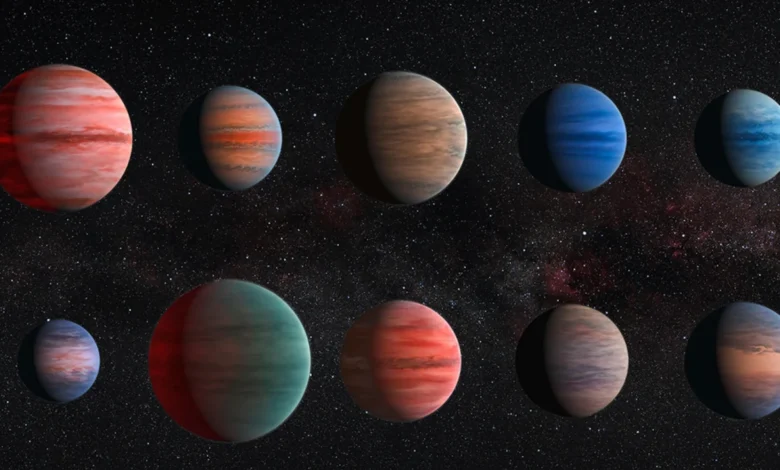
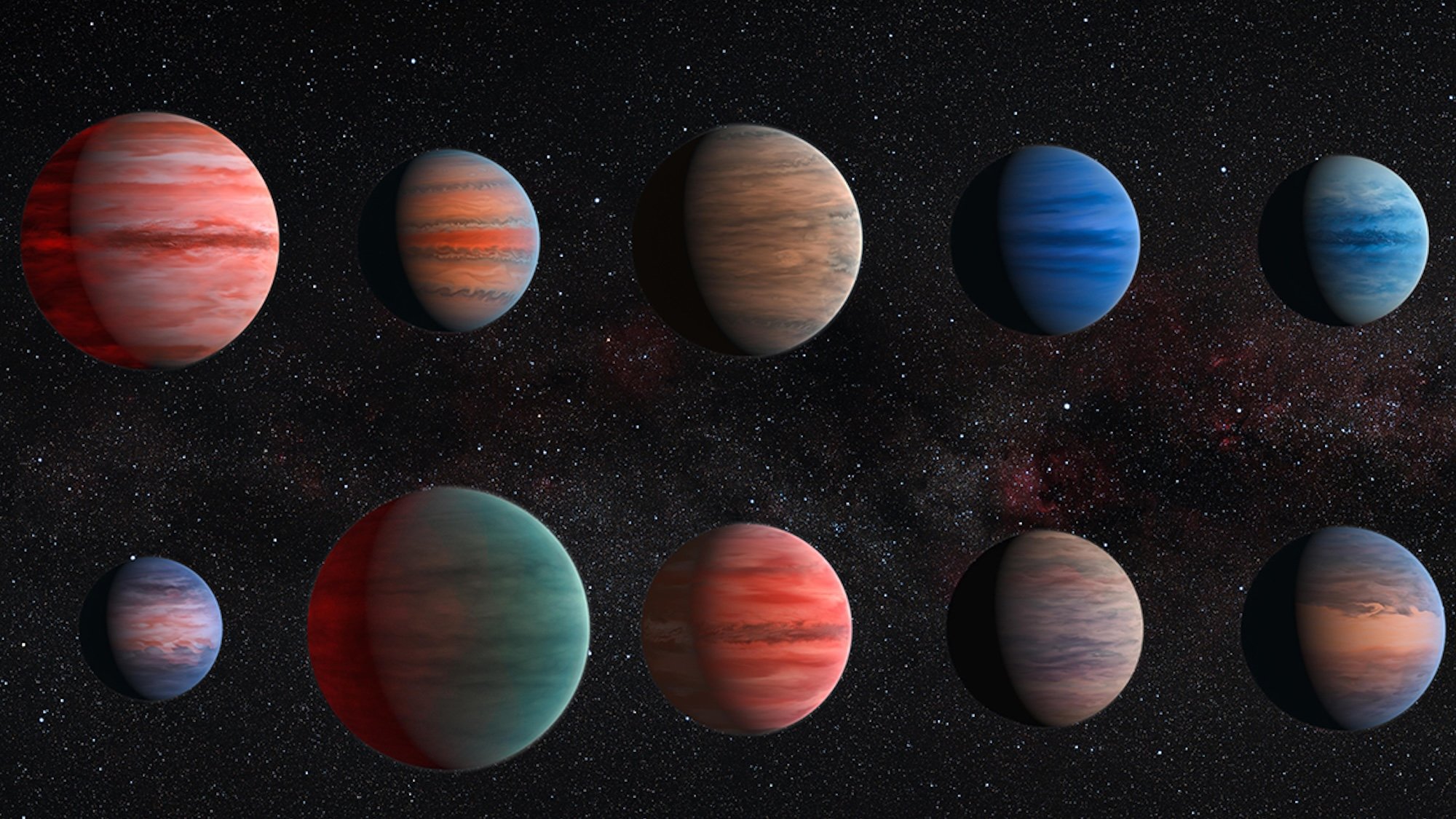
Located approximately 1,000 light-years from Earth, the planetary system in question hosts an exoplanet designated as TOI-2535 b. This strange world belongs to a peculiar class of celestial objects known as hot Jupiters—gaseous giants possessing masses comparable to or exceeding that of our own Jupiter, yet orbiting so perilously close to their parent stars that their surface temperatures soar into the thousands of degrees. While these worlds are typically detected through standard transit photometry, TOI-2535 b has recently demonstrated an erratic, unprecedented behavior that culminated in its complete disappearance from Earth-based telescopes.
According to a groundbreaking study published in the Astrophysical Journal Letters, the planet did not evaporate, disintegrate, or fly off into the interstellar void. Instead, the intense gravitational tug-of-war from a close planetary neighbor is causing TOI-2535 b to wobble dramatically on its axis and tilt out of its orbital plane. This orbital precession masks the planet from our line of sight, preventing it from crossing the face of its host star from our vantage point. The discovery offers unprecedented insight into the chaotic, dynamic nature of multi-planet systems and highlights the unpredictable forces shaping planetary architectures across the galaxy.
The Chronology of a Disappearing World: From TESS Discovery to Orbital Anomaly
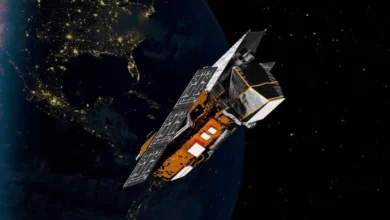
The story of TOI-2535 b began in April 2019, when NASA’s Transiting Exoplanet Survey Satellite (TESS) first trained its high-precision optical sensors on the star hosting the system. TESS operates by continuously monitoring vast swathes of the sky, tracking the infinitesimal, periodic dips in stellar brightness that occur when an orbiting planet passes—or transits—directly between the star and the telescope.
In many respects, TOI-2535 b is an astronomical outlier. While our solar system’s innermost planet, Mercury, requires 88 Earth days to complete a single revolution around the sun, TOI-2535 b orbits its host star in a staggering 8.25 days. For the first several years of observation, the planet registered predictable, albeit extraordinarily fast, transits. Yet, as researchers continued to compile data gathered by TESS over a seven-year observation window, subtle anomalies began to emerge.
By 2022 and 2023, the transits were no longer adhering to a strict, rigid schedule. Astronomers noticed that the expected dimming events were arriving anywhere from a few minutes to upwards of six hours early or late. Furthermore, the photometric signatures themselves were changing: the dips in stellar light were growing progressively shallower and shorter in duration, indicating that a smaller fraction of the planetary disc was passing across the face of the star.
The climax of this cosmic anomaly occurred in March of this year. During a scheduled monitoring campaign by TESS, TOI-2535 b simply failed to show up. The expected transit window passed without any measurable drop in the host star’s luminosity. The planet had vanished from the perspective of Earth-bound and space-based observers alike.
Unraveling the Mystery: The Physics of Orbital Precession
To explain the sudden disappearance of TOI-2535 b, an international team of astrophysicists turned to complex orbital mechanics. Samuel Yee, an astronomer at the University of California, Los Angeles (UCLA) and co-author of the study, noted that the data pointed decisively away from planetary destruction and toward orbital disruption.
"We think of the universe as resembling clockwork, where everything is regular, but that’s not true," Yee explained in a university profile. "If there are multiple planets in a system, they can affect each other’s orbits."
The research team concluded that TOI-2535 b is not traveling alone in its stellar neighborhood. Instead, the system harbors an extremely close gas giant neighbor possessing a severely tilted orbit. As these two massive worlds sweep through space in close proximity, their mutual gravitational fields exert tremendous tidal forces upon one another.
This gravitational interplay induces a phenomenon known as nodal precession, causing the planets to wobble like spinning tops. Over time, this forced precession tipped TOI-2535 b’s orbital plane at such a steep angle that it no longer crosses the observer’s line of sight from Earth.
"This is the most extreme example we’ve seen because the two planets are interacting so strongly," Yee stated, emphasizing the rapid pace of the transformation. "The planet’s orbit is tilting so quickly that its transit disappeared while we were watching."
Cosmic Parallels: Understanding Eclipses in Our Own Backyard
While the disappearance of an exoplanet sounds like a bizarre, science-fiction scenario, the physical forces governing TOI-2535 b are closely related to familiar celestial mechanics right here in our solar system.
Erik Petigura, a UCLA astrophysicist and co-author of the research, points to the mechanics behind solar and lunar eclipses to illustrate the concept. Eclipses do not occur every single month—as they theoretically would if all orbital planes were perfectly flat and aligned—because the Moon’s orbit around the Earth is tilted by approximately five degrees relative to the Earth’s orbital plane around the Sun (the ecliptic). This tilt is a legacy of the Moon’s cataclysmic formation following a massive planetary collision in the primordial solar system.
"If the Moon’s orbit around the Earth was perfectly aligned with the Earth’s orbit around the Sun, we would see an eclipse every month," Petigura explained. Just as the Moon’s inclination prevents monthly eclipses, the dramatic axial and orbital tilt of TOI-2535 b has shifted it out of the narrow corridor required for transit detection from Earth.
Supporting Data and Observational Challenges
The detection of this phenomenon was made possible only by the unprecedented photometric precision of modern instruments like TESS, combined with long-baseline archival data. Detecting subtle shifts in transit timing—known as Transit Timing Variations (TTVs)—is a primary method by which astronomers infer the presence of non-transiting or gravitationally interactive planets in distant star systems.
However, studying systems undergoing rapid orbital precession presents massive observational challenges. Because the geometry of the system is changing on human timescales rather than geological ones, astronomers must act quickly to capture multi-wavelength photometry and radial velocity measurements before key diagnostic windows close.
In the case of TOI-2535 b, mathematical models constructed by the UCLA research team indicate that the planetary alignment required to produce a transit from Earth’s perspective is exceptionally rare. Based on their orbital trajectory calculations, TOI-2535 b will likely remain hidden behind its inclined orbit, missing from Earth’s view for another 30 to 50 years before precession brings it back into alignment.
Implications for Exoplanetology and the Search for Habitable Worlds
The discovery of TOI-2535 b’s vanishing act carries profound implications for the broader field of exoplanetary science. For decades, transit surveys have operated on the foundational assumption that planetary orbits are relatively stable over the short term, allowing astronomers to build statistical models of planetary abundance, mass distribution, and system architecture.
The revelation that hot Jupiter systems can undergo violent, rapid orbital tilting upends these assumptions. It suggests that many planetary systems may be far more dynamically unstable and chaotic than previously understood. This instability is often driven by migration processes, where giant planets form further out in their stellar systems before spiraling inward toward their host stars, frequently disrupting inner planets and exciting high orbital inclinations or eccentricities in the process.
Furthermore, this discovery serves as a cautionary tale regarding null results in exoplanet surveys. Historically, if a candidate planet stopped transiting, astronomers might have concluded that the initial detection was a false positive, or that the planet had been consumed by its star or ejected from the system. TOI-2535 b demonstrates that an exoplanet can simply duck out of sight, remaining intact and operational within its system while temporarily evading detection.
Future Outlook and Next Steps
As the scientific community digests the findings published in the Astrophysical Journal Letters, researchers are already planning follow-up observations. While TOI-2535 b itself is currently invisible to transit photometry, astronomers hope to catch sight of its elusive, strongly interacting companion planet. If the neighbor’s orbit is similarly precessing, it may soon emerge from behind the stellar anchor, offering researchers a chance to directly characterize the instigator of this cosmic disappearing act.
Moreover, upcoming observations using advanced space-based observatories, such as the James Webb Space Telescope (JWST), could potentially apply infrared radiometry to detect the thermal emission of TOI-2535 b even while it is failing to transit. By measuring the planet’s dayside glow as it orbits the star, scientists could track its movement independently of transit geometry.
For now, Yee, Petigura, and their colleagues acknowledge their extraordinary fortune in having witnessed the event in real-time. Catching a planet in the exact act of tilting out of view is a vanishingly rare event in modern astronomy—a reminder that the universe remains an active, turbulent laboratory where the only constant is change.