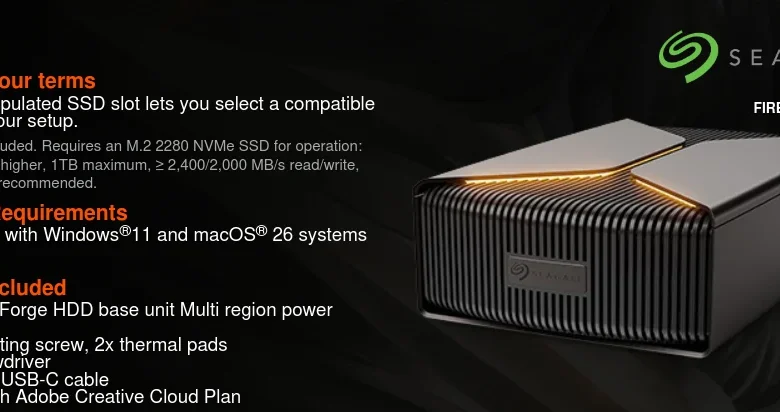
Seagate has officially signaled a return to the hybrid storage market with the launch of the FireCuda Forge, a new line of external storage solutions that marry high-capacity mechanical hard drives with the high-speed performance of user-supplied NVMe SSDs. Announced this past Tuesday, the product represents a significant pivot for the storage giant, which is attempting to solve the modern dilemma of skyrocketing flash storage costs by utilizing a tiered, software-managed architecture. By integrating its proprietary Alkemi intelligent storage platform, Seagate aims to provide the responsiveness of an all-flash array at a price point more aligned with traditional spinning platters.
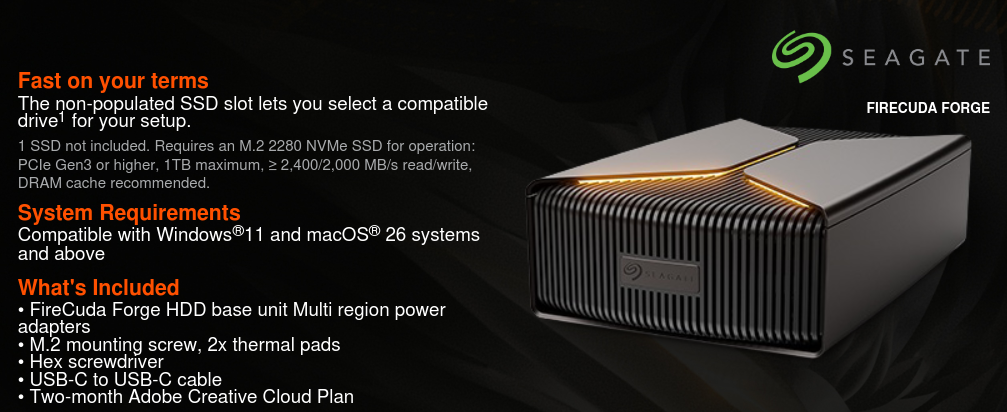
The FireCuda Forge is available immediately via the company’s direct web store, launching with two primary capacity configurations: an 8TB model priced at $699 and a 20TB variant at $899. Notably, these prices do not include the required M.2 NVMe SSD. Instead, the burden of provisioning the "fast" tier of the storage pool falls on the consumer. The units require a PCIe Gen3 or higher M.2 2280 NVMe drive, with a cap of 1TB for the SSD component. Furthermore, to ensure the Alkemi platform performs as intended, Seagate mandates that the user-supplied drive must meet a minimum performance threshold of 2,400MB/s read and 2,000MB/s write speeds, with a DRAM-equipped drive strongly recommended to prevent potential bottlenecks.
A Response to the AI-Driven Storage Crunch
The re-emergence of the hybrid drive concept is largely a reaction to the shifting economics of the storage industry in 2026. Following a period of relative affordability earlier in the decade, the cost per terabyte for high-performance flash storage has seen a sharp increase. This surge is widely attributed to the insatiable demand for high-speed data access driven by the rapid expansion of artificial intelligence and large-scale machine learning model training.
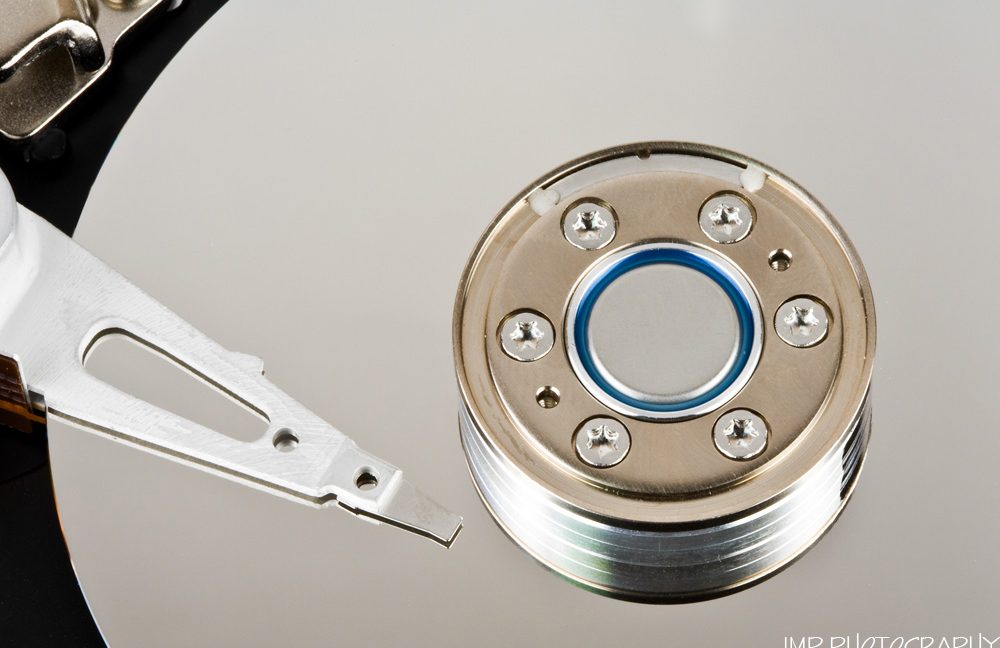
Market data underscores this volatility. Industry analysts at Tom’s Hardware have observed that certain high-capacity NVMe SSDs have seen their prices balloon to two or three times their historical lows recorded in previous years. Mechanical hard drives have not been immune to these pressures, either. A typical enterprise-grade mechanical drive, such as the Seagate Exos 24TB, which was available for approximately $298.99 in the summer of 2025, saw its market price spike to nearly $700 by August 2026. By introducing the FireCuda Forge, Seagate is effectively offering a compromise: the user pays a premium for the enclosure and the intelligent software management layer, but leverages the relative stability of mechanical drive pricing to maintain massive storage volumes without the astronomical cost of an 8TB or 20TB all-flash setup.
The Evolution of Hybrid Storage: A Historical Perspective
The concept of pairing an HDD and an SSD into a single volume is not new, though it has been largely absent from the consumer market for over a decade. In the early 2010s, hybrid drives were touted as the "bridge" technology for users who desired SSD speeds but lacked the budget for large-scale flash storage.
Perhaps the most famous iteration of this technology was Apple’s "Fusion Drive," introduced in 2012. The system worked by presenting two distinct physical disks as a single logical volume to the operating system. Apple’s implementation utilized 128KB tiered blocks, where the system would intelligently move frequently accessed files—often referred to as "hot data"—to the faster flash storage, while relegating colder, less frequently accessed files to the mechanical HDD.
At the time, this was a revolutionary approach to storage management. However, as NAND flash prices plummeted throughout the 2010s and early 2020s, the necessity for such complex tiering disappeared. The market moved toward all-flash arrays, and hybrid solutions were relegated to legacy systems. Seagate’s revival of this model suggests a belief that the current economic environment has come full circle, making the 2012-era strategy relevant once again.
The Alkemi Intelligent Storage Platform
Central to the FireCuda Forge’s value proposition is the Alkemi platform. Unlike previous hybrid solutions that relied on operating-system-level management—such as the macOS-based tiering used in Apple’s Fusion Drive—Alkemi operates directly from the enclosure. According to Seagate’s technical documentation, the platform is designed to "learn and adapt over time," autonomously determining which data belongs on the high-speed NVMe drive and which should reside on the high-capacity HDD.
This shift in management is critical. One of the primary criticisms of earlier hybrid solutions, particularly those that relied on OS-level tiering, was their inherent fragility. If one drive in the pair failed, the entire logical volume often became inaccessible or corrupted, leading to catastrophic data loss. By moving the intelligence to the enclosure’s controller, Seagate claims it can provide a more robust and "simple" user experience. However, the company has remained notably opaque regarding the specifics of how Alkemi handles data redundancy, drive failure, or the initial partitioning process.
Questions regarding whether the system uses simple caching or a more complex automated tiering algorithm remain unanswered. Furthermore, there is no official clarification on what happens if the user-supplied SSD fails, or if the system is capable of rebuilding the storage pool if the HDD suffers a physical malfunction.
Technical Implications and Market Reception
For power users and creative professionals who require both high-speed scratch disks and massive archival storage, the FireCuda Forge offers a compelling, albeit technically demanding, solution. The integration of USB4 support ensures that data transfer speeds are not bottlenecked by the interface, allowing the system to reach the advertised performance targets of 2,500MB/s read and 2,000MB/s write.

However, the requirement for users to bring their own NVMe SSD creates a "black box" variable in the user experience. Performance will vary significantly based on the quality and speed of the user’s chosen SSD. While Seagate provides recommendations, the lack of a standardized benchmark for the "Alkemi-optimized" experience could lead to inconsistent results across different user setups.
Industry experts have noted that while the FireCuda Forge solves the capacity-per-dollar problem, it introduces a level of complexity that the modern plug-and-play consumer may find daunting. The necessity for the user to understand PCIe specifications and DRAM-cache requirements adds a layer of "technical homework" that is rarely required for modern external drives.
Future Outlook and Industry Impact
As the product begins to reach the hands of early adopters, the tech community will be closely watching for evidence of how well the Alkemi platform manages "hot" versus "cold" data. If the system succeeds in delivering a seamless, high-performance experience, it could spark a broader industry trend toward similar hybrid enclosures, especially if the current global trends in NAND flash pricing continue to remain elevated.
Conversely, if the system proves to be as temperamental as the hybrid drives of the past, it may be viewed as a niche product rather than a viable mass-market solution. For now, the FireCuda Forge stands as a testament to the cyclical nature of technology; in an era of unprecedented AI-driven demand, a "new" solution for the storage crisis may indeed be a refined version of an idea that is over a decade old. Seagate has taken a calculated risk in betting that the market is ready to return to the hybrid model, and the success of the FireCuda Forge will likely depend on the platform’s ability to prove that its intelligent management system is truly more reliable than the tiered solutions of the past.