Shadows Over the Beaufort Sea: How a Russian-Backed Energy Venture Infiltrated America’s Arctic Frontier

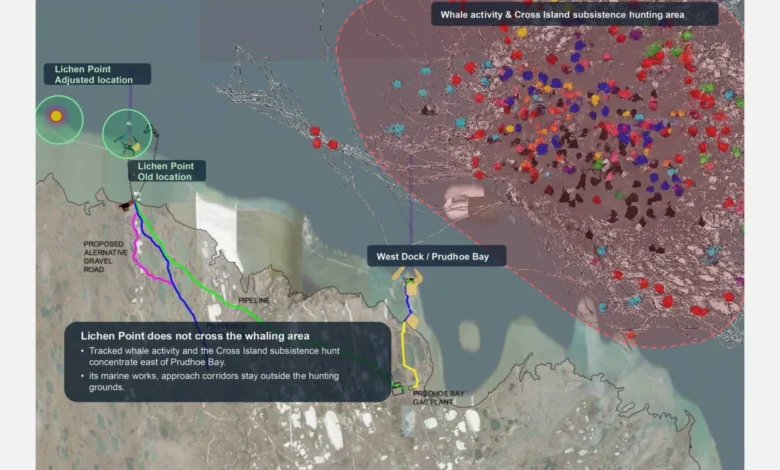
The frigid, storm-tossed waters of the Beaufort Sea off the coast of Alaska have long served as a quiet, vital outpost for American energy security and military surveillance. For decades, the region has been defined by the Trans-Alaska Pipeline System and the presence of U.S. Air Force long-range radar stations, which act as a critical shield against transpolar threats. However, recent investigative findings reveal that this strategic sanctuary was quietly penetrated by a complex, foreign-financed operation. Beneath the guise of a routine liquefied natural gas (LNG) development project, a UAE-based entity—steered by the Russian state-linked energy giant Novatek—conducted extensive seabed surveys that have raised profound questions regarding national security, intelligence gathering, and the integrity of American infrastructure.
The project, branded as Polar Train LNG, ostensibly sought to tap into Alaska’s vast, untapped natural gas reserves. Yet, internal documents and interviews with key stakeholders paint a picture of a venture designed to bypass U.S. sanctions, with the ultimate control of the operation resting in Moscow. The saga highlights a troubling convergence of geopolitical maneuvering, the vulnerability of Arctic data, and the limitations of domestic counterintelligence in an era of shifting global alliances.
A Chronology of Concealed Intentions
The origins of the project trace back to 2025, a year characterized by aggressive posturing in the Arctic. Following a summit in Anchorage, President Vladimir Putin publicly floated the prospect of "cooperating" with American partners in the Arctic, specifically citing Novatek as a potential collaborator. Shortly thereafter, executives from Abu Dhabi-based Tech Wave Industrial Project Management initiated discussions with major energy players, including ExxonMobil, to gauge interest in a North Slope LNG facility.
By the summer of 2025, the effort shifted from boardroom discussions to active surveying. Three large vessels—the Annika Marie, the Ukpik, and the U’alaq—were deployed to the Beaufort Sea. While these were staffed by American contractors, their mission was funded by Tech Wave, a firm effectively controlled by Bjorn Gundersen, a former deputy director for Novatek with a history of executing Russia’s most ambitious Arctic projects.

The scope of the work was alarming to experts. The surveyors utilized high-resolution sonar to map the seabed, collected sediment samples, and analyzed currents and tides. These activities occurred in immediate proximity to the origin of the Trans-Alaska Pipeline and the Oliktok Long Range Radar Site. By early 2026, the project had recruited Joel Riddle as CEO of the U.S.-based Polar Train LNG. Riddle’s tenure, however, was marked by mounting internal friction. He quickly discovered that the project was not merely a commercial venture but a vessel for Russian strategic interests. When Riddle attempted to steer the project toward less sensitive sites near Wainwright, he was met with explicit directives from Tech Wave to prioritize the area near Prudhoe Bay—a site of far greater military and logistical value.
The Metadata Trail and Sanctions Evasion
The most damning evidence of the project’s true authorship emerged from the digital footprints of its regulatory filings. In August 2026, Polar Train applied to the U.S. Treasury Department’s Office of Foreign Assets Control (OFAC) for a waiver to import specialized Russian equipment from a shipyard in Murmansk. While the application was signed by a Washington-based attorney, the document’s metadata identified the author as Evgeniya Kononova, a high-ranking legal officer at Novatek in Moscow.
This revelation suggested that the entire premise of an "American-led" operation was a façade. Further, correspondence obtained during this investigation shows that Denis Solovyov, a top lieutenant to Novatek CEO Leonid Mikhelson, was directly involved in managing the project’s finances and operational timelines. Messages between Solovyov and Riddle reveal a complex web of wire transfers routed through multiple shell companies, intended to keep the project afloat while maintaining a distance from the sanctioned parent entity.
Strategic Implications: Dual-Use Data
The collection of environmental and geophysical data in the Arctic is rarely a purely commercial endeavor; it is inherently "dual-use." Information regarding sea ice stability, bathymetry, and seabed composition is vital for the navigation of nuclear submarines and the deployment of long-range missiles.
Heather Conley, a senior fellow at the American Enterprise Institute, notes that such data collection by a foreign adversary represents a "direct challenge to sovereignty and security." In the Arctic, where satellite coverage is notoriously thin, local ground-level intelligence is a force multiplier. By mapping the seabed near critical military infrastructure, the entities behind Polar Train effectively created a blueprint of the U.S. Navy’s maneuvering space.

Troy Bouffard, director of the Center for Arctic Security and Resilience at the University of Alaska, Fairbanks, argues that the lack of federal interference in these surveys suggests a significant failure of domestic oversight. "It is highly unlikely that intelligence personnel were unaware of such an effort," Bouffard noted. "Work in the austere, militarily sensitive North Slope area stands out. It should not have happened."
The Political Climate and Regulatory Gaps
The timing of this infiltration coincides with a period of significant volatility in U.S. counterintelligence policy. Recent administrative shifts have included the reduction of specialized FBI counterintelligence units and the disbanding of task forces specifically charged with monitoring the assets of Russian oligarchs.
These policy changes have created a vacuum that adversaries are eager to exploit. Emily Harding, a former CIA analyst, emphasizes that effective counterintelligence requires not just personnel, but deep expertise in technical domains. "When you cut back on the people who understand the nexus of industry and state-sponsored espionage, you leave the door open for exactly this kind of ‘gray zone’ operation," Harding said.
Despite these warnings, the current administration has signaled a willingness to use such energy projects as bargaining chips in broader negotiations to end the conflict in Ukraine. The signing of a waiver in October 2026, which exempted Russia from certain sanctions mandated by the Graham Act, has further complicated the regulatory landscape.
Official Responses and Future Outlook
In response to inquiries, Novatek issued a categorical denial, stating: "We state clearly and categorically: any such claims or implications [of intelligence gathering] are false. We are focused on utilizing our technology in Alaska and view this opportunity as a standalone and self-sufficient project."

Polar Train, under the leadership of its new CEO Tim Talkington—a former Goldman Sachs executive with extensive experience in the Russian market—has maintained that the surveys were standard industry practice and that the project remains a vital opportunity for American energy dominance. Following Joel Riddle’s resignation in September 2026, the company dismissed his concerns, characterizing him as a "disgruntled employee."
However, the resignation of a CEO who warned of a "Russian ploy" to gain control of strategic U.S. assets has cast a long shadow over the project’s legitimacy. As Polar Train pushes forward with plans for 2030, the question remains whether the U.S. government will subject the venture to the rigorous national security review it arguably requires.
Conclusion
The case of Polar Train LNG serves as a stark case study in the modern vulnerabilities of the Arctic. As the region becomes increasingly accessible due to climate change, it is transitioning from a frozen buffer zone to a contested theater of geopolitical competition. The ability of a sanctioned Russian entity to organize, finance, and execute extensive surveys in the shadow of critical American military assets illustrates a profound disconnect between commercial ambition and national security.
Without a robust, unified federal strategy to monitor foreign activities in the Arctic, the United States remains susceptible to similar incursions. The Beaufort Sea incident is not merely an isolated dispute over oil and gas; it is a signal that the Arctic frontier is no longer a remote periphery, but a frontline in a sophisticated, ongoing competition for strategic dominance. The lessons from this episode suggest that in the pursuit of energy independence, the cost of overlooking the provenance of one’s partners may ultimately prove to be the loss of the very territory the industry seeks to develop.