The Submerged Predator: Unveiling the Evolutionary Mastery of the Whitemargin Stargazer

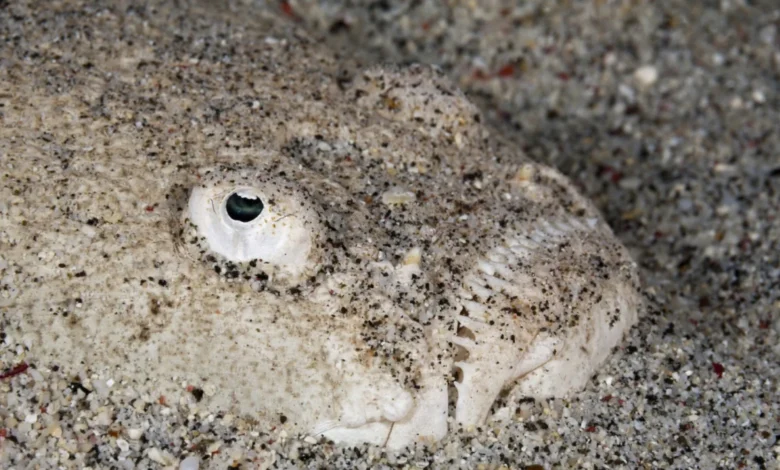
The orange glow of a jack-o’-lantern flickering on a neighborhood porch is a signal designed to be seen—a beacon intended to guide trick-or-treaters through the encroaching darkness of an autumn evening. Yet, beneath the waves of the tropical Indo-Pacific, a creature exists that mirrors this ghoulish aesthetic while operating on an entirely antithetical principle: the necessity of absolute invisibility. The whitemargin stargazer (Uranoscopus sulphureus), a member of the Uranoscopidae family, represents one of marine biology’s most specialized examples of ambush predation. While humans find its appearance unnerving, for the small crustaceans and reef fish that inhabit the same sandy benthic zones, the stargazer is not merely a creature of myth, but a lethal, biological trapdoor.
Anatomy of an Ambush Specialist
The Uranoscopidae family comprises approximately 50 distinct species, all of which share a highly derived morphological blueprint optimized for life on the seafloor. The whitemargin stargazer is perhaps the most iconic representative of this group. Its physical structure is a marvel of evolutionary engineering, specifically designed to function in environments characterized by a lack of three-dimensional cover, such as vast stretches of featureless sand or silt.
The most striking feature of the stargazer is the vertical orientation of its sensory organs. Unlike the vast majority of teleost fish, which possess laterally placed eyes, the stargazer’s eyes, nostrils, and mouth are situated squarely on the dorsal surface of its head. This arrangement allows the fish to remain entirely submerged beneath a layer of sediment while maintaining a constant, upward-facing vantage point. This is the origin of the name "stargazer"—a poetic moniker for a fish that is, in reality, watching the water column for the shadow of an unsuspecting meal.
The fish’s camouflage capabilities are further enhanced by specialized appendages. Surrounding its cavernous mouth are fringes known as cirri. These structures serve a dual purpose: they act as a biological filter, preventing abrasive sand from entering the gills and mouth during the rapid burial process, and they break up the outline of the fish’s face, effectively masking its presence against the textures of the seafloor. When a stargazer chooses to relocate, it employs its large, muscular pectoral fins to displace sand, disappearing beneath the surface in a matter of seconds.
The Lethal Defense: Venom and Electric Discharge
While the stargazer’s primary survival strategy is crypsis—remaining hidden until the moment of the strike—it is by no means defenseless. The family is notoriously well-equipped for encounters with larger predators. Just behind the operculum, or gill cover, the stargazer possesses a pair of formidable, venom-tipped spines. These spines are often associated with a potent proteinaceous venom that can cause severe, long-lasting pain to humans who inadvertently step on the fish in shallow waters.
Beyond its venomous arsenal, the stargazer belongs to a select group of fish capable of bio-electrogenesis. Various species within the Uranoscopidae family possess modified eye muscles that have evolved into electric organs. While not as powerful as those of an electric eel, these organs can generate an electric shock sufficient to deter predators or potentially stun prey. This combination of physical concealment, venomous defenses, and bio-electric capabilities makes the stargazer a formidable occupant of the benthic zone, capable of thriving in environments where other, more exposed species would quickly fall victim to predation.
Ecological Role and Predatory Efficiency
In the ecosystems of the Pacific and Indian Oceans, the whitemargin stargazer acts as a "sit-and-wait" predator. Its impact on the local food web is subtle but significant. By occupying the sediment-water interface, it creates a zone of high risk for organisms such as cardinalfish, blennies, and various species of porcelain crabs.
The mechanism of the strike is characterized by extreme speed. When prey swims within range, the stargazer creates a vacuum by rapidly expanding its buccal cavity, drawing the prey into its mouth in a fraction of a second. This "suction feeding" is a common strategy among many fish, but in the case of the stargazer, it is augmented by the element of total surprise. Because the predator is flush with the seafloor, the victim has virtually no opportunity to detect the threat until the strike is already underway.
Data from field observations in regions like Indonesia’s Komodo National Park suggest that stargazers are highly territorial. Once a suitable patch of sand is claimed, they may remain in that specific area for extended periods, provided the current remains consistent and the supply of prey is sufficient. This sedentary behavior highlights the efficiency of their evolutionary design; they do not need to expend energy hunting because their environment effectively brings the prey to them.
Historical Context and Human Perception
The fascination with the stargazer is deeply rooted in its unconventional morphology. Historically, marine researchers and naturalists have noted the species’ uncanny resemblance to human facial structures, albeit ones that appear distorted or monstrous. This perception has cemented the fish’s status as a subject of curiosity in marine science.
In terms of human interaction, the stargazer is largely a "passive" threat. It does not actively hunt humans, nor does it pursue them. Most human injuries occur when divers or swimmers inadvertently press their feet into the soft sand of the ocean floor, encroaching on the stargazer’s hiding spot. Marine safety experts in the Indo-Pacific region advise that while the stargazer is not inherently aggressive, it warrants the same respect as other venomous marine life, such as stonefish or lionfish. The implications for human safety are relatively low, but the potential for a painful, hospital-requiring injury remains a standard warning in diving and snorkeling safety briefings.
Broader Scientific Implications and Environmental Sensitivity
The study of the whitemargin stargazer provides valuable insights into the broader evolution of benthic fish. The convergence of its features—dorsal eyes, suction feeding, and venomous defenses—illustrates the intense selective pressures of open-sediment environments. As ocean temperatures rise and benthic habitats shift due to climate change, researchers are keeping a close watch on how these specialized predators adapt to changing seafloor compositions.
The degradation of coral reef ecosystems, which often transition into barren, sandy areas as they bleach and collapse, may, in the short term, expand the available habitat for ambush predators like the stargazer. However, the long-term stability of the marine food web depends on the balance between these predators and their prey. If the balance shifts too far toward ambush-style predation, it could lead to localized declines in the population of smaller reef-associated species.
Conclusion
The whitemargin stargazer remains a master of its domain, an evolutionary outlier that has successfully exploited the emptiness of the seafloor to become a apex predator on a micro-scale. Its life is one of patience and extreme, concentrated violence, hidden beneath the shifting sands of the world’s most biodiverse waters. Whether it is viewed as a biological wonder or a nightmarish curiosity, the stargazer serves as a potent reminder of the complexity of marine life. In the vast, dark stretches of the ocean floor, the creature that stays still, looks up, and waits is often the one that holds the most power. As research continues into the life cycles and environmental requirements of the Uranoscopidae, the stargazer will remain a vital subject of study, representing the incredible lengths to which life will evolve to survive in the most challenging of habitats.