Singapore Airlines Unveils Ambitious New Cabin Suite and Business Class Strategy to Redefine Ultra-Long-Haul Travel

Singapore Airlines has officially unveiled its next-generation long-haul cabin products, marking a significant strategic pivot in how the carrier approaches premium travel on its ultra-long-range Airbus A350 and upcoming Boeing 777-9 fleets. The announcement, which details a massive $1.6 billion investment, addresses long-standing passenger feedback regarding sleep quality and cabin flexibility. Central to the rollout are new First Class suites featuring double beds and a re-engineered Business Class product that replaces the traditional "flip-to-bed" mechanism with a more intuitive, continuous-adjustment seating system.

A Chronology of Cabin Evolution
The announcement arrives at a pivotal time for Singapore Airlines, which has historically maintained a reputation for industry-leading innovation. However, the gap between the introduction of its latest products and their fleet-wide implementation has become a point of contention for frequent flyers.
In November 2017, the airline introduced its current A380 Suites and Business Class seats to much fanfare. Yet, nine years later, the transition across the broader fleet remains incomplete, with many long-haul A350 and Boeing 777 aircraft still operating with 2013-era seat designs. The new project, slated for a staggered rollout beginning in the second half of 2027, aims to modernize the experience on 41 existing long-haul A350s and the 31 Boeing 777-9s currently on order.

The timeline for these installations has faced significant hurdles, having been delayed twice. Originally planned for the second quarter of 2026, then pushed to early 2027, the current projection of late 2027 reflects broader industry pressures, including supply chain bottlenecks and the delayed delivery of the Boeing 777-9 platform. While the 777-9 seats have already cleared certification, the A350-specific configurations remain in the testing phase, further complicating the debut date for the ultra-long-range fleet.
Engineering the Future of Business Class
The new Business Class seat, designed in collaboration with BMW’s Designworks and manufactured by Recaro, represents a departure from the airline’s previous "flip" mechanism. By utilizing a forward-facing, staggered 1-2-1 configuration with direct aisle access and privacy doors, the airline seeks to solve the issue of diagonal sleeping.

The technical specifications highlight a shift in ergonomics. While the older seats were noted for their exceptional width, they often required passengers to sleep at an angle. The new seats allow for continuous adjustment from an upright position to a fully flat bed. This shift allows for a more natural sleeping position, though it comes with a trade-off in seat width: the A350 seat will measure 22 inches wide, down from 28 inches in the previous generation, while the wider Boeing 777-9 will offer a 24-inch width. Passengers will also benefit from enhanced entertainment hardware, with 22-inch OLED screens on the A350 and 20-inch displays on the 777-9.
The Return of the Double Suite in First Class
Perhaps the most notable feature of the new rollout is the First Class cabin, designed by PriestmanGoode and manufactured by Collins Aerospace. This product will be installed on the ultra-long-range A350s (four suites) and the 777-9s (six suites).

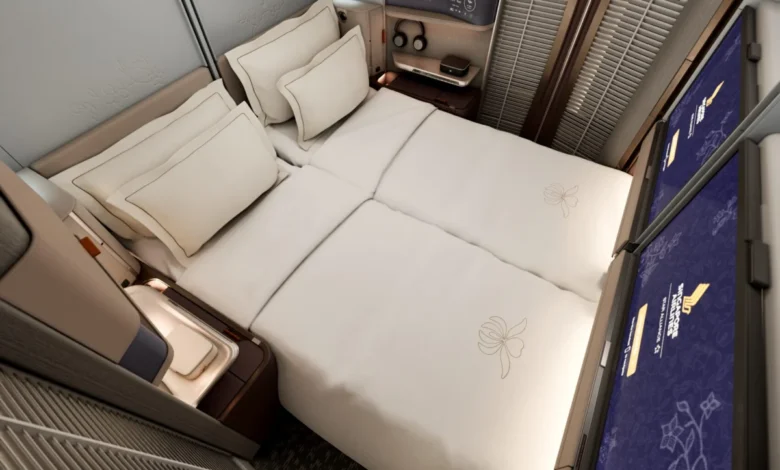
The center pair of seats has been designed to serve as a versatile space, capable of acting as two independent suites or opening into a single, shared environment. The configuration includes a sofa for two that converts into an 80-by-60-inch double bed—the dimensions of a standard U.S. queen mattress. Singapore Airlines has marketed this as the largest double bed currently available in commercial aviation.
The aesthetic design incorporates Poltrona Frau leather, batik-inspired motifs, and curved sliding doors, creating a distinct visual identity that differentiates the First Class cabin from the more clinical, tech-forward Business Class section. Each suite includes a personal wardrobe, an illuminated vanity, wireless charging, and a 32-inch 4K screen. A key return to form is the inclusion of companion dining, which allows two passengers to dine together using the ottoman, a feature that was notably absent in the standard A380 Suites experience.

Fleet-Wide Implementation and Strategic Trade-offs
The cabin refresh program will not be applied universally. The A380, existing 777-300ER, medium-haul A350, 787-10, and 737-8 aircraft are excluded from the current hardware upgrade plan. This leaves the airline with a split product strategy where the most modern experiences will be exclusive to the ultra-long-haul A350 and the new 777-9 jets.
A summary of the hardware allocation:

- 34 long-haul A350-900s: New Business Class, refreshed existing Premium Economy and Economy.
- 7 ultra-long-range A350-900s: New First and Business Class, refreshed Premium Economy.
- 31 Boeing 777-9s: Full suite of four new cabin classes.
The economic implications of this change are significant. On the ultra-long-range A350s, the total passenger capacity will decrease by 18%, from 161 to 132 seats. This is primarily driven by a 38% reduction in Premium Economy seating to make room for the new First Class suites. This restructuring signals a deliberate move by Singapore Airlines to prioritize high-yield premium traffic on its longest routes, which may, in turn, tighten the availability of award seats for loyalty program members.
Passenger Reception and Market Context
Initial reactions from the aviation community have been bifurcated. First Class has received widespread praise for its comfort and the return of social features like companion dining. Conversely, the Business Class cabin has drawn criticism on forums such as FlyerTalk and Reddit. Observers have compared the color palette—characterized by gray surfaces and bright yellow accents—to the interiors of low-cost carriers like Scoot. Critics suggest that while the functionality of the new seats is superior, the design language lacks the warmth and premium feel that defined the airline’s earlier, award-winning cabins.

Furthermore, the complexity of the internal hardware rollout is highlighted by the differences between the first 12 Boeing 777-9s and the subsequent 19 aircraft. The latter will feature OLED screens but omit USB-A ports and universal power outlets in Economy, a move that reflects the rapid pace of technological obsolescence even in brand-new aircraft.
Broader Impact on the Aviation Industry
Singapore Airlines’ decision to invest $1.6 billion during a period of fluctuating global demand underscores the necessity of maintaining a competitive edge in the ultra-long-haul market. By focusing on sleep quality, cabin privacy, and modularity, the airline is attempting to insulate itself from the growing competition in the premium segment, where carriers like Emirates, Qatar Airways, and Lufthansa are also investing heavily in cabin hardware.

As the industry moves toward 2030, the success of this project will be measured not just by the comfort of the seats, but by the airline’s ability to maintain a consistent product across its long-haul network. With the project scheduled for completion by the end of 2030, the airline faces the challenge of managing a diverse product offering while ensuring that its flagship routes remain attractive to the high-spending business and leisure travelers that drive the carrier’s profitability.
The transition, while delayed, represents a necessary evolution. By prioritizing the "sleep experience"—the most critical metric for passengers on 15+ hour flights—Singapore Airlines is positioning its product to remain the benchmark in an increasingly crowded and sophisticated premium travel market. The ultimate test will come in 2027, when the first refurbished aircraft enters service and the long-awaited improvements are finally subjected to the scrutiny of the flying public.