Trump Official Who Wants Data Centers on Public Lands Has Tens of Millions Invested in AI Industry

This ambitious initiative, aimed at securing American technological dominance, has become a cornerstone of the administration’s domestic policy. However, the aggressive push to transform federal land into hubs for high-compute data centers has sparked a growing controversy regarding potential conflicts of interest. As the Department of the Interior and other federal agencies expedite permitting processes, public records reveal that high-ranking officials overseeing these initiatives hold significant financial stakes in the very industry they are actively promoting.
The Strategic Imperative: An Existential Arms Race
The White House has framed the development of AI as a national security necessity. Interior Secretary Doug Burgum, a central architect of this policy, has repeatedly characterized the global competition with China as an “AI arms race.” During his January 2025 Senate confirmation hearing, Burgum emphasized the urgency of the situation, stating, “AI is manufacturing intelligence, and if we don’t manufacture more intelligence than our adversaries, it affects every job, every company, and every industry.”
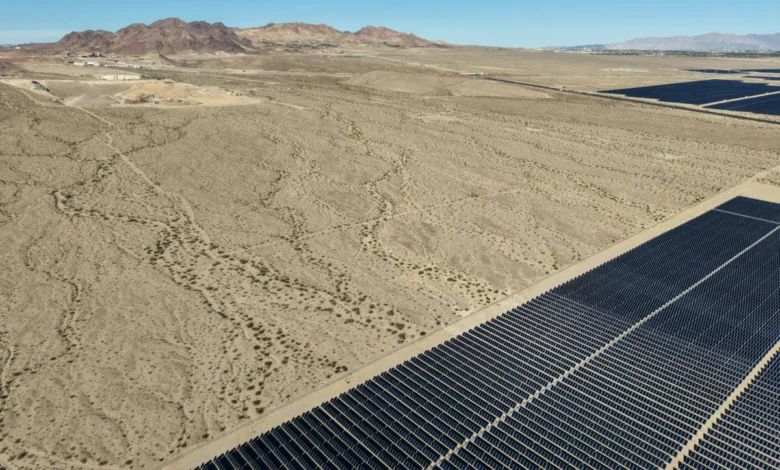
This perspective has led to a pivot in land management policy. The administration is now actively facilitating the construction of massive, power-hungry data centers on federally managed public lands. According to a U.S. Geological Survey report released earlier this year, at least 91.3 million acres of public land—a territory roughly the size of Montana—are being considered as potential sites for this critical infrastructure.
Financial Entanglements and Personal Portfolios
While the administration argues that these projects are vital for the nation’s future, the personal financial disclosures of key officials have raised eyebrows among ethics watchdogs.

Secretary Burgum, who built his fortune in the software industry before entering politics, remains deeply invested in technology. According to his 2026 financial disclosure, a substantial portion of his wealth is tied to Arthur Ventures, an investment firm he co-founded. An analysis by the public lands advocacy group Save Our Parks found that between $18.1 million and $64.4 million of his portfolio is concentrated in AI-focused companies. In the year preceding his appointment, Burgum realized between $2.1 million and $11 million in capital gains from AI-related holdings. In 2025 alone, his divestments and capital gains from the sector totaled between $2.5 million and $15.1 million.
Burgum is not alone. A database developed by ProPublica tracking the financial disclosures of Trump administration appointees shows widespread exposure to industry giants. Approximately 380 appointees or their spouses hold financial interests in Nvidia, the primary manufacturer of chips powering the AI boom. Over 320 have ties to Alphabet, Google’s parent company, which has pledged $195 billion toward AI infrastructure, while more than 240 have investments in Meta Platforms.
Chronology of Policy and Protests
The rapid acceleration of the data center agenda has been marked by a series of significant events:
- January 2025: Doug Burgum testifies at his confirmation hearing, framing AI development as an existential national security priority.
- May 2025: EPA Administrator Lee Zeldin executes trades involving Datavault AI, a company specializing in AI-driven data products.
- June 2025: The Bureau of Land Management (BLM) approves a change in land use for a project near Boulder City, Nevada, pivoting from a solar plant to a data center without an extensive environmental review.
- June 2025: Secretary Burgum attends a high-level dinner at Cafe Milano in Washington with the United Arab Emirates’ AI lead, Sultan Ahmed Al Jaber, and investment firm executive Amos Hochstein.
- July 2025: The EPA proposes a rule change that would eliminate requirements for states to solicit public feedback on air permits for facilities like data centers.
- October 2025: Democratic senators formally demand that the administration cease efforts to use public lands for data centers and call for greater transparency.
- Late 2025: An Interior Department appeals board pauses the Boulder City project, citing a lack of proper environmental evaluation.
Ethics, Recusal, and Public Oversight
The intersection of public policy and private profit has drawn sharp criticism from ethics experts. While the Department of the Interior maintains that Secretary Burgum has met all federal disclosure requirements, critics argue that compliance with minimum legal standards does not equate to the avoidance of conflicts of interest.
Cynthia Brown, senior ethics counsel at the Citizens for Responsibility and Ethics in Washington (CREW), notes that while criminal statutes require a high threshold of proof—such as direct, documented quid pro quo—there are broader ethical guidelines. “These rules instruct officials not to work on anything that would create the appearance of a conflict of interest,” Brown stated. She argues that Burgum’s active promotion of data centers on public land while maintaining significant investments in the AI sector falls squarely into this category.

Richard Painter, a former chief ethics lawyer for President George W. Bush, suggests that the standard should be more rigorous. “In the Bush administration, the answer would have been, ‘he has to recuse,’” Painter said, emphasizing that an official should stay away from decisions that directly benefit an industry in which they hold significant equity.
Institutional Responses
The administration has consistently defended its actions as a necessary component of economic and technological growth. An Interior Department spokesperson stated, “Secretary Burgum is responsible for helping unleash American energy production and ensuring our nation has the resources and infrastructure necessary to lead the future. That mission requires engagement with industry leaders, stakeholders, and international partners.”
Similarly, the EPA has defended Administrator Zeldin, stating that he followed all ethical protocols to the letter and that his transactions were vetted and cleared by agency ethics officials. Similar defenses have been issued on behalf of Steve Pearce, Director of the Bureau of Land Management, and Michael Boren, an Undersecretary at the USDA. Both officials hold substantial investments in AI and data center-adjacent companies, including xAI and real estate firms specializing in data center acquisitions.
The Broader Implications: Transparency and Environmental Impact
The implications of this policy shift extend beyond potential financial conflicts. By prioritizing the fast-tracking of data centers on federal land, the administration is effectively bypassing the more stringent local and state regulatory processes that have historically served as a check on massive infrastructure projects.
Local communities have expressed significant concerns regarding the environmental footprint of these facilities. Data centers are notoriously water-intensive—often requiring millions of gallons for cooling—and demand massive amounts of electricity. When these facilities are placed on federal land, the public’s ability to intervene or demand accountability is significantly curtailed.

The proposed EPA rule change to limit public comment on air permits for these facilities further underscores the administration’s strategy of minimizing friction. Democratic senators have argued that this move makes it easier to "shroud their construction in secrecy," preventing the very transparency required for a democratic process.
As the "AI Manhattan Project" continues, the tension between national security, economic ambition, and ethical governance remains palpable. The administration’s reliance on the 1976 Federal Land Policy and Management Act—a law written long before the advent of modern cloud computing—to justify these projects remains a point of legal contention. Whether these projects will ultimately serve the public interest or be viewed as a massive, government-facilitated enrichment of the tech sector remains the subject of intense debate in the halls of Congress and beyond.
For now, the administration shows no sign of slowing its pace. As the data center build-out continues, the divide between officials who view these investments as a patriotic duty and critics who view them as a profound breach of public trust continues to widen, setting the stage for ongoing legal and political challenges in the months ahead.