The historical narrative of the Stone Age has long been dictated by the materials that survive the brutal erosion of time. Because lithic artifacts—stone scrapers, blades, and hand axes—are virtually indestructible, they dominate the archaeological record, leading to the colloquial naming of the era itself. However, a groundbreaking discovery at the Abric Romaní rock shelter in Capellades, near Barcelona, is forcing a radical reevaluation of this bias. Archaeologists have uncovered a treasure trove of 597 wooden artifacts, preserved not by waterlogging as is typical, but by the miraculous process of mineral-rich travertine sedimentation. This find, dating back 62,000 to 40,000 years, provides the most compelling evidence yet that Neanderthals were not merely "dumber cousins" of modern humans, but sophisticated woodworkers who operated with complex, planned technological systems.
A Geological Time Capsule
The preservation of organic material from the Middle Paleolithic is an extreme rarity in archaeology. Typically, wood, hide, and fiber decay within years or decades. The Abric Romaní site, however, sits at the base of a towering travertine cliff. Travertine, a form of limestone, is deposited by spring water saturated with calcium carbonate. Over millennia, this water dripped across the shelter’s floor, coating fallen branches, leaves, and discarded tools in a thin, protective mineral crust. As the organic material inside these casts eventually rotted away, it left behind "negative" impressions—perfect, hollow molds of the original objects.
These molds act as high-fidelity fossils. In many cases, the impressions are so precise that microscopic analysis reveals the cellular structure of the wood itself. Since excavations began in earnest in 1983, the research team at the Catalan Institute of Human Paleoecology and Social Evolution (IPHES-CERCA) has painstakingly refined the process of documenting these "empty" objects. Using advanced 3D scanning, photogrammetry, and 3D printing, researchers have been able to "reconstruct" the tools, effectively bringing them back into existence for modern study.
Chronology and Context
The artifacts recovered from the site span a significant window of time, from 62,000 to 40,000 years ago. This period is crucial in human evolutionary history, as it encompasses the later stages of the Neanderthal occupation of Europe, just prior to their eventual replacement by Anatomically Modern Humans (AMH).
The site itself served as a long-term habitation area rather than a temporary kill site. Unlike the famous wooden spears found at Schöningen, Germany, or the spear tips unearthed at Clacton-on-Sea, England—which were primarily associated with hunting events—the Abric Romaní collection represents a full domestic suite. Archaeologists have cataloged a diverse array of items: spears, digging sticks, bark trays, components of structural shelters, and a unique, enigmatic wooden club. The presence of these items in sequential strata proves that woodworking was not a sporadic activity, but an ingrained, routine component of the Neanderthal way of life.
The Complexity of Neanderthal Housekeeping
The evidence from Abric Romaní suggests a structured, organized domestic environment. The team identified a recurring pattern along the back wall of the shelter: a series of small, discrete hearths, roughly 50 centimeters in diameter and spaced about a meter apart. These are interpreted as "sleeping hearths," providing warmth, light, and a perimeter of safety against predators during the night.
The debris patterns around these areas are telling. The innermost parts of the shelter appear to have been used for specialized tasks. The team discovered a five-meter-long branchless pole that fits into the structural logic of a windbreak or a simple lean-to shelter, indicating that Neanderthals possessed the cognitive capacity to modify their environment to create climate-controlled living spaces.
Beyond the sleeping areas, the "busy end" of the shelter was a hub of industrial activity. Here, researchers found large, overlapping hearths surrounded by a high density of animal bones, stone-knapping waste, and discarded firewood. This spatial organization implies a division of labor and a clear understanding of site utility—a hallmark of advanced social intelligence.
Technological Specialization: Spears and the Enigmatic Club
Among the 13 modified tools identified within the collection, the weaponry stands out for its technological maturity. The team recovered a 2.45-meter-long spear lying in close proximity to the antlers of red deer. Analysis of the spear’s point revealed impact fractures that are strikingly similar to those found on the tools of indigenous Australian hunter-gatherers, suggesting that Neanderthals utilized high-velocity, precision-based hunting techniques that required significant force and impact durability.

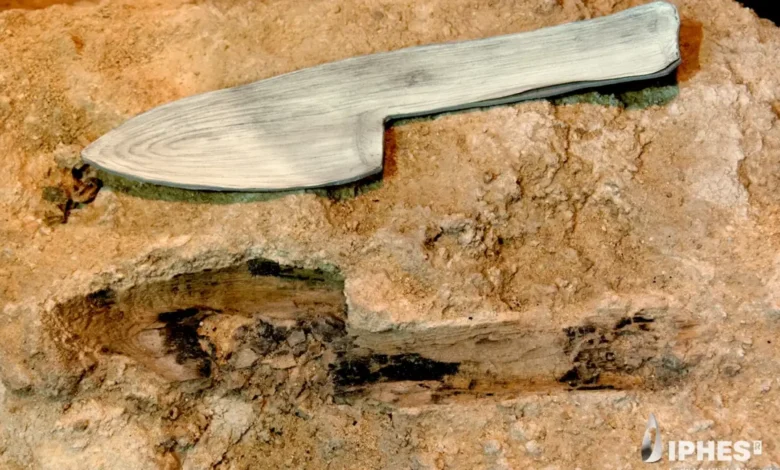
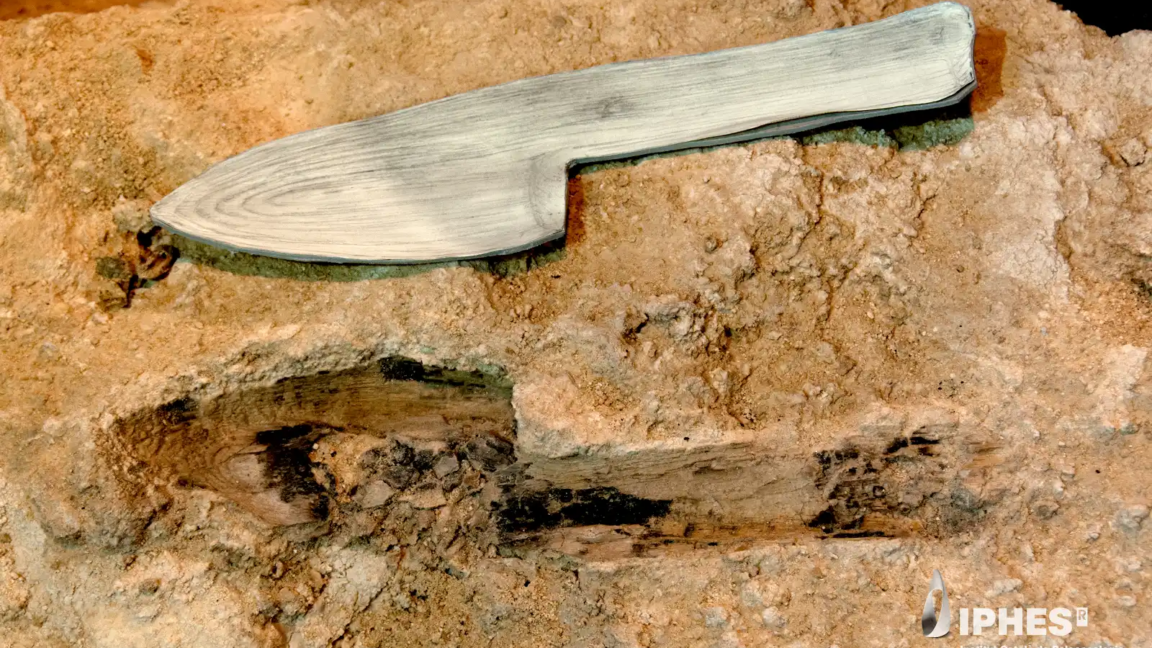
Perhaps most intriguing is the discovery of a wooden club, an object that appears to have no direct precursor in the archaeological record of the region. Carved from a single piece of wood, the club features a 16-centimeter handle, a pointed, triangular head, and a distinct right-angle "step" at the junction, likely designed to prevent the user’s hand from slipping during a strike. While a similarly aged club was discovered at Kalambo Falls in Zambia, the Abric Romaní specimen represents a distinct regional design.
Anthropologists note that in later human societies, clubs served multiple roles—as weapons for close-quarters combat, as tools for processing game, and as symbols of social status. While M. Gema Chacón and her colleagues are careful not to overstate the symbolic value of the object, its presence in a domestic context alongside food-preparation tools suggests it was an essential, multi-purpose implement of everyday survival.
Implications for Human Evolution
The selection of materials reveals a deep, nuanced understanding of forest ecology. The Neanderthals at Abric Romaní demonstrated a clear preference for specific woods for specific tasks: Scots pine was favored for its workability and drying speed, while the fibrous bark of juniper was selected for the construction of trays—likely used for transporting food or managing embers, mirroring the function of "coolamons" used by Aboriginal populations.
This level of material selection implies more than just rote behavior; it requires "executive function," the ability to plan, anticipate needs, and organize labor accordingly. This discovery serves as the latest in a mounting body of evidence—including the creation of decorative objects, the manipulation of fibers for cordage, and genetic evidence of interbreeding—that necessitates a total abandonment of the "dim-witted brute" caricature of the Neanderthal.
Future Directions and Scientific Caution
Despite the significance of the find, the researchers express a sobering concern regarding the history of archaeology. Because wooden tools are so easily overlooked or mistaken for natural debris during the excavation process, it is highly probable that similar discoveries have been lost in the past. Chacón reports that many of her colleagues have expressed regret over past excavations where wooden "anomalies" were discarded because their significance was not recognized at the time.

The Abric Romaní project underscores the need for greater investment in specialized archaeological excavation techniques. As the field moves toward more sophisticated, non-destructive, and digital-first documentation methods, the "missing half" of the Paleolithic—the wooden and organic component—is finally beginning to come into view.
The study, published in Science Advances, concludes that the tools from Abric Romaní should serve as a new interpretive framework for other sites across Eurasia. By treating the archaeological record as a dynamic landscape of both hard and soft materials, future research may finally provide a complete picture of the Neanderthal mind and the complex, resourceful lives they led in the challenging environments of the Pleistocene. The Neanderthals, it appears, were not merely observers of their world; they were its architects, using the very wood of the forest to build the foundations of a successful, enduring culture.