Federal Judge Halts Big Bend Border Wall Construction Following Legal Challenge from Conservationists and Residents

Federal Judge Kathleen Cardone issued a significant preliminary injunction on Friday, effectively freezing all construction activities related to the border wall within the expansive Big Bend sector of Texas. The ruling represents a major victory for environmental advocates, local business owners, and residents who have long argued that the federal government’s fast-tracked barrier projects threaten the ecological integrity and cultural heritage of one of the United States’ most remote and biologically diverse regions. The injunction mandates an immediate halt to all development—including the erection of 30-foot steel barriers and the clearing of land—across the entire sector, which encompasses more than 500 miles of borderland, including Big Bend National Park and Big Bend Ranch State Park.
Legal Grounds and Judicial Reasoning
The decision came after an intensive four-hour hearing in an El Paso federal courtroom, during which the court examined the legality of the Department of Homeland Security’s (DHS) use of federal waivers to bypass environmental and historical preservation laws. Judge Cardone determined that the plaintiffs, a coalition including the Center for Biological Diversity and local stakeholders, were likely to succeed on the merits of their case. Crucially, the judge found that the continued construction posed an “irreparable harm” to the landscape, stating that the government must adhere to established legal frameworks—such as the National Environmental Policy Act (NEPA) and the Archaeological and Historic Preservation Act—before proceeding with any further infrastructure development.
The ruling specifically stays the effect of the waivers that the federal government had previously invoked to expedite the project. By doing so, the court has forced the executive branch to pause its operations until the underlying litigation, filed in April 2026, can be resolved through a full judicial process.
A Chronology of Conflict
The tension in the Big Bend region has escalated steadily throughout 2026. The current administration’s push to fortify the border in West Texas faced immediate pushback due to the unique nature of the land.
- February 2026: Customs and Border Protection (CBP) begins modifying construction plans for the Big Bend sector, signaling an intent to increase barrier density.
- April 2026: A coalition consisting of the Center for Biological Diversity, the Friends of the Ruidosa Church, and local river guide Danny Miller Jr. files a lawsuit against the Department of Homeland Security, challenging the constitutionality of the legal waivers used to bypass environmental oversight.
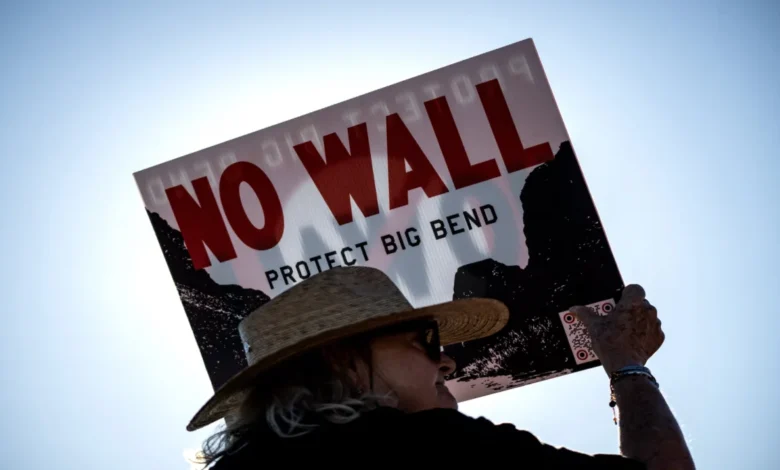
- August 15, 2026: Protesters gather to voice opposition as tensions rise over the deployment of heavy machinery into protected parklands.
- August 17, 2026: Following public outcry and the initial legal pressure, CBP briefly pauses construction activities within Big Bend National Park.
- Late August 2026: The pause is lifted, and construction commences on a 30-foot steel wall in Hudspeth County, prompting the emergency motion for an injunction that led to Friday’s court ruling.
Disputing the Need for Barriers: Data and Analysis
A central pillar of the plaintiffs’ case was the empirical evidence challenging the federal government’s justification for the wall. The government’s official stance has relied on the classification of the Big Bend sector as a high-traffic area for illegal border crossings, a designation that triggers the emergency waivers.
However, expert testimony provided by Adam Isaacson of the Washington Office on Latin America (WOLA) painted a vastly different picture. Isaacson presented data categorizing the Big Bend sector as a “distant last place” in terms of unauthorized entries compared to the other nine border sectors. The plaintiffs’ legal team highlighted that despite repeated requests for granular data regarding apprehensions specifically within the Big Bend National Park boundaries, the federal government failed to produce evidence that would justify the environmental devastation of a protected park.
The disparity between the government’s stated security necessity and the actual border encounter data suggests a disconnect that legal analysts believe may be the weak point in the government’s defense. By failing to provide location-specific data, the DHS faces increasing scrutiny regarding the administrative necessity of its construction projects in such ecologically sensitive zones.
Perspectives from the Frontline
For many in the region, the construction is not merely a policy dispute but an existential threat to their livelihood and connection to the land. Danny Miller Jr., a long-time river guide and a plaintiff in the case, provided emotional testimony during the hearing. He described the proposed wall as a “visible scar that will never go away,” emphasizing that the barrier would permanently alter the character of the Rio Grande corridor.
The courtroom atmosphere was charged; as the injunction was announced, many attendees who had traveled from remote communities like Terlingua and Marfa reacted with relief. For these residents, the Big Bend region is a fragile ecosystem known for its “dark night skies” and status as a refuge for rare biodiversity. They argue that a physical wall would disrupt migratory patterns for wildlife, interfere with the natural hydrology of the Rio Grande, and destroy archaeological sites that have not yet been properly surveyed due to the waived legal requirements.
Official Government Response
The federal government’s stance remains one of cautious resolve. While the Department of Justice provided minimal argument during the Friday hearing and did not present witnesses, a spokesperson for Customs and Border Protection issued a statement following the ruling.
“We stand by our assessment and remain confident in our legal authorities to secure the border while preserving the unique landscape of the Big Bend region,” the spokesperson said. The statement further indicated that the agency is currently in consultations with the Department of Justice to determine the next steps, though the injunction effectively prevents any movement on the ground in the interim.
Implications for Future Border Policy
The injunction carries broader implications for how the federal government interacts with protected lands. By forcing the government to comply with the National Environmental Policy Act, the court is effectively asserting that national security directives do not grant the executive branch total immunity from environmental and cultural preservation mandates.
If the plaintiffs ultimately prevail, the case could set a significant precedent, potentially requiring the government to perform comprehensive environmental impact statements before initiating border projects on public lands. Such a requirement would likely lead to significant delays and higher costs, effectively ending the era of “fast-track” wall construction that has characterized recent policy in the region.
Furthermore, the case highlights the growing divide between federal security mandates and local environmental stewardship. As the litigation proceeds, the court will likely delve deeper into the definition of "border security" and whether the current strategy of building physical barriers is an efficient use of resources in areas where migration patterns have historically been low. For now, the machinery in the Big Bend sector remains silent, and the pristine landscape of the borderlands is granted a temporary reprieve from the encroachment of steel and concrete. The legal battle, however, is far from over, as both sides prepare for the long-term resolution of the constitutional questions at hand.
Related posts: