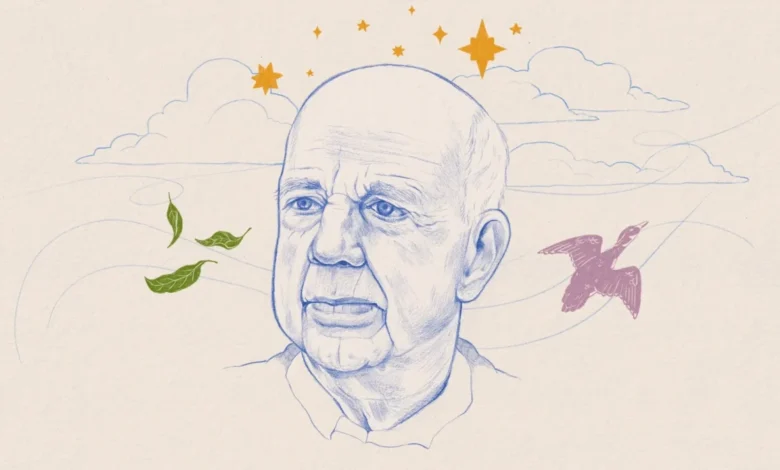
Wendell Berry, the renowned agrarian philosopher, poet, and environmental activist who spent his life championing the sanctity of the natural world and the dignity of local community, died on August 31 at the age of 92. From his ancestral home in Henry County, Kentucky, Berry cultivated a body of work that challenged the trajectory of modern industrialization, urging society to reconsider its relationship with the land. A prolific writer with more than 50 books to his name, Berry’s influence spans generations, bridging the gap between literary critique and grassroots environmentalism. His death marks the conclusion of a singular life that served as a moral compass for those grappling with the intersections of technology, agriculture, and the global climate crisis.
A Chronology of a Life in Resistance
Born in 1934 in Newcastle, Kentucky, Berry’s identity was inextricably linked to the rural landscape of his home state. His career was characterized by a deliberate rejection of the modern digital shift; he famously eschewed computers and smartphones, opting instead for a manual typewriter and pen. This choice was not merely a personal quirk but a fundamental protest against the alienation of labor caused by rapid technological advancement.
His activism was marked by a series of notable public interventions:
- 1972: Published the seminal essay Think Little, arguing that the environmental crisis is not merely a policy failure but a fundamental rupture in how individuals interact with their local ecosystems.
- 1979: Arrested for his participation in protests against the construction of a nuclear power plant in Indiana, signaling his early commitment to direct action.
- 1987: Published Why I am not Going to Buy a Computer in Harper’s Magazine, a defining critique of the encroaching technological dependency of the era.
- 2011: Engaged in a high-profile sit-in at the Kentucky state capitol to protest the practice of mountaintop removal coal mining, resulting in his arrest and bringing national attention to the issue.
- 2015: Withdrew his personal papers from the University of Kentucky in a move of protest against the institution’s acceptance of a $7 million donation from Alliance Coal, citing a conflict of interest with the university’s mission.
Intellectual Framework and the Agrarian Philosophy
At the heart of Berry’s philosophy was a rejection of dualisms. He argued against the artificial separation of humanity from the natural world, the body from the soul, and the partisan divides that often paralyze social progress. His work suggested that the health of the planet is directly proportional to the health of the local community. By "thinking little"—focusing on the immediate, tangible responsibilities of one’s own life and land—Berry believed individuals could counteract the systemic damage caused by global industrial capitalism.
His writing, often categorized as pastoral or agrarian, was in fact deeply radical. He advocated for a return to small-scale farming and the revival of local economies, asserting that industrial agriculture was depleting the soil and the social fabric of rural America. In his famous poem, Manifesto: Mad Farmer Liberation Front, he instructed readers to "Invest in the millennium. Plant sequoias," a directive that served as an antidote to the short-term, profit-driven mindset of the late 20th century.
Impact of Industrialization and Environmental Degradation
To understand the urgency of Berry’s work, one must examine the backdrop of his life: the rapid industrialization of American agriculture. According to data from the U.S. Department of Agriculture (USDA), the number of farms in the United States dropped from approximately 6.8 million in 1935 to roughly 1.9 million by 2024. This consolidation toward massive, corporate-owned industrial farms—the very phenomenon Berry spent his life critiquing—has led to significant environmental degradation, including topsoil erosion, water contamination, and a loss of biodiversity.
Berry’s critiques of the coal industry in Kentucky also mirrored a broader national struggle. During the 2010s, as the U.S. transitioned away from coal-fired power plants, Appalachian communities faced the dual burden of economic decline and the environmental scars of mountaintop removal. Berry’s insistence that these communities be treated as more than "sacrifice zones" for the energy industry provided a moral framework for local activists who felt ignored by state and federal regulators.
Perspectives on the "Luddite" Label
Critics often labeled Berry a "Luddite," a term he largely embraced in the historical sense. Much like the 19th-century English textile workers who destroyed machinery that threatened their livelihoods, Berry argued that technology should serve human dignity rather than diminish it. In an era where artificial intelligence and automation are accelerating at an unprecedented rate, his warnings regarding the dehumanizing effects of digital tools have gained new relevance.
Jeffrey Bilbro, a professor at Grove City College and a prominent scholar of Berry’s work, noted that the author’s refusal to adopt modern tools was a form of self-discipline. "He recognized the need in a fallen world," Bilbro observed. "Our hands are all dirty, and we’re making these compromises, and it’s better to be honest about the necessity to do so and try to do what we can to live right."
Broader Implications and Future Legacy
The passing of Wendell Berry leaves a void in the American literary and environmental landscape. His legacy is currently being assessed by scholars and activists who see his work as increasingly pertinent in the face of the accelerating climate crisis. Unlike many environmental thinkers who rely on apocalyptic rhetoric, Berry maintained a stance of grounded hope. He argued that while the destruction is profound, the cycle of life and death is constant, and the act of planting, tending, and preserving remains a revolutionary act.
His influence extends far beyond the academic or literary circles. Organizations like The Berry Center, founded in his family’s honor, continue to advocate for small farmers and the protection of land rights. The center’s work serves as a practical application of Berry’s theoretical arguments, demonstrating that sustainable food systems and healthy local communities are not just ideals, but achievable realities.
As climate change continues to alter the viability of traditional farming, Berry’s emphasis on "localism" is being revisited by policymakers looking for solutions to supply chain fragility and carbon emissions. His insistence that we treat the land with a "universal kinship" serves as a reminder that the environmental crisis is, at its core, a crisis of relationship.
A Concluding Reflection
In the final years of his life, Berry continued to write, reflecting on the cycle of time. In his poem A Discipline, he wrote: "It is the time’s discipline to think / of the death of all living, and yet live." This sentiment encapsulates his enduring appeal: the ability to confront the massive, often terrifying scale of environmental and social decline without losing the capacity for joy, labor, and connection.
Wendell Berry leaves behind not just a library of books, but a blueprint for a life lived with intention. Whether through his defense of Kentucky’s mountains or his quiet, persistent cultivation of his own farm, he exemplified the belief that one does not need to change the entire world in a single stroke to make a difference. Instead, by tending to the smallest plot of earth—and the smallest relationship—one contributes to the healing of the whole. His life’s work serves as a testament to the idea that even in a world defined by industrial, technological, and environmental disruption, the most radical act remains the simplest: to stay, to care, and to live with purpose.
Related posts: