Trump Fast Tracks Energy Infrastructure for AI Data Centers Amid Environmental and Local Opposition

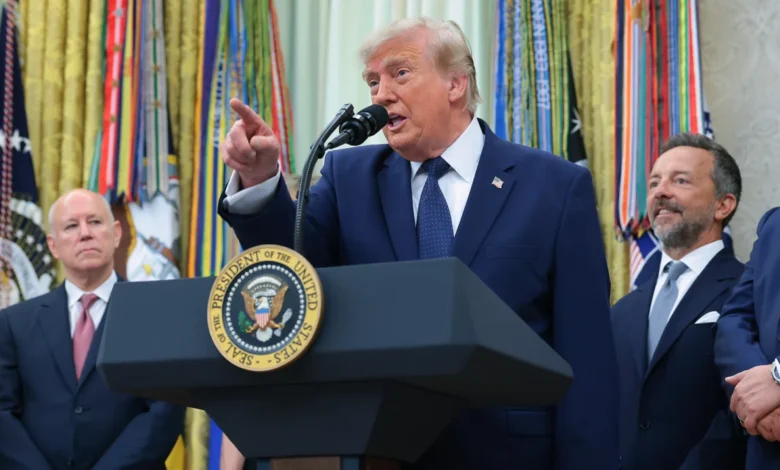
President Donald Trump announced on Monday that his administration has implemented a streamlined regulatory framework designed to approve energy facilities for artificial intelligence data centers within a matter of weeks. Speaking to reporters at the White House on July 6, 2026, the President emphasized that the move is essential to maintaining the United States’ technological edge over foreign competitors. The announcement marks a significant escalation in the administration’s efforts to deregulate the energy sector in favor of Big Tech’s rapidly expanding infrastructure needs.
During his remarks, Trump revealed that recent discussions with leaders in the technology industry—including Meta’s Mark Zuckerberg, Amazon’s Jeff Bezos, OpenAI’s Sam Altman, and SpaceX’s Elon Musk—highlighted a critical bottleneck in the development of next-generation AI: energy capacity. According to the President, these executives informed him that the current race for AI supremacy requires a near-doubling of the country’s existing electrical capacity. Trump noted that many of these leaders were initially skeptical of the administration’s promise to bypass traditional permitting timelines, which typically span years.
"They thought we were kidding," Trump said. "They can’t believe it, that they’re approved in a period of a matter of weeks."
The Surge in AI Energy Demand and Infrastructure
The push for rapid expansion comes as the computing power required for artificial intelligence reaches unprecedented levels. Unlike traditional data processing, AI training and inference require massive clusters of high-performance Graphics Processing Units (GPUs) that operate at high temperatures and consume vast quantities of electricity around the clock.
A report released in June 2026 by the Environmental Integrity Project (EIP) underscores the scale of this industrial shift. The study identified plans for 74 new or expanded methane gas plants across the United States specifically dedicated to powering data centers. These proposed facilities are expected to generate approximately 143 gigawatts of electricity—a figure nearly three times the total power consumption of the state of California.
The geographic distribution of these projects is concentrated in regions with easy access to natural gas and available land. According to the EIP data:
- Texas: 32 proposed gas plants.
- Ohio: 10 proposed gas plants.
- Pennsylvania: 7 proposed gas plants.
These "behind-the-meter" generating units are built on-site, allowing tech companies to bypass the standard electrical grid and ensure a dedicated, uninterrupted power supply. While this practice helps stabilize the broader public grid by isolating heavy industrial loads, it also concentrates pollution and resource consumption in specific localities.
Regulatory Overhaul and the Exclusion of Renewables
The administration’s strategy for achieving "weeks-long" approvals involves a combination of executive actions and agency-level rule changes. Environmental Protection Agency (EPA) Administrator Lee Zeldin has been a central figure in this transition, advocating for the loosening of construction rules for gas-fired plants and the waiving of certain federal environmental protections.
In June 2026, during an energy summit, Zeldin clarified that the federal government would not impose nationwide environmental requirements or recommendations on the data center industry. Instead, the EPA’s stance is that states and local municipalities should determine their own standards. Critics, such as Clara Vondrich, senior policy counsel with Public Citizen’s Climate Program, argue that this hands-off approach is a "green light" for tech companies to build polluting facilities without federal oversight.
Furthermore, the President’s energy policy for AI is notably selective regarding fuel sources. Trump explicitly stated that the administration supports nuclear, oil, and gas for these projects but strictly forbids the inclusion of wind energy in the fast-track program.
"We don’t allow wind," Trump told reporters. "Wind is terrible, it just doesn’t work."
This stance contradicts current energy market trends. According to the U.S. Energy Information Administration (EIA), wind energy currently accounts for approximately one-tenth of the total electricity generated in the United States. Many tech companies had previously committed to carbon-neutral goals, often relying on Power Purchase Agreements (PPAs) with wind and solar farms. The administration’s pivot toward fossil fuels and nuclear power represents a fundamental shift in the industrial energy landscape.
Chronology of the AI Infrastructure Push (2024–2026)
The current acceleration is the result of a multi-year policy trajectory focused on energy independence and technological dominance.
- Late 2024: Major tech firms report a "power crunch," noting that data center projects are being delayed by 24 to 72 months due to grid interconnection queues.
- July 2025: The Trump administration introduces an "AI Action Plan," which begins the process of waiving certain federal environmental rules for "nationally significant" technology projects.
- March 2026: In response to the growing energy demand, the EPA proposes looser construction rules specifically for gas plants serving data centers, citing the need for "energy reliability."
- June 2026: The Environmental Integrity Project releases its report warning that the proposed wave of data center power plants could release 662 million tons of greenhouse gas pollution annually—roughly equivalent to the total annual emissions of Australia.
- July 2026: President Trump confirms that "behind-the-meter" approvals are now occurring in "weeks," and confirms direct coordination with Big Tech CEOs to bypass state-level delays.
Local Resistance and Legislative Countermeasures
Despite the federal push, the rapid expansion of data centers has met with significant resistance at the state and local levels. The primary concerns involve air quality, noise pollution, and the massive water consumption required for server cooling systems. Data centers can consume millions of gallons of water daily, a significant burden in regions prone to drought.
The political backlash has crossed traditional party lines. In Texas, Governor Greg Abbott, a Republican, recently called for a block on new data center developments in rural parts of the state. Abbott expressed concern that the rapid influx of these facilities could overwhelm local resources and negatively impact residential communities. This marked a shift from his previous calls for data centers to simply pay for their own infrastructure.
In the Northeast, the New York State Legislature passed a one-year moratorium on data center permits in June 2026. The bill currently awaits a signature from Governor Kathy Hochul. While Hochul has expressed a preference for municipal-level decision-making, she faces pressure from environmental groups and constituents ahead of the upcoming election.
At the federal level, legislative opposition is being led by Senator Bernie Sanders (I-Vt.) and Representative Alexandria Ocasio-Cortez (D-N.Y.). In March 2026, they introduced a bill proposing a national moratorium on all new data center construction. The legislation seeks to halt expansion until a comprehensive set of AI safeguards—including labor protections and strict environmental standards—is established.
Environmental and Public Health Implications
The environmental impact of 74 new gas-fired power plants is a central point of contention. Beyond greenhouse gas emissions, these facilities release nitrogen oxides and particulate matter, which contribute to smog and respiratory illnesses.
Jen Duggan, executive director of the Environmental Integrity Project, stated that "an industry of the future should not be chained to dirty fuels of the past." Duggan emphasized that the public has a right to transparency regarding water usage and air pollution, particularly in areas already struggling with environmental degradation.
Proponents of the administration’s plan argue that the economic and strategic benefits of AI leadership outweigh these concerns. They contend that the rapid deployment of AI will eventually lead to efficiencies in other sectors, such as logistics and manufacturing, which could indirectly reduce emissions. However, there is currently little data to suggest that these indirect gains will offset the immediate and massive increase in carbon output from dedicated gas plants.
Broader Economic and Global Impact
The White House’s decision to fast-track energy infrastructure is deeply rooted in the concept of "AI Sovereignty." The administration views the development of large-scale AI models as a national security priority, similar to the space race or the development of nuclear technology in the 20th century. By reducing the "permitting friction," the U.S. hopes to attract more investment from global tech firms that might otherwise look to regions with fewer regulations.
However, the strategy creates a complex landscape for multinational corporations. Many of the companies Trump mentioned—Meta, Amazon, and Google—have long-standing corporate sustainability goals. Being "forced" or incentivized to use gas and oil rather than renewables could create friction with their shareholders and international regulators, particularly in the European Union, which maintains strict carbon accounting standards.
As the midterm elections approach, the debate over data centers is expected to intensify. With communities in Ohio, Pennsylvania, and Virginia increasingly vocal about the industrialization of rural landscapes, the administration’s "weeks-long" approval process will likely face legal challenges from environmental groups and local governments seeking to reassert their authority over land use and resource management. For now, the administration remains committed to its course, viewing the hum of data center servers as the sound of the future American economy.