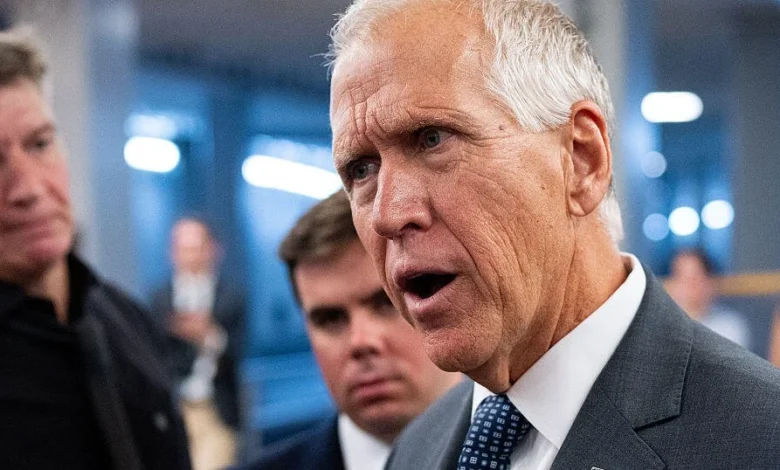
Republican Senator Thom Tillis has publicly challenged the diplomatic strategy of President Donald Trump following the decision to host Chinese President Xi Jinping for a formal state dinner at the White House this week. The retiring North Carolina senator, in a candid interview with CBS Evening News anchor Tony Dokoupil, characterized the administration’s red-carpet treatment of the Chinese leader as a "WTF moment," highlighting a deepening rift within the Republican Party regarding the appropriate posture toward Beijing.
This state visit represents a significant pivot in the administration’s foreign policy, moving from the aggressive tariff-heavy confrontations that defined the early months of President Trump’s second term to an emphasis on diplomatic engagement and personal rapport. For observers of U.S.-China relations, the sudden shift has raised questions about the strategic objectives of the White House and the potential trade-offs regarding American security and human rights advocacy.
A Chronology of the Diplomatic Shift
The current state of U.S.-China relations is the result of a volatile two-year period. Upon returning to the Oval Office in early 2025, President Trump initiated a series of aggressive trade policies, implementing substantial tariffs on Chinese imports. This sparked a retaliatory cycle that saw both nations hike duties to levels exceeding 100% on various goods, creating significant disruption in global supply chains.
By mid-2025, the economic strain of the trade war, coupled with inflationary pressures in the U.S. and domestic challenges within China, led both sides to pursue a "tariff truce." The agreement, signed later that year, sought to stabilize markets and provide a foundation for dialogue. However, the current state dinner signifies a transition from a purely transactional economic negotiation to a broader diplomatic overture.
During the arrival ceremony on Thursday, President Trump surprised many observers by declaring that he and President Xi had developed a "truly great friendship." This rhetoric stands in stark contrast to the populist, "America First" campaign promises that originally propelled the administration’s hardline stance against Beijing.
Senator Tillis’s Critique and Security Concerns
Senator Tillis, a senior member of the Senate Armed Services Committee, articulated his disapproval not just through the lens of political optics, but through specific security and human rights concerns. He noted that the administration’s warm reception of the Chinese leadership occurs against a backdrop of ongoing geopolitical friction.
Tillis pointed to several critical issues that he believes warrant a more confrontational approach:
- Human Rights: The ongoing international condemnation of China’s treatment of Uyghur populations in Xinjiang.
- Espionage and Cyber Activity: Allegations regarding Chinese access to sensitive U.S. voter databases and the sophisticated use of cyber-espionage tools.
- Regional Instability: Reports suggesting that Iran has leveraged Chinese-provided intelligence to target U.S. military assets in the Middle East.
- Taiwanese Defense: The recent, unexplained delay in critical arms shipments destined for Taiwan, which Tillis views as a concession that undermines regional security architecture.
"It’s not that Xi Jinping is coming here to learn how to become a democratic, capitalist nation," Tillis argued. "Xi Jinping is trying to understand how his opposition will ultimately embrace their worldview." The senator’s frustration centers on the perceived lack of reciprocity in the relationship. He emphasized that building a productive relationship requires holding the Chinese government accountable for actions that violate international norms, a standard he feels the White House is currently failing to maintain.
The Contrast with Allied Relations
A central component of the senator’s critique is the perceived imbalance in how the White House prioritizes its relationships with global partners. Tillis noted that the elaborate preparations for President Xi’s visit seem disproportionate when compared to the reception afforded to democratic allies, such as Ukrainian President Volodymyr Zelenskyy.
This comparison touches on a broader debate within the U.S. foreign policy establishment regarding "realism" versus "value-based" diplomacy. Critics of the current administration’s approach argue that by prioritizing high-level access for autocrats over steadfast support for democratic partners, the U.S. risks eroding the alliances that have served as the bedrock of Western security since the post-World War II era.
Economic and Strategic Implications
The sudden warming of ties has prompted speculation about what, exactly, has changed behind closed doors. Senator Tillis admitted his confusion, stating, "I just don’t know what has changed. Whatever has changed had to have been at a confidential level, because I haven’t seen any public basis for the sea change that we see right now in our posture towards China."
Economists suggest that the shift could be driven by a necessity to address long-term debt sustainability and the desire to avoid a prolonged global recession. China remains the second-largest economy in the world and a critical link in the manufacturing of high-tech components. A rapprochement could lead to a more stable environment for American corporations, but it also risks emboldening China in its territorial ambitions in the South China Sea and its economic dominance in the Pacific.
Furthermore, the "confidential" nature of the policy shift raises questions regarding oversight. If the administration has entered into unpublicized agreements with Beijing, it may face pushback from Congress, where bipartisan sentiment remains deeply skeptical of China’s global influence.
Legislative and Political Reactions
While Tillis has been the most vocal critic, he is part of a growing contingent of lawmakers concerned about the administration’s trajectory. The bipartisan consensus on China—which has historically been one of the few areas of agreement in a polarized Washington—is showing signs of stress.
Some Republican colleagues of the president have adopted a "wait-and-see" approach, suggesting that the president’s personal diplomacy may be a tactical maneuver designed to extract concessions on intellectual property rights or trade imbalances. Others, however, share Tillis’s concern that the "great friendship" rhetoric could signal a retreat from the competitive stance that the administration championed during the election.
The Democratic response has been similarly nuanced. While party leaders have historically criticized the administration’s isolationist tendencies, they are now criticizing the lack of transparency regarding this sudden pivot. Many are calling for a classified briefing to understand what intelligence or strategic calculations triggered the shift in posture.
Looking Ahead
The coming weeks will be critical in determining whether this state visit produces tangible results or if it remains a purely symbolic event. The success of the visit will likely be measured by several benchmarks:
- Market Access: Whether China makes concrete commitments to reduce non-tariff barriers for American firms.
- Military De-escalation: Whether there is a measurable decrease in Chinese military maneuvers in the Taiwan Strait.
- Intellectual Property: Whether Beijing takes steps to curb the state-sponsored theft of American technology.
For Senator Tillis and his colleagues, the administration’s current path is fraught with risk. The challenge for the White House will be to balance the desire for diplomatic breakthroughs with the imperative to address the legitimate security concerns of a bipartisan majority in Congress. As the geopolitical landscape remains increasingly volatile, the "sea change" in U.S.-China relations will undoubtedly continue to be a focal point of debate in Washington for the remainder of the presidential term.