Three Frontier Airlines passengers arrested after boarding flight without authorization during baggage fee dispute

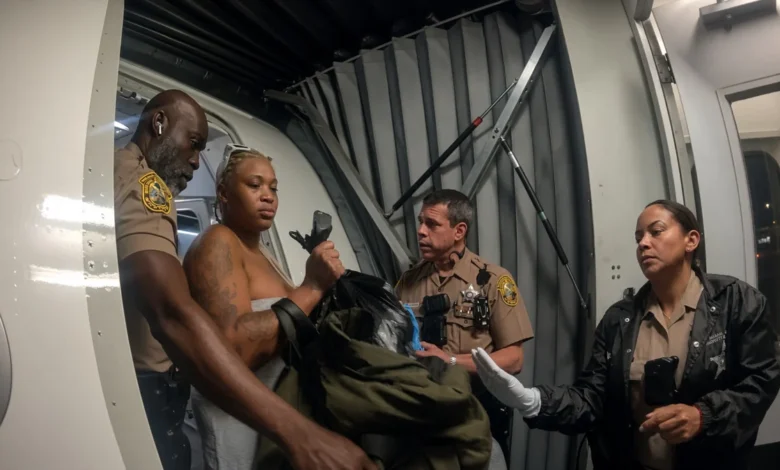
The escalation of tensions at boarding gates has become a persistent challenge for modern commercial aviation, culminating in a dramatic scene at Miami International Airport (MIA) on March 29. What began as a routine disagreement over carry-on luggage fees aboard Frontier Airlines Flight 1204 rapidly spiraled into a security incident, resulting in the physical removal and subsequent arrest of three passengers. Newly released body-camera footage from the Miami-Dade Police Department has provided a granular look at the encounter, reigniting debates regarding passenger conduct, airline enforcement protocols, and the appropriate threshold for law enforcement intervention in civil aviation disputes.
Chronology of the Incident
The sequence of events commenced during the pre-boarding phase of Flight 1204, which was scheduled to depart from Miami to Philadelphia. The dispute originated from a common airline operational policy: the necessity for passengers to pay for additional carry-on baggage that exceeds the weight or quantity limits stipulated by their specific fare class.
According to flight manifests and ground staff reports, the three passengers in question possessed three individual reservations but were attempting to travel with two carry-on bags, despite only having pre-paid for one. Gate agents informed the passengers that the second carry-on bag required an additional payment before they would be permitted to board the aircraft.
As the situation intensified, the passengers engaged in a verbal altercation with the ground staff. Despite being explicitly informed that their boarding privileges had been voided due to their non-compliance and aggressive demeanor, the individuals bypassed the gate agents. One passenger was recorded instructing her companions to ignore the staff, stating, "We don’t have to listen; let’s just go." The group proceeded through the boarding door and entered the cabin, effectively circumventing the standard security and verification protocols required for commercial air travel.
Police Intervention and Removal
Upon being alerted to the unauthorized boarding, Frontier Airlines staff requested the assistance of law enforcement. Before the aircraft pushed back from the gate, Miami-Dade police officers arrived to address the breach. During the preliminary briefing on the jetbridge, a Frontier representative informed the officers that the airline had officially canceled the passengers’ reservations and that they were not to be rebooked. Additionally, the airline staff cited concerns regarding the passengers’ behavior, noting that they suspected the individuals may have been under the influence of alcohol.
Officers entered the cabin and instructed the women to deplane. When the passengers refused to comply with the directive to exit the aircraft, the situation necessitated a physical escort. The subsequent footage captured the women being removed from the cabin and brought back onto the jetbridge, where the scene turned confrontational.
The video shows a physical struggle as officers attempted to secure the passengers in handcuffs. During the altercation, one of the women was forced to the floor. An officer is heard on the recording stating, "We’re going to put cuffs on you whenever we want. We’re not going to tell you anything. You’re going to do what you’re told." This specific exchange has since drawn scrutiny regarding the conduct of law enforcement, as legal experts point out that the standard for arrest and the use of restraints must be predicated on specific legal justifications rather than discretionary authority.
Legal Ramifications and Charges
Following their removal from the aircraft, the three women were taken into custody and processed by the Miami-Dade Police Department. All three were charged with trespassing and resisting an officer without violence. Furthermore, one of the individuals faced an additional charge of battery, stemming from allegations that she had spat on a Frontier Airlines employee during the initial dispute at the boarding gate.
All three defendants have entered pleas of not guilty to the charges brought against them. The case serves as a stark reminder of the legal consequences of interfering with airline operations, a category of behavior that has seen increased scrutiny from the Federal Aviation Administration (FAA) and the Department of Justice in recent years. Under 49 U.S.C. § 46504, interfering with the flight crew or flight attendants—or causing a disturbance that threatens the safety of the aircraft—can carry severe federal penalties, including significant fines and imprisonment.

Contextualizing Airline Fee Disputes
The incident at Miami International Airport is not an isolated event but rather part of a broader trend of friction between low-cost carriers and passengers. Frontier Airlines, like many ultra-low-cost carriers (ULCCs), operates on a business model that unbundles services, charging base fares for travel while extracting additional revenue from baggage, seat assignments, and carry-on items.
Critics of this model often point to the high stress levels generated at the gate. When passengers are surprised by ancillary fees at the point of boarding, the resulting frustration can lead to confrontations with gate agents, who are often the frontline employees tasked with enforcing strict corporate policies. While airlines maintain that these fees are transparently disclosed at the time of booking, the perception among many travelers is that the fees are hidden or unfairly applied.
However, industry analysts emphasize that regardless of the validity of a fee dispute, boarding an aircraft after being denied authorization by airline personnel is a significant security violation. "The gate agent is the final authority on who boards the aircraft," says one aviation safety consultant. "Bypassing that authority is not just a customer service issue; it is a security breach that triggers a mandatory law enforcement response."
Implications for Aviation Security
The use of police force in this instance has prompted a discussion about the de-escalation training provided to both airline ground staff and airport law enforcement. While the passengers’ actions were clearly disruptive and legally actionable, the verbal exchange caught on camera—specifically the assertion by the officer regarding the arbitrary nature of the handcuffing—has raised questions about the standard of conduct for law enforcement in high-tension civilian environments.
Moreover, the incident highlights the ongoing challenges airlines face in maintaining operational flow. When a flight is delayed due to an unruly passenger incident, it creates a ripple effect across the carrier’s network, impacting crew duty times, aircraft availability, and passenger connections. For Frontier Airlines, which has faced repeated criticism for its handling of passenger complaints, this incident provides a case study in the difficulty of balancing rigorous policy enforcement with the necessity of maintaining order and safety.
Historical Patterns and Industry Trends
This is not the first time a passenger has refused to deplane from a Frontier aircraft in Miami. In previous incidents, the airline has had to deal with passengers biting law enforcement or creating significant scenes that require the complete offloading of other passengers to ensure the security of the flight.
The frequency of such incidents has led the FAA to maintain a "zero-tolerance" policy regarding unruly passengers. Since the peak of the COVID-19 pandemic, the number of reports regarding disruptive behavior has remained historically high, although it has fluctuated from the extreme highs seen in 2021. Airlines are increasingly utilizing their right to permanently ban passengers who engage in aggressive or illegal behavior, a practice that is becoming more common as carriers seek to protect their staff and maintain the integrity of their flight schedules.
Conclusion
The events of March 29 serve as a multifaceted lesson in the intersection of customer service, corporate policy, and public safety. While the dispute began as a disagreement over a baggage fee—a common point of contention in modern travel—the decision by the passengers to board the aircraft without permission transformed the situation into a criminal matter.
As the legal proceedings continue, the case will likely remain a focal point for discussions regarding how airlines manage passenger expectations and how law enforcement manages the resulting confrontations. Ultimately, the incident underscores the reality that in the environment of commercial aviation, compliance with crew and ground staff directives is a fundamental requirement for the safe and orderly operation of the national airspace system.