The Secret Life and Lethal Strategy of the Whitemargin Stargazer Beneath the Ocean Floor

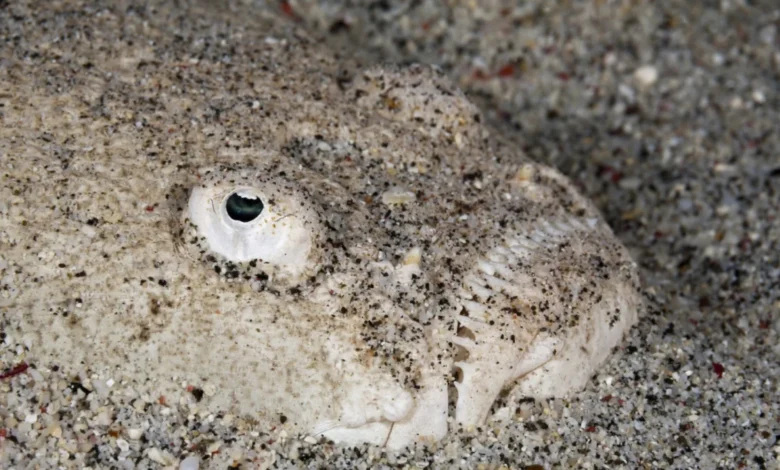
The ocean floor is often perceived as a barren, static expanse of sediment, yet it serves as the stage for some of the most sophisticated predatory adaptations in the natural world. Among these, the whitemargin stargazer (Uranoscopus sulphureus) stands out as a master of biological concealment. While Halloween jack-o’-lanterns rely on internal illumination to cut through the darkness and draw the eye, the whitemargin stargazer utilizes an evolutionary suite of tools designed to ensure that it remains entirely invisible to both predators and prey. This specialized ambush predator, found across the tropical expanses of the Indo-Pacific, represents a pinnacle of morphological adaptation, turning the seafloor into a lethal trap.
Morphology and Evolutionary Adaptation
The whitemargin stargazer belongs to the family Uranoscopidae, a group comprising approximately 50 species characterized by their upward-facing eyes and mouths. Unlike the majority of marine life that relies on speed or schooling behavior to survive, the stargazer has opted for a sedentary lifestyle defined by extreme patience. Its physical structure is entirely optimized for subterranean life. The fish possesses a flattened, sturdy body and oversized, powerful pectoral fins that function like biological shovels, allowing it to bury itself completely beneath the sand or silt in a matter of seconds.
One of the most distinct features of the stargazer is the placement of its sensory organs. Evolution has migrated its eyes, nostrils, and mouth to the dorsal side of its cranium. This anatomical arrangement allows the fish to remain buried with only its most vital observation and intake tools exposed to the water column. As the fish settles into the substrate, it employs a series of oral fringes known as cirri. These delicate, comb-like structures serve a critical functional purpose: they prevent sand and debris from entering the mouth during the burial process, effectively acting as a filter while the fish prepares its ambush.
Chronology of Discovery and Taxonomic Classification
The classification of the Uranoscopidae family dates back to the early 19th century, with initial descriptions often focusing on the fish’s bizarre, "human-like" facial features. The whitemargin stargazer, in particular, was first formally described by scientists who noted its striking, albeit unsettling, appearance. Throughout the 20th century, marine biologists categorized the fish as a primary example of "sit-and-wait" predation.
Recent decades have seen a shift in research focus, moving from mere classification to an understanding of the stargazer’s physiological capabilities, including its ability to generate bio-electric pulses and its potent venom delivery system. Historical records indicate that human encounters, while relatively rare due to the fish’s cryptic nature, have long served as a cautionary tale for divers and coastal researchers. The timeline of understanding the stargazer has evolved from viewing it as a biological curiosity to recognizing it as a key component of the benthic ecosystem, capable of regulating the populations of smaller crustaceans and reef fish.
Data and Physiological Insights
The danger posed by the whitemargin stargazer is not merely in its bite, but in its specialized defense mechanisms. Positioned just above the pectoral fins, the stargazer possesses venomous spines capable of inflicting severe, painful wounds. Data from marine toxicology studies suggest that these spines are coated in a proteinaceous venom that, while rarely fatal to a healthy adult human, causes extreme localized pain, edema, and in some cases, systemic shock.
From a physiological perspective, the stargazer is also a marvel of energy efficiency. Because it spends the vast majority of its time buried, its metabolic rate is significantly lower than that of active, pelagic hunters. This allows it to survive for extended periods between feedings. Marine ecologists estimate that a stargazer can remain in a single location for several days, waiting for the perfect opportunity to strike. When prey, such as a cardinalfish or porcelain crab, wanders within striking distance, the stargazer lunges upward with lightning speed, creating a vacuum that draws the victim directly into its jaws.
The Ecological Role of Ambush Predators
In the complex hierarchy of tropical marine ecosystems, the stargazer plays an essential role in maintaining the balance of the seafloor community. By controlling the population of small bottom-dwelling organisms, they prevent the over-grazing of specific micro-habitats. Their presence is an indicator of a healthy, sediment-rich environment.
Research conducted in areas such as Komodo National Park and the Great Barrier Reef highlights the importance of the stargazer’s niche. Unlike sharks or groupers, which patrol large territories, the stargazer influences a localized area. This "neighborhood" impact ensures that prey species remain mobile, preventing them from over-consuming resources in a single spot. Marine biologists note that the loss of such predators in a given ecosystem could lead to an imbalance in the distribution of smaller invertebrates, potentially cascading into issues for coral reef health.
Human Perspectives and Safety Implications
For human observers, the whitemargin stargazer occupies a space between fascination and fear. Its "ghoulish" appearance, often described in literature as nightmare-inducing, is a result of human projection onto a creature that has simply evolved to survive in a low-light, high-risk environment. Diving safety organizations and local maritime authorities in the Indo-Pacific region frequently include warnings about the stargazer in their educational materials.
The primary risk to humans is accidental contact. Because the fish is perfectly camouflaged, a diver or a wader might inadvertently step on or disturb the fish. Medical professionals specializing in marine envenomations emphasize that immediate immersion of the affected area in hot water—typically between 40°C and 45°C—is the most effective first-aid measure, as it helps to denature the heat-labile toxins present in the stargazer’s venom. Despite the inherent risk, experts emphasize that the stargazer is not aggressive toward humans and will only deploy its venomous defenses as a last resort when it feels threatened or is stepped upon.
Broader Implications for Marine Conservation
The study of species like the whitemargin stargazer provides broader insights into the resilience of marine life. As climate change continues to impact ocean temperatures and sediment composition, the ability of specialized predators to adapt will be a critical factor in ecosystem survival. Shifts in ocean chemistry can affect the availability of prey and the suitability of sand as a substrate for burial.
Conservationists argue that protecting the habitat of the stargazer is synonymous with protecting the health of the entire benthic zone. Pollution, excessive trawling, and coastal development pose significant threats to the soft-bottom environments that these fish rely upon. If the sediment is disrupted or degraded, the stargazer loses its primary defensive and predatory tool, forcing it into more vulnerable positions.
Conclusion
The whitemargin stargazer remains one of the most intriguing, yet misunderstood, inhabitants of the world’s oceans. Its existence serves as a reminder of the sheer diversity of strategies that evolution can produce in the face of environmental necessity. While it may appear to the casual observer as a monster of the deep, it is, in fact, a highly specialized, efficient, and vital component of the marine food web. By understanding the biology and behavior of this "star-gazing" predator, we gain a deeper appreciation for the complex, often hidden, dynamics that govern life beneath the waves. The stargazer does not need to look for attention; it remains content in its sandy solitude, a silent sentinel of the ocean floor, waiting for the world to pass it by.