The Phonological Evolution of Early Childhood and the Enduring Legacy of Linguistic Mispronunciations

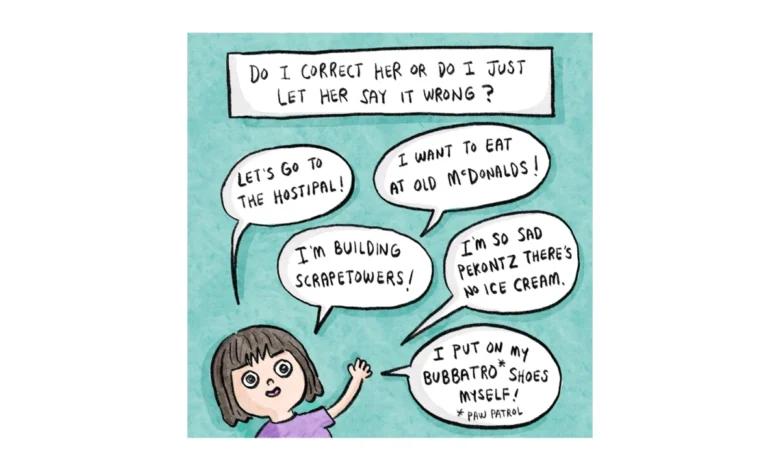
The linguistic development of children between the ages of two and seven represents one of the most complex cognitive milestones in human growth. As toddlers transition from singular words to complex sentence structures, their attempts to master phonemes often result in creative, albeit technically incorrect, pronunciations. Recent discourse among parents and linguistics experts suggests that these "kid-isms"—ranging from "skabetti" for spaghetti to "hop-a-leno" for jalapeño—serve not only as indicators of brain development but also as foundational elements of family culture. While some parents feel an urge to correct these speech patterns, child development professionals argue that these phonetic errors are a natural, fleeting, and significant aspect of cognitive maturation.
The Science of Phonological Acquisition
From a developmental perspective, children do not simply hear a word and reproduce it perfectly. Instead, they must map the auditory input to their own articulatory capabilities. Speech-language pathologists note that the average child does not master all English phonemes until age seven or eight. For instance, the "r," "l," and "s" sounds are notoriously difficult to coordinate, leading to common transpositions where "library" becomes "liBEARy" or "star" becomes "tar."
These errors occur because a child’s brain is operating under immense cognitive load. They are simultaneously learning vocabulary, syntax, and the social rules of communication. When a toddler invents a word—such as "terriscared" to combine "terrified" and "scared"—they are demonstrating a sophisticated understanding of how language roots function, even if they have not yet mastered the standard lexicon. According to data from the American Speech-Language-Hearing Association, the vast majority of these errors are normative. However, early childhood educators emphasize that while these mispronunciations are charming, they are also a window into how children categorize the world around them.
A Chronology of Linguistic Milestones
The trajectory of language acquisition generally follows a predictable timeline, though individual variance is significant. By age two, children typically possess a vocabulary of 50 to 200 words and begin two-word phrases. It is during this period that phonological "shortcuts" are most common, as the child prioritizes communication speed over articulation precision.
By age four, sentences become more complex, but "over-regularization"—applying a grammatical rule where it does not belong—becomes common, such as saying "runned" instead of "ran." By age six, most children have attained near-adult clarity in speech. The "loss" of these mispronunciations, which many parents report with a sense of nostalgia, actually signifies that the child has successfully integrated the rules of their native language.
The Cultural Impact of "Family Slang"
One of the most intriguing phenomena observed in modern households is the "institutionalization" of these linguistic errors. Families frequently adopt these mispronunciations as permanent fixtures of their internal dialect. Interviews with parents suggest that words like "constructions" (for Lego instructions) or "hot sticks" (for French fries) become symbols of shared history.
This adoption of "secret languages" serves a sociological function: it reinforces group cohesion. When an 18-year-old continues to refer to a specific brand of potato chips as "Old Ouch" because they misread the label as a toddler, they are signaling their belonging to a specific family unit. This practice creates a sense of legacy that transcends the child’s actual developmental stage. Experts suggest that these words act as "linguistic heirlooms," maintaining a connection to the child’s early years long after the child has moved into adolescence.
Professional Perspectives on Correction
There is an ongoing debate among parents regarding whether to correct these errors. The current consensus among speech-language pathology professionals is to avoid overt correction, which can discourage a child from speaking. Instead, the "modeling" technique is recommended. If a child says, "Look at the hop-dinger," a parent should respond, "Yes, that is a loud helicopter."
This method provides the child with the correct auditory feedback without the negative reinforcement associated with being told they are wrong. Over time, the child’s neural pathways adjust to the correct phonology without the child feeling self-conscious. Dr. Elena Rodriguez, a specialist in pediatric language development, notes, "Correction can be perceived by a young child as a rejection of their attempt to communicate. By modeling, we support their growth while acknowledging that their current, albeit ‘incorrect,’ version of the word is a perfectly valid step in their development."
When to Seek Intervention
While the majority of childhood speech patterns are benign, experts stress that parents should be aware of the difference between normative development and potential speech disorders, such as dyspraxia or phonological processing disorders. If a child’s speech remains largely unintelligible to strangers by age three, or if specific sound patterns persist well beyond the expected age range, a professional evaluation is advisable.
"The goal is not to police the child’s speech, but to ensure they have the tools to interact effectively with the world," says Dr. Rodriguez. "Most of these ‘cute’ errors—the ‘skabettis’ and ‘liBEARies’—will resolve on their own. However, if a child is struggling to be understood by peers in school, early intervention can make a significant difference in their long-term academic and social outcomes."
Broader Implications for Parenting in the Digital Age
The documentation of these speech patterns has evolved in the digital age. Where parents once relied on handwritten journals, modern caregivers now use digital notes, video, and social media to capture these ephemeral linguistic moments. This creates a permanent archive of a child’s developmental journey.
However, this constant documentation brings new implications. As children grow older, they may find their past mispronunciations recorded and shared without their consent. The balance between capturing a precious memory and respecting the child’s privacy as they grow into a teenager is a new frontier for modern parents.
Ultimately, the phenomenon of the "mispronounced word" remains one of the most humanizing aspects of parenthood. It serves as a reminder that language is not a static set of rules, but a living, breathing, and evolving system. Whether it is a "mystery hook" for a question mark or a "Big Y" for a local supermarket, these utterances represent a child’s first attempt to make sense of the world.
As children mature, they will inevitably replace these charming errors with the precision of standard language. While the loss of these words can feel like the end of an era, the permanence of the family dialect—the "secret code" that persists in the home—ensures that the spirit of these early years remains. For the parent, the lesson is clear: patience, active listening, and a willingness to occasionally embrace the incorrect can provide a richer, more meaningful experience for both the child and the adult. In the rush to raise a child who can speak clearly and effectively, the brief, beautiful window where language is still a work of art should not be overlooked. The "skabetti" may eventually become spaghetti, but the memory of the conversation remains a permanent feature of the family’s narrative.