Texas Education Policy at a Crossroads After Democratic Sweep Dismantles Governor Abbott’s Voucher Program

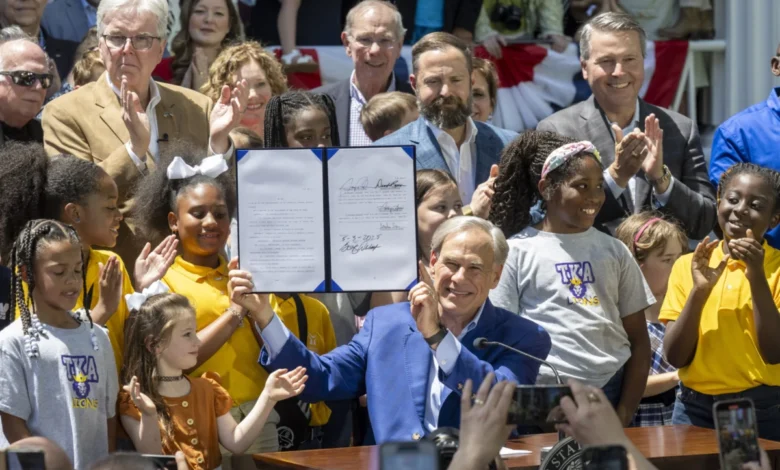
The political landscape of Texas underwent a seismic shift this Tuesday as an aggressive Democratic electoral surge dismantled the cornerstone of Governor Greg Abbott’s second-term agenda, casting the future of the state’s burgeoning private school voucher program into deep uncertainty. After years of meticulous maneuvering by the governor to reshape the Texas education system through privatization and curricular reform, the decisive Democratic victory in the House and the election of Governor-elect Gina Hinojosa suggest that the state is poised for a dramatic, perhaps unprecedented, reversal of policy.
For the past two years, Governor Abbott had successfully enforced a vision that prioritized school choice, state-led intervention in underperforming districts, and a realignment of social studies standards to emphasize American and Texas history alongside mandatory Bible instruction. With the appointment of Commissioner Mike Morath to oversee the Texas Education Agency, the state had embarked on its most aggressive series of public school takeovers in recent history. However, as the final ballots were tallied on Tuesday night, the legislative coalition that sustained these policies fractured, leaving proponents of the voucher program scrambling to salvage a system that serves approximately 110,000 of the state’s 5 million schoolchildren.
A Chronology of the Voucher Conflict
The current crisis for the Texas GOP is the culmination of a protracted legislative battle that began in earnest in 2024. Governor Abbott, frustrated by a bloc of rural Republicans who consistently blocked his voucher proposals out of concern for their local public schools, took the extraordinary step of using his political capital and campaign war chest to unseat these incumbents during the primary season.
By early 2025, the effort reached its zenith: Abbott successfully replaced traditionalist Republicans with pro-voucher candidates, securing the votes necessary to pass a $1 billion state voucher program. This victory, while celebrated by the governor’s inner circle at the time, sowed the seeds of the subsequent political backlash. By the time the 2026 general election cycle arrived, the very districts where Abbott had invested heavily to install loyalists became the primary battlegrounds for a public reckoning.
The electoral results were stark: at least 13 Republicans who were either endorsed or heavily funded by the governor’s political apparatus during the voucher push were defeated by Democratic challengers. The transition of power now shifts to Governor-elect Hinojosa, who has centered her platform on the total dismantling of the voucher infrastructure, labeling the program a "scam" and pledging to terminate the oversight of Commissioner Morath.
The Rural Rejection and the Shifting Electorate
The failure of the voucher program to maintain its political viability was driven, in large part, by a profound loss of support in rural and semi-rural Texas—territory that has traditionally functioned as the backbone of the Republican Party. A comprehensive analysis of the 2026 returns indicates that Abbott’s margin of victory in rural counties plummeted by 16 percentage points compared to his 2022 performance against Beto O’Rourke. In exurban districts, the decline was even more pronounced, dropping by 20 percentage points.
Former state Representative Dewayne Burns, an anti-voucher Republican from the Fort Worth area who lost his seat to an Abbott-backed challenger in 2024, observed that the governor’s heavy-handed tactics created a sense of alienation among his base. "There was a fundamental misunderstanding of the loyalty rural Texans hold toward their local schools," Burns noted. "When the state began treating public education as a secondary priority to a private subsidy program, the bond between the party and the rural voter began to dissolve."
This sentiment was mirrored in the race for House District 121, where incumbent Marc LaHood, who received over $700,000 in support from pro-voucher entities, was defeated by Democrat Zack Dunn. Throughout the campaign, voters in the district consistently identified the preservation of public school funding as their primary concern, effectively neutralizing the narrative that the voucher program was a benefit to families.
Administrative Hurdles and the Path to Repeal
While the political will to end the voucher program exists, the practical path to doing so is complicated by the state’s legislative structure. While Democrats have reclaimed control of the Texas House for the first time in 24 years, Republicans maintain a slim majority in the Senate, creating a significant hurdle for any bill aimed at total repeal.

However, the incoming administration is already preparing to utilize administrative tools to constrain the program’s growth and increase transparency. Sarah Eckhardt, the incoming state comptroller, has announced her intention to move beyond the opaque practices of her predecessors. Under the previous administration, the comptroller’s office frequently cited student privacy laws to withhold data regarding the specific funding levels allocated to private schools and the attrition rates of public school districts.
Eckhardt has pledged to implement rigorous performance audits, tracking the flow of taxpayer dollars to ensure that the voucher program is meeting its stated benchmarks. "My office will follow the money," Eckhardt said in a press conference. "If the legislative investment in this program is not yielding measurable benefits for students, it is my duty to present those findings to the legislature and the public."
The Implications for Private Education Providers
The uncertainty surrounding the program has sent shockwaves through the private school sector. Legal experts representing these institutions warn that the abrupt shift in political power could lead to a chaotic transition. Scott Schneider, an attorney for private schools, indicated that many institutions are currently bracing for a "hot mess" as they navigate potential funding cuts.
While some lobbyists may push for a "grandfathering" clause—which would protect funding for students currently enrolled in the program—the broader consensus is that the program’s future is tenuous at best. Representative Diego Bernal, the Democratic vice chair of the House education committee, expressed confidence that the program would be fundamentally altered, if not abolished, in the upcoming legislative session.
"The program, in its current form, is a relic of the previous administration’s ideology," Bernal said. "It is not sustainable, and it will be unrecognizable by the time the legislature concludes its business."
Broader Policy Impact: A Return to Public Focus?
The broader implications of this political turnover extend beyond the voucher program. The controversial social studies curriculum—which mandated the integration of Bible stories and shifted the focus of history education away from global perspectives toward a more narrow, nationalist framing—is also likely to face a swift repeal.
Educational experts note that the 2026 election serves as a referendum on the role of state-level oversight in local school boards. The aggressive "takeover" policy led by Commissioner Morath, which saw the state seize control of failing districts, has faced criticism for its lack of efficacy and its tendency to ignore local community input. With a new administration committed to local control, the Texas Education Agency is expected to undergo a radical restructuring.
As Texas prepares for this transition, the state’s education system stands at a critical juncture. The experiment with large-scale privatization has met with a decisive electoral rebuke, and the incoming leadership is signaling a return to a more traditional model of state-supported public education. Whether the legislative gridlock between a Democratic House and a Republican Senate will allow for a wholesale repeal of the voucher program remains the most significant unanswered question in Texas politics.
What is certain, however, is that the era of unfettered expansion for the Texas school voucher system has ended. The debate has shifted from whether the state should prioritize private school funding to how quickly and effectively it can return those resources to the public school system, setting the stage for one of the most consequential legislative sessions in the history of the Lone Star State.