Washington Supreme Court Unanimously Removes Pro Tempore Judge for Forging Official Court Document to Obtain Parking Discount

In a decisive ruling that underscores the uncompromising standards of integrity required of the American judiciary, the Washington Supreme Court has ordered the permanent removal of David Ruzumna from his position as a judge pro tempore. The unanimous decision, handed down on Thursday, concludes a multi-year investigation into an incident where Ruzumna used his access to judicial resources to forge an official court document for the purpose of securing a $10 daily parking discount. The high court’s ruling emphasizes that the small monetary value of the benefit sought does not mitigate the gravity of the ethical breach, asserting that honesty is the foundational requirement for any individual entrusted with the power of the bench.
The Incident: A Conflict Over Ten Dollars
The events leading to David Ruzumna’s removal began in 2023 at a parking facility utilized by employees of the King County District Court. Ruzumna, who had served as a substitute or "pro tempore" judge since 2013, sought to avail himself of a $10 discount offered to court personnel. To qualify for this reduced rate, parking attendants required a valid employee badge or an official document affirming the individual’s status as a court employee.
According to court records and the subsequent investigation by the Washington Commission on Judicial Conduct (CJC), Ruzumna first attempted to use his judicial name placard and his judicial robe as proof of his employment. When the parking attendant rejected these items as insufficient identification, Ruzumna did not seek proper HR documentation or pay the full parking rate. Instead, he returned to the court facilities to create a fraudulent credential.
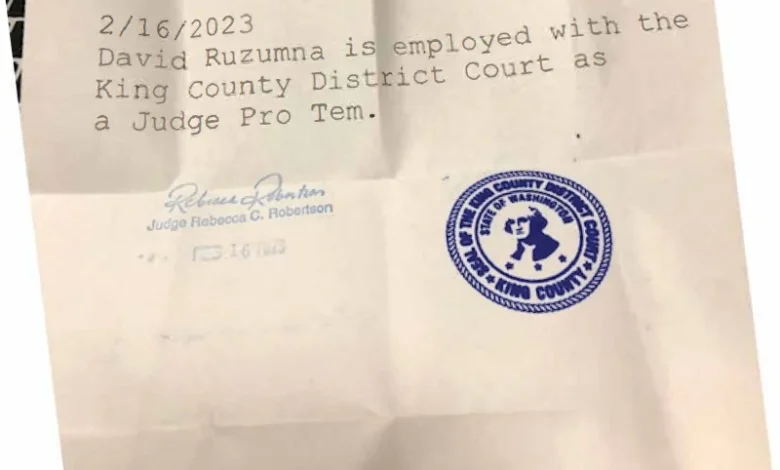
Utilizing his access to the King County District Court’s administrative tools, Ruzumna drafted a letter on official letterhead. To give the document the appearance of authenticity, he applied the court’s official seal and used the signature stamp of Judge Rebecca C. Robertson, a sitting judge at the King County District Court. The forged document falsely affirmed that Ruzumna was an employee entitled to the parking discount. Armed with this falsified paper, Ruzumna successfully obtained the $10 daily discount, a move that would ultimately cost him his judicial career.
The Role of the Pro Tempore Judge
To understand the weight of the Supreme Court’s decision, it is necessary to examine the role David Ruzumna held. In Washington’s legal system, a judge pro tempore (often abbreviated as "pro tem") is a member of the bar who is appointed to sit as a temporary judge. These individuals are essential to the functioning of the state’s busy municipal and district courts, stepping in to hear cases when full-time judges are ill, on vacation, or recused due to conflicts of interest.
Since 2013, Ruzumna had served in this capacity across both King County and Snohomish County. While pro tem judges are part-time and often maintain private law practices, they are held to the exact same ethical standards as full-time, elected judges while they are serving on the bench. The Washington Code of Judicial Conduct makes no distinction between permanent and temporary judges regarding the duty to uphold the integrity and independence of the judiciary.
Investigation and the "Joke" Defense
The discovery of the forged document triggered an immediate investigation by the Washington Commission on Judicial Conduct. During the proceedings, Ruzumna admitted to creating the document and using Judge Robertson’s signature stamp without her knowledge or authorization. However, his defense centered on the claim that the act was intended as a "joke."
Ruzumna argued that the forgery was a lighthearted response to the parking attendant’s refusal to recognize his robe and placard. He suggested that there was no malicious intent to defraud the county of significant funds, but rather a misguided attempt at humor.
The Commission on Judicial Conduct, and later the Washington Supreme Court, found this defense entirely unpersuasive. In its May 13, 2025, censure document, the Commission noted that forgery—the act of falsely making or completing a written instrument with the intent to defraud—is a serious matter that cannot be dismissed as a prank. The Commission found that Ruzumna’s actions violated several canons of the Code of Judicial Conduct, most notably the requirement that a judge comply with the law and act at all times in a manner that promotes public confidence in the independence, integrity, and impartiality of the judiciary.
The Supreme Court’s Mandate on Integrity
The case moved to the Washington Supreme Court for a final determination on the appropriate sanction. While the Commission on Judicial Conduct had recommended a severe censure, the Supreme Court exercised its authority to go further, opting for the total removal of Ruzumna from his judicial office.
In the court’s unanimous opinion, the justices highlighted that the core of the judicial system is the public’s trust in the honesty of its officers. "Honesty and integrity are among the most critical traits expected of those entrusted with judicial office," the justices wrote. They further clarified that the specific amount of money involved in the fraud—$10—was irrelevant to the ethical calculation. The act of using a colleague’s signature and the court’s official seal to create a false document constituted a fundamental betrayal of the judicial office.
The court’s ruling noted: "Judge Pro Tem Ruzumna’s violations warrant the sanction of removal. The use of a judicial seal and another judge’s signature for personal gain, no matter how small, is an abuse of power that undermines the entire legal institution."
Chronology of the Case
The timeline of the case illustrates the deliberate and thorough nature of judicial discipline in Washington:
- 2013: David Ruzumna begins serving as a judge pro tempore in King and Snohomish counties.
- 2023: The parking lot incident occurs. Ruzumna attempts to use his robe for identification, is denied, and subsequently forges a document using Judge Rebecca C. Robertson’s signature stamp to save $10.
- Late 2023 – Early 2024: The forgery is discovered by court administration, and a complaint is filed with the Commission on Judicial Conduct.
- May 13, 2025: The Washington Commission on Judicial Conduct issues a formal censure document, detailing the findings of the investigation and Ruzumna’s admissions.
- Late 2025: The case is elevated to the Washington Supreme Court for a final ruling on sanctions.
- April 14, 2026: The Washington Supreme Court issues a unanimous decision to remove Ruzumna from his position as judge pro tempore.
Broader Implications and Analysis
The removal of a judge for a $10 infraction may seem disproportionate to some observers, but within the legal community, the decision is seen as a necessary protection of the "appearance of impropriety" standard. Judges are often the final arbiters of truth in a courtroom; if a judge is willing to falsify a document for a minor personal convenience, their ability to fairly weigh evidence and testimony in significant criminal or civil matters is irredeemably compromised.
The Erosion of Public Trust
Judicial ethics experts suggest that "minor" acts of dishonesty by public officials can be more damaging to public trust than complex scandals. A $10 parking fraud is an easily understood violation that suggests a sense of entitlement. When a judge uses the "trappings of the office"—such as a robe or a seal—to circumvent rules that apply to the general public, it reinforces a perception that the legal system operates on a double standard.
Precedent for Judicial Conduct
This ruling sets a firm precedent in Washington State. It signals to all judicial officers, including part-time and pro tem judges, that the Supreme Court will not tolerate any level of document falsification. It also serves as a warning regarding the use of signature stamps and official seals, which are administrative necessities but also powerful tools that can be easily abused.
Impact on the King County District Court
The removal of an experienced pro tem judge like Ruzumna creates an administrative vacuum. King County and Snohomish County must now ensure that the cases previously handled by Ruzumna are managed by other qualified individuals. Furthermore, the court may implement stricter controls over the accessibility of judicial signature stamps and official seals to prevent similar incidents of unauthorized use.
Official Responses and Reactions
While Judge Rebecca C. Robertson, whose signature was forged, has not issued a personal statement regarding the betrayal of trust, the King County District Court administration has reaffirmed its commitment to ethical transparency.
Legal analysts have noted that Ruzumna’s "joke" defense likely backfired by suggesting a lack of appreciation for the gravity of his actions. By characterizing forgery as humor, he demonstrated a failure to understand the sacred nature of the court’s seal and the authority of a judge’s signature.
The Washington State Bar Association (WSBA) may also take note of this Supreme Court ruling. While the court’s decision removes him from the bench, Ruzumna’s status as a practicing attorney could face separate scrutiny. Under the Rules of Professional Conduct (RPC) for lawyers, "conduct involving dishonesty, fraud, deceit, or misrepresentation" is grounds for disciplinary action, which could range from a reprimand to the suspension or revocation of his license to practice law.
Conclusion
The case of David Ruzumna serves as a stark reminder that in the eyes of the law, there is no such thing as a "small" forgery when committed by an officer of the court. The Washington Supreme Court’s unanimous decision to oust him underscores a vital principle: the value of judicial integrity far outweighs the value of any daily parking fee. As the court stated, the office of a judge is a position of public trust, and those who treat that trust as a tool for personal convenience forfeit the right to hold the gavel. This ruling ensures that the standards of the Washington judiciary remain high, protecting the institution from the corrosive effects of even the most seemingly minor ethical lapses.